ART WIKI37,791 on view
MapCollectionArtistsMuseumsExhibitionsJournal
Sign in

ART WIKI

Where to see art and when to visit.

Collections: Art Institute of Chicago, Cooper Hewitt, Smithsonian Design Museum, Getty Villa, Harvard Art Museums, Hirshhorn Museum and Sculpture Garden, J. Paul Getty Museum, Minneapolis Institute of Art, Musée du Louvre, National Gallery of Art, National Museum of Asian Art, National Portrait Gallery (Smithsonian), Pushkin State Museum of Fine Arts, Rijksmuseum, Smithsonian American Art Museum, SMK — National Gallery of Denmark, State Hermitage Museum, State Russian Museum, The Cleveland Museum of Art, The Metropolitan Museum of Art, The Museum of Modern Art, Tretyakov Gallery, Victoria and Albert Museum, Whitney Museum of American Art, Yale Center for British Art, Yale University Art Gallery, State Catalogue of the Museum Fund of Russia (274 museums), Europeana (19 museums), Wikidata (44 museums), Paris Musées (12 museums), Joconde, the French Ministry of Culture's museum database (495 museums), and the Catalogo generale dei Beni Culturali of Italy's Ministry of Culture (74 museums). Images belong to their rights holders.

Sections

  • Map
  • Search
  • Collection
  • Masterpieces
  • Stolen and lost
  • Embed artwork status
  • On view now
  • Artists

More

  • Museums & galleries
  • Exhibitions
  • Journal
  • Where the data comes from
  • Privacy & cookies
  • About
  • Terms of use
HomeMapBrowse

Browse

Ivory

Ivory carving turns teeth and tusks into objects small enough to hold, wear or open like a book. Elephant ivory is one source; mammoth and walrus ivory also have long histories in sculpture. The material takes fine cuts and a smooth polish, but its shape limits the carver. A curved Madonna can still carry something of the tusk from which she emerged.

2,053 works from 85 museums547 on view nowClear all

/
Technique
  • All
  • Bronze19,138
  • Plaster15,671
  • Wood12,391
  • Terracotta and ceramics11,922
  • Marble11,017
  • Stone8,366
  • Metal4,064
  • Ivory2,053
La dame de Brassempouy ; La dame à la capucheVenus of BrassempouyMusée d'Archéologie nationale
Netsuke in de vorm van een staande vreemdeling met hellebaard, anonymous, c. 1700 - c. 1800anonymousNetsuke in de vorm van een staande vreemdeling met hellebaardc. 1700 - c. 1800Rijksmuseum
Temperantia, rugfiguur van een naakte vrouw met schenkkan, anonymous, c. 1600 - c. 1625anonymousTemperantia, rugfiguur van een naakte vrouw met schenkkanc. 1600 - c. 1625Rijksmuseum
Lodewijk XIV, koning van Frankrijk [?], anonymous, 1710anonymousLodewijk XIV, koning van Frankrijk [?]1710Rijksmuseum
Netsuke, anonymous, 1700 - 1900anonymousNetsuke1700 - 1900Rijksmuseum
Astronomie, Venus Urania, anonymous, 1700 - 1900anonymousAstronomie, Venus Urania1700 - 1900Rijksmuseum
Figuur in de vorm van een walvis, anonymous, c. 1700 - c. 1900anonymousFiguur in de vorm van een walvisc. 1700 - c. 1900Rijksmuseum
Netsuke voorstellend een liggende os, anonymous, 1700 - 1900anonymousNetsuke voorstellend een liggende os1700 - 1900Rijksmuseum
Netsuke, anonymous, 1800 - 1900anonymousNetsuke1800 - 1900Rijksmuseum
Maria met Christuskind, anonymous, c. 1330 - c. 1340anonymousMaria met Christuskindc. 1330 - c. 1340Rijksmuseum
Kop van ivoor, anonymous, c. 1700 - c. 1799anonymousKop van ivoorc. 1700 - c. 1799Rijksmuseum
Netsuke, anonymous, 1700 - 1900anonymousNetsuke1700 - 1900Rijksmuseum
Little Long Ivory Equivalent, Carl Andre, 1977Carl AndreLittle Long Ivory Equivalent1977National Gallery of Art
Diptych with the Virgin and Child and the Crucifixion, anonymous, c. 1350 - c. 1400anonymousDiptych with the Virgin and Child and the Crucifixionc. 1350 - c. 1400Rijksmuseum
Figuur in de vorm van een dolfijn, anonymous, c. 1700 - c. 1900anonymousFiguur in de vorm van een dolfijnc. 1700 - c. 1900Rijksmuseum
Taiyi, anonymous, c. 1680 - c. 1720anonymousTaiyic. 1680 - c. 1720Rijksmuseum
Beeldhouwwerk, anonymous, c. 1750 - c. 1900anonymousBeeldhouwwerkc. 1750 - c. 1900Rijksmuseum
Netsuke, anonymous, c. 1800 - c. 1900anonymousNetsukec. 1800 - c. 1900Rijksmuseum
Relief with the Deposition, anonymous, c. 1400 - c. 1420anonymousRelief with the Depositionc. 1400 - c. 1420Rijksmuseum
Reliëf met een voorstelling van de tronende koning Rama, anonymous, c. 1700anonymousReliëf met een voorstelling van de tronende koning Ramac. 1700Rijksmuseum
Maria met Christuskind, anonymous, c. 1270 - c. 1280anonymousMaria met Christuskindc. 1270 - c. 1280Rijksmuseum
Steigerend leeuwtje, anonymous, 1500 - 1600anonymousSteigerend leeuwtje1500 - 1600Rijksmuseum
Ivoren leeuwtje, anonymous, c. 1400 - c. 1950anonymousIvoren leeuwtjec. 1400 - c. 1950Rijksmuseum
Frame with Four Portrait Medallions, Representing Johan van Oldenbarnevelt (1547-1619), Joost van den Vondel (1587-1679), Michiel Adriaensz de Ruyter (1607-1676) and Johan de Witt (1625-1672), anonymous, c. 1850 - c. 1875anonymousFrame with Four Portrait Medallions, Representing Johan van Oldenbarnevelt (1547-1619), Joost van den Vondel (1587-1679), Michiel Adriaensz de Ruyter (1607-1676) and Johan de Witt (1625-1672)c. 1850 - c. 1875Rijksmuseum
Couteau du Gebel el-Arak, Nagada II C-D (attribution d'après style) (-3600 - -3200)Gebel el-Arak Knife3600–3200 BCESalle 633, Aile Sully, Niveau 1Musée du Louvre
Netsuke, anonymous, 1800 - 1900anonymousNetsuke1800 - 1900Rijksmuseum
Twee vechtende krijgslieden, anonymous, c. 1680 - c. 1700anonymousTwee vechtende krijgsliedenc. 1680 - c. 1700Rijksmuseum
Relief with the Nativity, anonymous, c. 1180anonymousRelief with the Nativityc. 1180Rijksmuseum
Keizerin Elisabeth I van Rusland (1709-1762), anonymous, 1725 - 1775anonymousKeizerin Elisabeth I van Rusland (1709-1762)1725 - 1775Rijksmuseum
Netsuke, anonymous, 1700 - 1900anonymousNetsuke1700 - 1900Rijksmuseum
Rechtervleugel van een tweeluik met de kruisiging, anonymous, c. 1400 - c. 1425anonymousRechtervleugel van een tweeluik met de kruisigingc. 1400 - c. 1425Rijksmuseum
Netsuke, anonymous, 1700 - 1900anonymousNetsuke1700 - 1900Rijksmuseum
Harlekijn, anonymous, 1700 - 1725anonymousHarlekijn1700 - 1725Rijksmuseum
Bacchanaal (pronkbeker), anonymous, 1771anonymousBacchanaal (pronkbeker)1771Rijksmuseum
Diptych with the Virgin a nd Child and the Crucifixion, anonymous, c. 1350 - c. 1400anonymousDiptych with the Virgin a nd Child and the Crucifixionc. 1350 - c. 1400Rijksmuseum
Rechtervleugel van een veelluik met de kruisiging, anonymous, c. 1375 - c. 1400anonymousRechtervleugel van een veelluik met de kruisigingc. 1375 - c. 1400Rijksmuseum
Little Long Ivory Equivalent, Carl Andre, 1977Carl AndreLittle Long Ivory Equivalent1977National Gallery of Art
Little Wide Ivory Equivalent, Carl Andre, 1977Carl AndreLittle Wide Ivory Equivalent1977National Gallery of Art
Drie Nederlanders in een sloep, anonymous, c. 1725 - c. 1750anonymousDrie Nederlanders in een sloepc. 1725 - c. 1750Rijksmuseum
Figuur van geleerde of wijze, anonymous, 1700 - 1800anonymousFiguur van geleerde of wijze1700 - 1800Rijksmuseum
Netsuke, anonymous, 1700 - 1900anonymousNetsuke1700 - 1900Rijksmuseum
Lo Spinario, anonymous, 1475 - 1500anonymousLo Spinario1475 - 1500Rijksmuseum
Hoofd van ivoor, anonymous, before c. 1800 - before c. 1900anonymousHoofd van ivoorbefore c. 1800 - before c. 1900Rijksmuseum
Mansfiguur in Lodewijk XIV klederdracht, anonymous, 1700 - 1800anonymousMansfiguur in Lodewijk XIV klederdracht1700 - 1800Rijksmuseum
Naaldenkoker van ivoor met in reliëf vlinders, anonymous, 1800 - 1900anonymousNaaldenkoker van ivoor met in reliëf vlinders1800 - 1900Rijksmuseum
Rechtervleugel van een tweeluikje, met onder meer de geboorte van Jezus, anonymous, c. 1350 - c. 1400anonymousRechtervleugel van een tweeluikje, met onder meer de geboorte van Jezusc. 1350 - c. 1400Rijksmuseum
Schaatser, anonymous, 1700 - 1800anonymousSchaatser1700 - 1800Rijksmuseum
Figuur in de vorm van een walvis, anonymous, c. 1700 - c. 1900anonymousFiguur in de vorm van een walvisc. 1700 - c. 1900Rijksmuseum

Ivory

The Lady of Brassempouy has no carved mouth. Yet the brow and long nose are enough to make the small head seem to look back. Found in 1894, it was cut from mammoth ivory and finished with engraved details. The grid around its face has been read as braided hair, a net or a hood. The familiar name Lady with the Hood has settled a question that the object itself leaves open.

Lady of Brassempouy. Mammoth ivory, Musée d'Archéologie nationale, Saint-Germain-en-Laye.

How do you carve a tusk?

First the carver must decide where an object will fit. An elephant tusk narrows and curves; part of it contains the pulp cavity. Useful material has to be selected around that structure. Ivory is dentine, a tooth material, rather than ordinary skeletal bone. A broad rectangular relief and a slender standing figure therefore pose different problems before any face or fold is cut. The outline begins with the animal's anatomy as well as the proposed image.

Sawing separates the blank, after which a design can be marked across its surfaces. Knives and chisels remove material; drills open recesses; files refine the result before polishing. Medieval chessmen preserve evidence of this sequence on their undersides, where finishing did not erase every mark. A drill could start an opening that admitted a saw blade. An apparently effortless gap between two forms might require several tools and a carefully chosen order of operations.

Ivory accepts small details without behaving exactly like wood. Its fine internal structure permits cutting from different directions with less risk of splitting than a strongly directional grain would suggest. That helps explain the narrow drapery ridges and minute faces of later carvings. It does not make the material indestructible. Surface polish is evidence of finishing, not a guarantee that the object can withstand changes in its surroundings.

A Madonna loses her jewellery

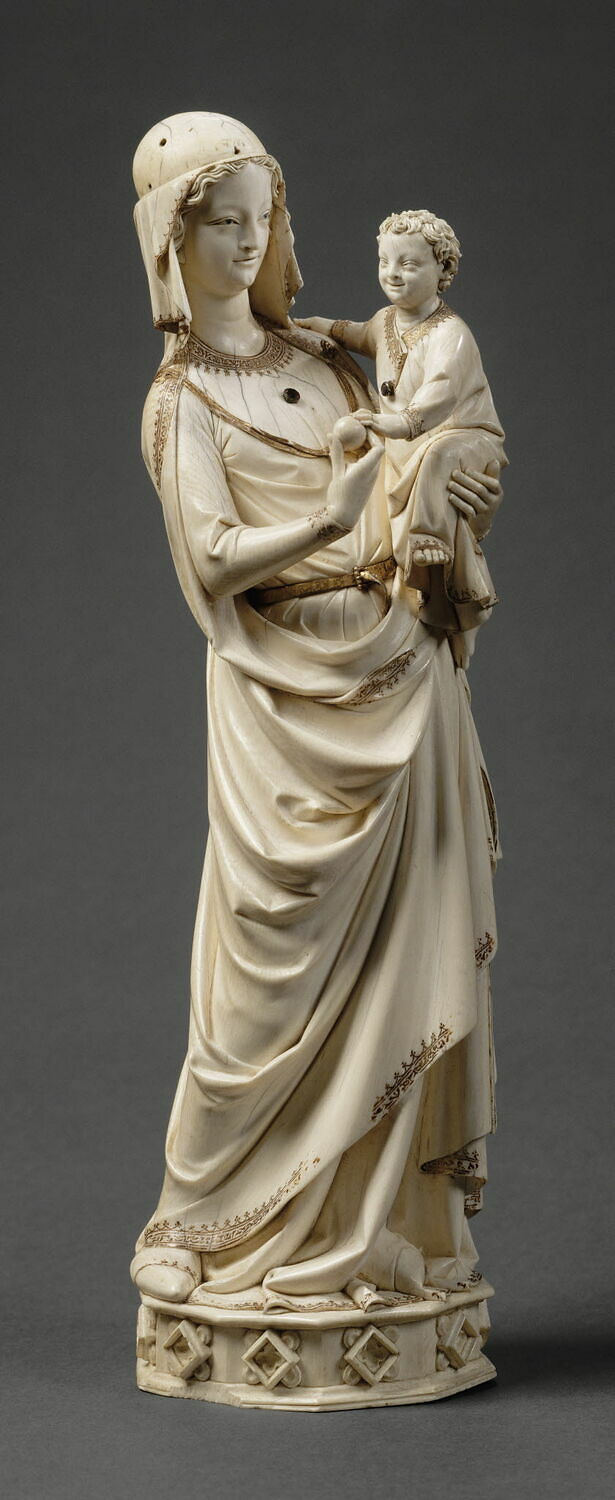
The once belonged to the chapel's treasury. Her silhouette follows the curve associated with a tusk, but she was not meant to appear simply as pale carved material. Historical inventories describe precious ornaments; physical traces include places where large clasps were attached and a finger thinned to receive a ring. The missing additions were part of the way this figure was dressed and seen.
1
Virgin and Child from the Sainte-Chapelle

During the Revolution the treasury was dispersed. Alexandre Lenoir received the Virgin with her metalwork in 1791; when he bought her back in 1797, the precious ornaments were gone. The sculpture passed through private collections before the Louvre acquired it in 1861. Its survival is therefore also a history of separation. The carved body endured, while jewellery that changed its appearance travelled another, largely missing, route.

Virgin and Child from the Sainte-Chapelle. Ivory, Louvre, Paris.

Room 503 in the Louvre's Richelieu wing, level 1, held the Virgin on our autumn 2026 check. Look at the angle of the body before following individual folds. The bend and the cut drapery work together, so the pose cannot be separated neatly into a natural shape supplied by the tusk and a design imposed upon it. The sculptor had to make the available curve serve a standing human figure.

A garden on the back

Ivory also offered a way to make portable reliefs with opening wings. On the Harbaville Triptych, Christ sits between the Virgin and John the Baptist; saints fill the other compartments. Turn to its reverse in the catalogue photographs and the figures give way to a cross among trees, with birds and animals. The object has more than one reading surface. Closing it does not turn it into a blank container.

This Byzantine triptych retains traces of red paint and gilding. It was in Room 501, Richelieu wing, level 1, on our autumn 2026 check. Compare the depth of the central figures with the shallower cutting on the back. Different depths let the same material carry a gathered company of people on one side and the details of a garden on the other.

At Saint-Germain-en-Laye, the Lady of Brassempouy belongs to the Musée d'Archéologie nationale. Her right cheek is split, probably because the ivory dried too quickly after excavation. The crack records a much more recent event than the flint cuts around her face.