ART WIKI37,791 on view
MapCollectionArtistsMuseumsExhibitionsJournal
Sign in

ART WIKI

Where to see art and when to visit.

Collections: Art Institute of Chicago, Cooper Hewitt, Smithsonian Design Museum, Getty Villa, Harvard Art Museums, Hirshhorn Museum and Sculpture Garden, J. Paul Getty Museum, Minneapolis Institute of Art, Musée du Louvre, National Gallery of Art, National Museum of Asian Art, National Portrait Gallery (Smithsonian), Pushkin State Museum of Fine Arts, Rijksmuseum, Smithsonian American Art Museum, SMK — National Gallery of Denmark, State Hermitage Museum, State Russian Museum, The Cleveland Museum of Art, The Metropolitan Museum of Art, The Museum of Modern Art, Tretyakov Gallery, Victoria and Albert Museum, Whitney Museum of American Art, Yale Center for British Art, Yale University Art Gallery, State Catalogue of the Museum Fund of Russia (274 museums), Europeana (19 museums), Wikidata (44 museums), Paris Musées (12 museums), Joconde, the French Ministry of Culture's museum database (495 museums), and the Catalogo generale dei Beni Culturali of Italy's Ministry of Culture (74 museums). Images belong to their rights holders.

Sections

  • Map
  • Search
  • Collection
  • Masterpieces
  • Stolen and lost
  • Embed artwork status
  • On view now
  • Artists

More

  • Museums & galleries
  • Exhibitions
  • Journal
  • Where the data comes from
  • Privacy & cookies
  • About
  • Terms of use
HomeMapBrowse

Browse

Stone

Stone sculpture starts with a block and proceeds by removal, through blows, cuts, drilling and abrasion. Granite, limestone and other rocks resist tools differently, so the material helps determine the result. A polished face may conceal months of rough work; a painted surface may conceal the stone itself. In a museum, joints and unfinished patches can be as informative as the parts meant to impress.

8,366 works from 322 museums2,631 on view nowClear all

/
Technique
  • All
  • Bronze19,138
  • Plaster15,671
  • Wood12,391
  • Terracotta and ceramics11,922
  • Marble11,017
  • Stone8,366
  • Metal4,064
  • Ivory2,053
Woman's Head, Amedeo Modigliani, 1912Amedeo ModiglianiWoman's Head1912The Metropolitan Museum of Art
De verkondiging aan Maria, Tilman Riemenschneider, c. 1485 - c. 1487Tilman RiemenschneiderDe verkondiging aan Mariac. 1485 - c. 1487Rijksmuseum
Head, Amedeo Modigliani, 1915?Amedeo ModiglianiHead1915?The Museum of Modern Art
Stèle de Mesha, IXe s. av. J.-C. (Epoque de Mesha vers 830-805) (-830 - -805)Mesha Stele9th century BCE (830–805)Salle 303, Aile Sully, Niveau 0Musée du Louvre
Sarcophage d'Eshmunazor, Achéménide (Premier quart du Ve siècle avant J.-C.) et Achéménide (bibliographie/travail de référence) (-500 - -475 et vers -525)Sarcophage d'EshmunazorSalle 311, Aile Sully, Niveau 0Musée du Louvre
Helikon, Barbara Hepworth, 1948Barbara HepworthHelikon1948The Museum of Modern Art
Biolith, Barbara Hepworth, 1948 to 1949Barbara HepworthBiolith1948 to 1949On viewYale Center for British Art
De verkondiging aan Maria, Tilman Riemenschneider, c. 1485 - c. 1487Tilman RiemenschneiderDe verkondiging aan Mariac. 1485 - c. 1487Rijksmuseum
Fragment van een boeddhahoofd, anonymous, 700 - 800anonymousFragment van een boeddhahoofd700 - 800Rijksmuseum
Fragment van een beeldhouwwerk, anonymous, 1300 - 1500anonymousFragment van een beeldhouwwerk1300 - 1500Rijksmuseum
Maria met Christuskind, anonymous, c. 1325 - c. 1349anonymousMaria met Christuskindc. 1325 - c. 1349Rijksmuseum
The Nativity with the Adoration of the Shepherds, anonymous, c. 1600 - c. 1620anonymousThe Nativity with the Adoration of the Shepherdsc. 1600 - c. 1620Rijksmuseum
Code de Hammurabi, 1ère dynastie de Babylone : Hammurabi (-1792 - -1750)Code de Hammurabi1ère dynastie de Babylone : Hammurabi (-1792 - -1750)Salle 227, Aile Richelieu, Niveau 0Musée du Louvre
De bodhisattva Maitreya, anonymous, 500 - 525anonymousDe bodhisattva Maitreya500 - 525Rijksmuseum
Timpaan van de abdij van Egmond, anonymous, in or after 1121 - in or before 1130anonymousTimpaan van de abdij van Egmondin or after 1121 - in or before 1130Rijksmuseum
Franciscan II, Robert Rauschenberg, 1972Robert RauschenbergFranciscan II1972The Museum of Modern Art
Cursed Gossip, Jean Dubuffet, June 1954Jean DubuffetCursed GossipJune 1954The Museum of Modern Art
Saint James the Greater, Gil de Siloe, 1489–93Gil de SiloéSaint James the Greater1489–93The Metropolitan Museum of Art
Two Young Girls, Aristide Maillol, c. 1930Aristide MaillolTwo Young Girlsc. 1930Gallery 5 · West Building, Ground FloorNational Gallery of Art
Male Head, Style of Egyptian Ptolemaic Period, probably 19th or early 20th centuryanonymousMale Headprobably 19th or early 20th centuryNational Gallery of Art
Hoofd van een boeddha, anonymous, c. 1650 - c. 1950anonymousHoofd van een boeddhac. 1650 - c. 1950Rijksmuseum
Adorant, anonymous, c. 960 - c. 1279anonymousAdorantc. 960 - c. 1279Rijksmuseum
Heavenly beauty, anonymous, c. 950anonymousHeavenly beautyc. 950Rijksmuseum
Stemma gentilizio della famiglia Martelli, Donatello, sec. XVDonatelloStemma gentilizio della famiglia Martellisec. XVBargello National Museum
Slapende Vishnu, anonymous, c. 1100 - c. 1300anonymousSlapende Vishnuc. 1100 - c. 1300Rijksmuseum
Portrait of Shah Jahan, anonymous, c. 1630 - c. 1650anonymousPortrait of Shah Jahanc. 1630 - c. 1650Rijksmuseum
Great Rock of Inner Seeking, Isamu Noguchi, 1974Isamu NoguchiGreat Rock of Inner Seeking1974Gallery 100 · East Building, Ground LevelNational Gallery of Art
Ptolemy I, Jean (Hans) Arp, 1953Jean ArpPtolemy I1953The Museum of Modern Art
Human Concretion, Jean (Hans) Arp, 1935 (replica of original plaster, cast 1949)Jean ArpHuman Concretion1935 (replica of original plaster, cast 1949)The Museum of Modern Art
Granite Bench, Jenny Holzer, 1986Jenny HolzerGranite Bench1986The Museum of Modern Art
Stations, Bill Viola, 1994Bill ViolaStations1994The Museum of Modern Art
Reliëf, anonymous, 200 - 300anonymousReliëf200 - 300Rijksmuseum
Africa, anonymous, c. 1600anonymousAfricac. 1600Rijksmuseum
The Mercy Seat, anonymous, c. 1420 - c. 1430anonymousThe Mercy Seatc. 1420 - c. 1430Rijksmuseum
Maria met kind, anonymous, c. 1480anonymousMaria met kindc. 1480Rijksmuseum
Hoofd van een boeddha of god, anonymous, 1175 - 1300anonymousHoofd van een boeddha of god1175 - 1300Rijksmuseum
Untitled, Max Ernst, 1934Max ErnstUntitled1934The Museum of Modern Art
Head of a Woman, Amedeo Modigliani, c.1911-1912Amedeo ModiglianiHead of a Womanc.1911-1912Gallery 103A · East Building, Ground LevelNational Gallery of Art
Durga Killing the Buffalo Demon, anonymous, c. 1000 - c. 1100anonymousDurga Killing the Buffalo Demonc. 1000 - c. 1100Rijksmuseum
Caryatid, Amedeo Modigliani, c. 1914Amedeo ModiglianiCaryatidc. 1914The Museum of Modern Art
Galaxy Calligraphy, Isamu Noguchi, 1983–84Isamu NoguchiGalaxy Calligraphy1983–84Yale University Art Gallery
The Ragman, Jean Dubuffet, April 1954Jean DubuffetThe RagmanApril 1954The Museum of Modern Art
Santa Giustina/ Cristo redentore, Gio Ponti, 1940Gio PontiSanta Giustina/ Cristo redentore1940Museo di Scienze Archeologiche e d'Arte
Stemma comunale di Padova, Gio Ponti, 1940Gio PontiStemma comunale di Padova1940Museo di Scienze Archeologiche e d'Arte
Johannes slapend in de armen van Christus (?), opgegraven te Utrecht bij het oude minderbroederklooster (fragment), anonymous, c. 1500anonymousJohannes slapend in de armen van Christus (?), opgegraven te Utrecht bij het oude minderbroederklooster (fragment)c. 1500Rijksmuseum
De bodhisattva Lokeshvara, anonymous, 1175 - 1250anonymousDe bodhisattva Lokeshvara1175 - 1250Rijksmuseum
Fragment van een schoorsteenfries met een gedeeltelijke voorstelling van Maria met kind, anonymous, c. 1510 - c. 1525anonymousFragment van een schoorsteenfries met een gedeeltelijke voorstelling van Maria met kindc. 1510 - c. 1525Rijksmuseum
Christ on the Cross with the Virgin, St John, Mary Magdalene and St Francis, anonymous, c. 1475 - c. 1500anonymousChrist on the Cross with the Virgin, St John, Mary Magdalene and St Francisc. 1475 - c. 1500Rijksmuseum

Stone

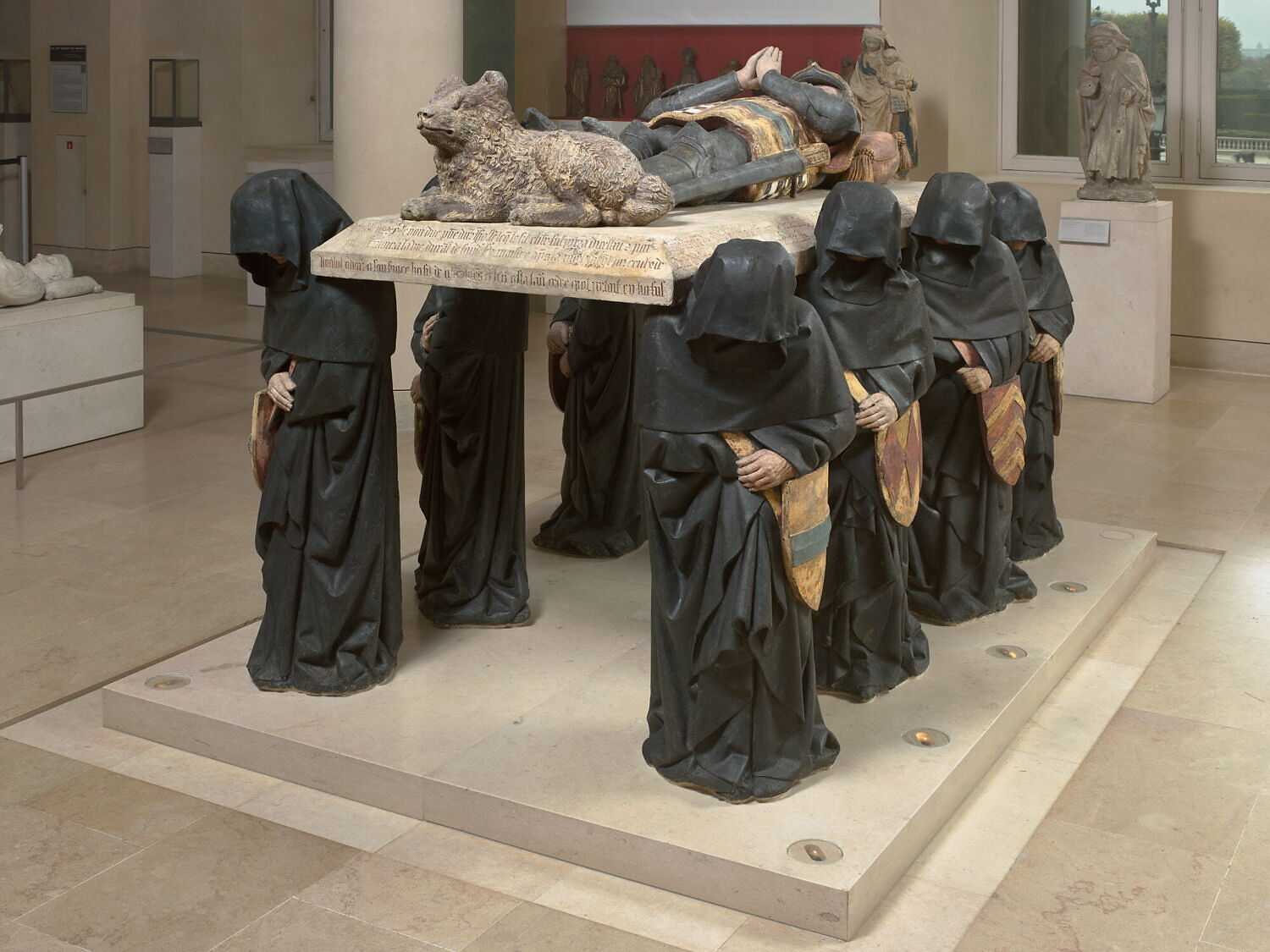
Eight hooded men carry a knight through the Louvre, without taking a step. In the Tomb of Philippe Pot, the stone slab bearing the recumbent figure rests on narrow supports at the mourners' shoulders. The procession is also a problem of weight. Before studying the heraldry or the knight's armour, look beneath the slab and consider how much material those small points have to carry.

How a stone figure is made

A carver removes large masses first, then works towards smaller forms. Pointed tools rough out the surface; toothed chisels leave parallel tracks; flat chisels refine it. Drills reach into recesses that a broad blade cannot enter. Abrasives then wear down the remaining ridges. These are alternatives within a toolkit, not a recipe used unchanged by every civilisation. The important distinction is between breaking away pieces and gradually grinding a surface.

Hard Egyptian stones demanded more than a sharp metal edge. Saws and tubular drills worked with abrasive particles, which helped cut the rock. A small limestone fragment from Amarna supplied evidence of how this could happen. Researchers found corundum grains, powdered limestone and corroded bronze together at the bottom of a drill hole. They interpreted the mixture as evidence for a bronze drill assisted by an abrasive containing corundum. A residue in a hole had preserved part of a workshop procedure.

That finding is a reason to inspect the less polished portions of sculpture. A glossy cheek tells you about the final surface; a recess may retain traces of earlier operations. Neither is more authentic than the other. They answer different questions. When a label names granite, do not assume that the smooth skin was cut with the same tool or at the same pace as the first outline of the body.

A sphinx with more than one royal name

The Great Sphinx of Tanis is carved from pink granite. Its inscriptions include the names of several rulers, among them Amenemhat II and Merneptah. Its original date remains debated; the Louvre records proposals reaching from the Fourth Dynasty to the reign of Amenemhat II. A royal name therefore does not automatically date the carving beneath it. Later rulers could claim a durable object that already existed.

1
Great Sphinx of Tanis. Pink granite, Louvre, Paris. The date of the original carving is disputed.

The sphinx, on our autumn 2026 check, was in Room 338, Sully wing, level −1. Approach its inscriptions as another layer of work on the body, rather than a caption added outside the sculpture. The block has carried an image and successive assertions of ownership. Its survival does not make its history simple; the disagreement over the date is part of what the object asks a viewer to untangle.

The black cloaks are paint

Philippe Pot's mourners provide a different warning about appearances. Their cloaks are painted stone, not a naturally black material. The monument was commissioned during Pot's lifetime for Cîteaux Abbey. In 2018, cleaning removed dirt and residues left by an earlier moulding campaign, allowing the relationship between the black robes and the coloured heraldry to be read again. Conservation here involved recovering distinctions between colours, not returning everything to bare rock.

Tomb of Philippe Pot, late 15th century. Painted stone, Louvre, Paris.

The tomb was in Room 210, Richelieu wing, level 0, on our autumn 2026 check. Its shields refer to Pot's ancestry, while repaired portions include the knight's hands and parts of the mourners' hoods. Viewing it as one untouched medieval surface would miss the work of later repairers. The visible monument combines the original funeral image with changes made to keep it standing and legible.

When paper outlived stone

The Louvre also holds the Mesha Stele, a basalt inscription broken in the nineteenth century during a dispute over its possession. A paper impression had been taken before the destruction. Together with surviving fragments, it helped recover the text and reconstruct the monument. The stele was in Room 303, Sully wing, level 0, on our autumn 2026 check. Look at the boundaries between original fragments and reconstruction before trying to follow the lines of writing.