ART WIKI37,791 on view
MapCollectionArtistsMuseumsExhibitionsJournal
Sign in

ART WIKI

Where to see art and when to visit.

Collections: Art Institute of Chicago, Cooper Hewitt, Smithsonian Design Museum, Getty Villa, Harvard Art Museums, Hirshhorn Museum and Sculpture Garden, J. Paul Getty Museum, Minneapolis Institute of Art, Musée du Louvre, National Gallery of Art, National Museum of Asian Art, National Portrait Gallery (Smithsonian), Pushkin State Museum of Fine Arts, Rijksmuseum, Smithsonian American Art Museum, SMK — National Gallery of Denmark, State Hermitage Museum, State Russian Museum, The Cleveland Museum of Art, The Metropolitan Museum of Art, The Museum of Modern Art, Tretyakov Gallery, Victoria and Albert Museum, Whitney Museum of American Art, Yale Center for British Art, Yale University Art Gallery, State Catalogue of the Museum Fund of Russia (274 museums), Europeana (19 museums), Wikidata (44 museums), Paris Musées (12 museums), Joconde, the French Ministry of Culture's museum database (495 museums), and the Catalogo generale dei Beni Culturali of Italy's Ministry of Culture (74 museums). Images belong to their rights holders.

Sections

  • Map
  • Search
  • Collection
  • Masterpieces
  • Stolen and lost
  • Embed artwork status
  • On view now
  • Artists

More

  • Museums & galleries
  • Exhibitions
  • Journal
  • Where the data comes from
  • Privacy & cookies
  • About
  • Terms of use
HomeMapBrowse

Browse

Gouache

Gouache is an opaque, water-based paint, usually bound with gum. Unlike a transparent watercolour wash, it can cover what lies beneath and give colour a solid, matte presence. That makes it useful for much more than small studies. A magazine face can become a furnished room; a sheet of painted paper can supply the colour for a shape cut with scissors.

9,482 works from 133 museums58 on view nowClear all

/
Technique
  • All
  • Graphite139,727
  • Pen and ink61,432
  • Watercolour59,084
  • Ink52,798
  • Chalk39,879
  • Charcoal9,549
  • Gouache9,482
  • Pastel4,296
  • Oil2,442
  • Silverpoint430
  • Mixed media301
The Death of Harlequin [recto], Pablo Picasso, 1905Pablo PicassoThe Death of Harlequin [recto]1905National Gallery of Art
Tapestry Cartoon Fragment: The Top of Woman's Head with Hair Braided over a Cloth Headdress, Raphael, 1500–50RaphaelTapestry Cartoon Fragment: The Top of Woman's Head with Hair Braided over a Cloth Headdress1500–50The Metropolitan Museum of Art
The Gypsy Lover. Costume design for Scene I of the ballet Aleko, Marc Chagall, 1942Marc ChagallThe Gypsy Lover. Costume design for Scene I of the ballet Aleko1942The Museum of Modern Art
Bathers and Youths. Sketch for the choreographer for Scene III of the ballet Aleko, Marc Chagall, 1942Marc ChagallBathers and Youths. Sketch for the choreographer for Scene III of the ballet Aleko1942The Museum of Modern Art
Aleko. Costume design for Scene I of the ballet Aleko, Marc Chagall, 1942Marc ChagallAleko. Costume design for Scene I of the ballet Aleko1942The Museum of Modern Art
Bat. Costume design for Scene IV of the ballet Aleko, Marc Chagall, 1942Marc ChagallBat. Costume design for Scene IV of the ballet Aleko1942The Museum of Modern Art
Homage to Gogol. Design for curtain for Gogol festival, Marc Chagall, 1917Marc ChagallHomage to Gogol. Design for curtain for Gogol festival1917The Museum of Modern Art
Le Peintre (The Painter), Pablo Picasso, October 13, 1964Pablo PicassoLe Peintre (The Painter)October 13, 1964Yale University Art Gallery
Standing Nude with a Patterned Robe, Egon Schiele, 1917Egon SchieleStanding Nude with a Patterned Robe1917National Gallery of Art
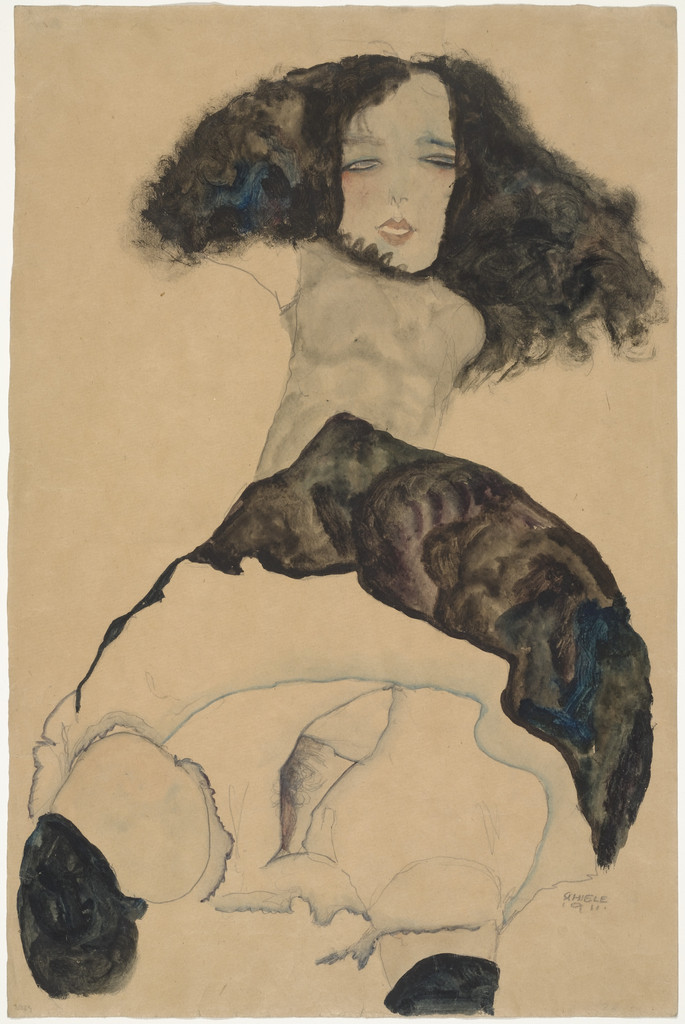
Girl with Black Hair (Mädchen mit schwarzem Haar), Egon Schiele, 1911Egon SchieleGirl with Black Hair (Mädchen mit schwarzem Haar)1911The Museum of Modern Art
Two Women Embracing, Egon Schiele, 1913Egon SchieleTwo Women Embracing1913The Metropolitan Museum of Art
Standing Girl, Back View, Egon Schiele, 1908Egon SchieleStanding Girl, Back View1908The Metropolitan Museum of Art
Horse's head, Raphael, 1500–50RaphaelHorse's head1500–50The Metropolitan Museum of Art
Purim, Marc Chagall, 1917Marc ChagallPurim1917National Gallery of Art
Head of a boy and section of a horse's mane, Raphael, 1500–50RaphaelHead of a boy and section of a horse's mane1500–50The Metropolitan Museum of Art
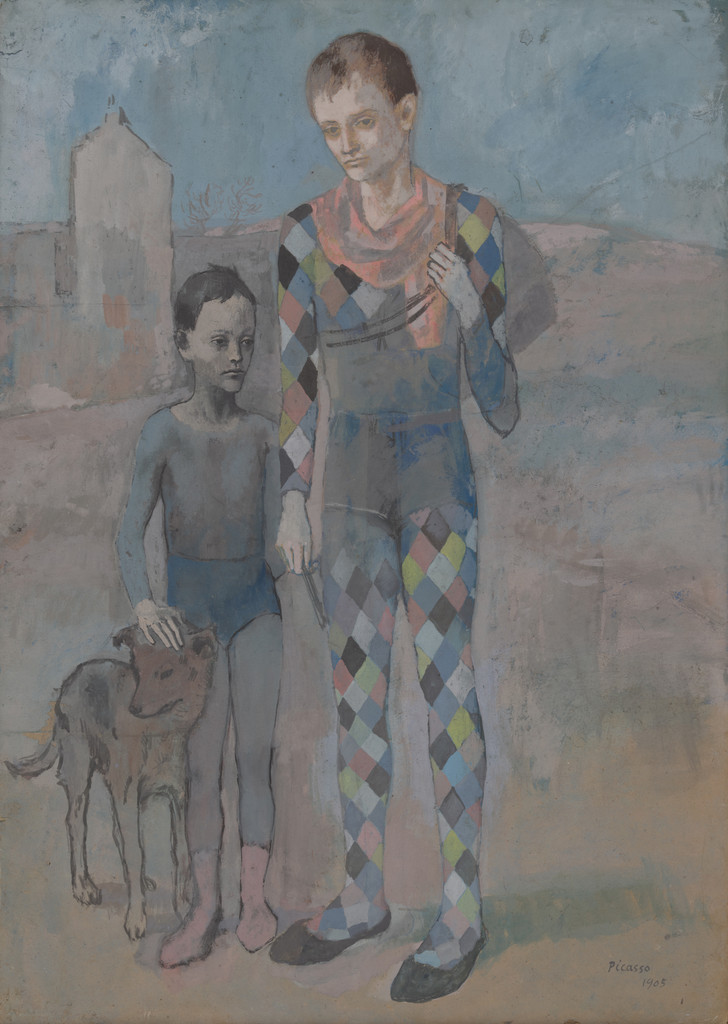
Two Acrobats with a Dog, Pablo Picasso, 1905Pablo PicassoTwo Acrobats with a Dog1905The Museum of Modern Art
Fragment of a Tapestry Cartoon: Foot in a Buskin, Drapery, and a Plant, Raphael, 1500–50RaphaelFragment of a Tapestry Cartoon: Foot in a Buskin, Drapery, and a Plant1500–50The Metropolitan Museum of Art
Fragment of a Tapestry Cartoon: Outstretched Hand, Body of a Seraph, and a Wing, Raphael, 1500–1550RaphaelFragment of a Tapestry Cartoon: Outstretched Hand, Body of a Seraph, and a Wing1500–1550The Metropolitan Museum of Art
Tuft of Cowslips, Albrecht Dürer, 1526Albrecht DürerTuft of Cowslips1526National Gallery of Art
A Horse. Costume design for Scene II of the ballet Aleko, Marc Chagall, 1942Marc ChagallA Horse. Costume design for Scene II of the ballet Aleko1942The Museum of Modern Art
Zemphira. Costume design for the ballet Aleko, Marc Chagall, 1942Marc ChagallZemphira. Costume design for the ballet Aleko1942The Museum of Modern Art
A Rooster. Costume design for Scene IV of the ballet Aleko, Marc Chagall, 1942Marc ChagallA Rooster. Costume design for Scene IV of the ballet Aleko1942The Museum of Modern Art
A Poet and His Muse. Costume design for Scene IV of the ballet Aleko, Marc Chagall, 1942Marc ChagallA Poet and His Muse. Costume design for Scene IV of the ballet Aleko1942The Museum of Modern Art
A Street Dancer and Gypsies. Costume design for Scene II of the ballet Aleko, Marc Chagall, 1942Marc ChagallA Street Dancer and Gypsies. Costume design for Scene II of the ballet Aleko1942The Museum of Modern Art
Féla and Odilon, Marc Chagall, 1915Marc ChagallFéla and Odilon1915National Gallery of Art
Maquette for Nuit de Noël, Henri Matisse, 1952Henri MatisseMaquette for Nuit de Noël1952The Museum of Modern Art
Head of an Apostle Surrounded by a Tongue of Fire and a Nimbus: Fragment of a Cartoon for a Descent of the Holy Spirit, Raphael, 1500–50RaphaelHead of an Apostle Surrounded by a Tongue of Fire and a Nimbus: Fragment of a Cartoon for a Descent of the Holy Spirit1500–50The Metropolitan Museum of Art
Bathers in a Forest, Pablo Picasso, 1908Pablo PicassoBathers in a Forest1908The Museum of Modern Art
Nave Nave Fenua, Paul Gauguin, probably 1894Paul GauguinNave Nave Fenuaprobably 1894National Gallery of Art
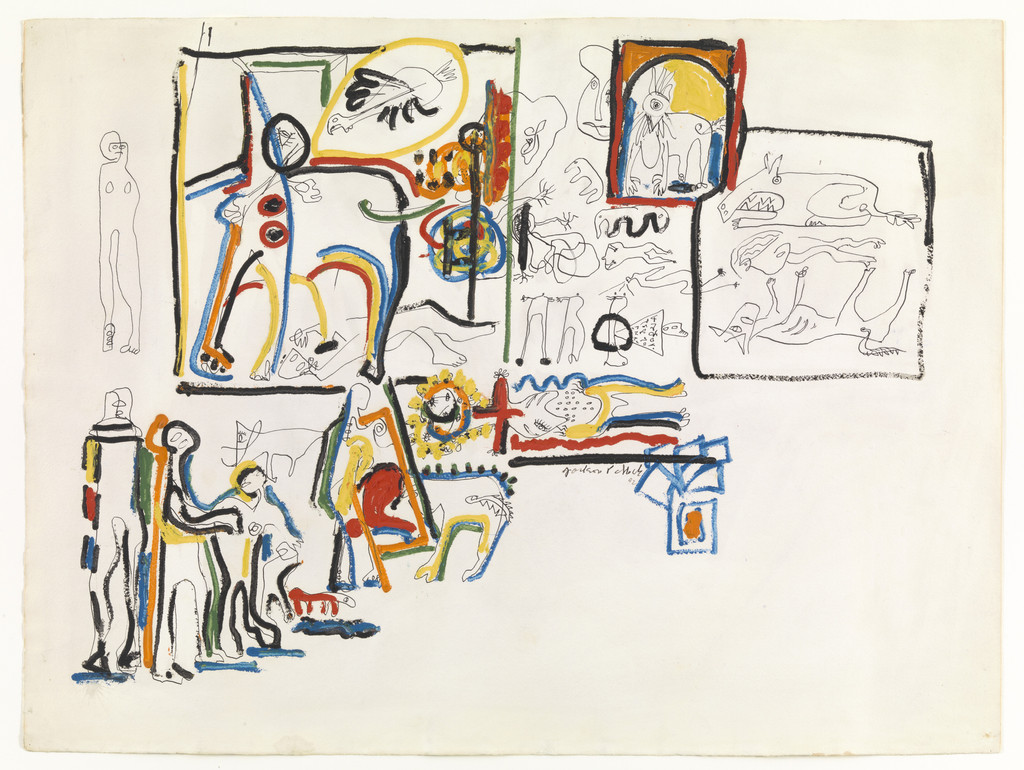
Untitled (Animals and Figures), Jackson Pollock, 1942Jackson PollockUntitled (Animals and Figures)1942The Museum of Modern Art
The Entombment, Sir Edward Burne-Jones, 1879Edward Burne-JonesThe Entombment1879The Metropolitan Museum of Art
The Beautiful Bird Revealing the Unknown to a Pair of Lovers (Le Bel oiseau déchiffrant l'inconnu au couple d'amoureux) (from the Constellation series), Joan Miró, 1941Joan MiróThe Beautiful Bird Revealing the Unknown to a Pair of Lovers (Le Bel oiseau déchiffrant l'inconnu au couple d'amoureux) (from the Constellation series)1941The Museum of Modern Art
Collage, Joan Miró, 1934Joan MiróCollage1934The Museum of Modern Art
Maquette for poster for Recent Works (Oeuvres récentes), Galerie Maeght, Paris, 1953, Joan Miró, 1953Joan MiróMaquette for poster for Recent Works (Oeuvres récentes), Galerie Maeght, Paris, 19531953The Museum of Modern Art
The Escape Ladder (from the Constellation series), Joan Miró, 1940Joan MiróThe Escape Ladder (from the Constellation series)1940The Museum of Modern Art
Head of a Man, Joan Miró, 1937Joan MiróHead of a Man1937The Museum of Modern Art
Cover design for exhibition catalogue Henri Matisse, Henri Matisse, 1951Henri MatisseCover design for exhibition catalogue Henri Matisse1951The Museum of Modern Art
Sleeping Peasants, Pablo Picasso, 1919Pablo PicassoSleeping Peasants1919The Museum of Modern Art
Head of a Woman, Pablo Picasso, Spring 1909Pablo PicassoHead of a WomanSpring 1909The Museum of Modern Art
Grun Auf Grun, No. 487 (1932), Wassily Kandinsky, 1932Vasily KandinskyGrun Auf Grun, No. 487 (1932)1932Yale University Art Gallery
Abstract Construction, from Will Grohmann's book "Kandinsky" (Paris: Éditions "Cahiers d'Art," [1930]), Wassily Kandinsky, ca. 1930Vasily KandinskyAbstract Construction, from Will Grohmann's book "Kandinsky" (Paris: Éditions "Cahiers d'Art," [1930])ca. 1930Yale University Art Gallery
Head of the Medical Student (Study for Les Demoiselles d'Avignon), Pablo Picasso, 1907Pablo PicassoHead of the Medical Student (Study for Les Demoiselles d'Avignon)1907The Museum of Modern Art
Portrait de Paule de Lazerme en catalane, Pablo Picasso, 1954Pablo PicassoPortrait de Paule de Lazerme en catalane1954Musée Hyacinthe-Rigaud
Caryatid, Amedeo Modigliani, 1914Amedeo ModiglianiCaryatid1914The Museum of Modern Art
Head of a Woman, Pablo Picasso, 1906–7Pablo PicassoHead of a Woman1906–7Yale University Art Gallery
Segment of Pear, Wineglass and Ace of Clubs, Pablo Picasso, Spring 1914Pablo PicassoSegment of Pear, Wineglass and Ace of ClubsSpring 1914Yale University Art Gallery
A Russian Baba and a Cow. Costume design for Scene IV of the ballet Aleko, Marc Chagall, 1942Marc ChagallA Russian Baba and a Cow. Costume design for Scene IV of the ballet Aleko1942The Museum of Modern Art
A Cat. Costume design for Scene IV of the ballet Aleko, Marc Chagall, 1942Marc ChagallA Cat. Costume design for Scene IV of the ballet Aleko1942The Museum of Modern Art

Gouache

Mae West’s nose becomes a fireplace. Her eyes turn into framed pictures, her hair into curtains and her mouth into a sofa. Salvador Dalí made Mae West’s Face which May be Used as a Surrealist Apartment by painting over a magazine photograph in 1934–35. Gouache helped him interrupt an existing image without losing its recognisable features. The joke depends on both readings remaining possible: the room cannot entirely swallow the face.

Salvador Dalí, Mae West’s Face which May be Used as a Surrealist Apartment, 1934–35. Art Institute of Chicago; not on view on our autumn 2026 check.

The change is worth following feature by feature. A nose already projects, so making it a fireplace gives a familiar volume a new use. Lips already suggest a soft, rounded object, making the leap to upholstery feel disconcertingly plausible. Dalí supplies enough painted information to redirect the photograph, leaving the viewer to complete the conversion. The small sheet contains an interior that can never quite become an ordinary place to live.

What makes gouache different from watercolour?

Both media can combine pigment with a water-soluble gum binder. Their usual visual aims differ. A transparent wash allows the paper to participate strongly in the colour; gouache gives the painted layer greater covering power. That distinction concerns what the layer does, rather than simply how much water is in the brush. A pale gouache passage can sit over an earlier image instead of depending on an untouched pale area of paper.

Opaque pigments provide the body, and some colours also contain white fillers such as chalk. Gouache dries quickly and can be wetted again. This makes revision possible, but also complicates it: adding water to a new passage can disturb what has already been painted. The practical sequence is a negotiation between coverage and reactivation. More water does not automatically make a correction easier, and a confident-looking patch may conceal several decisions about consistency.
1

A catalogue of hats misbehaves

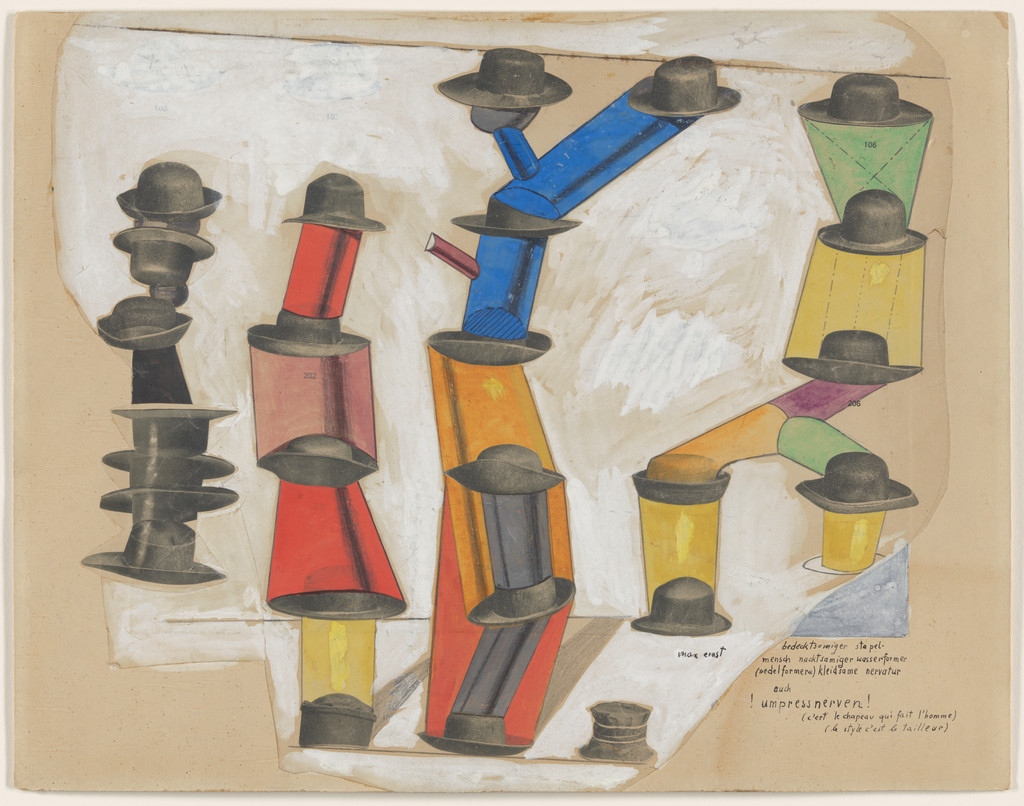
Max Ernst began The Hat Makes the Man with an orderly catalogue page of women’s hats. He painted over it and added cut-out hats, creating towers that suggest bodies, plants and phalluses. The medium includes gouache alongside pencil, oil, ink and pasted printed paper. Ernst did not need to draw every component afresh. Commercial illustration supplied convincing fragments; painting and rearrangement made those fragments stop behaving like merchandise.

Max Ernst, The Hat Makes the Man, 1920. MoMA, New York; not on view on our autumn 2026 check.

Notice the difference from Dalí’s procedure. In the apartment-face, an existing arrangement holds the transformation together. Ernst breaks the arrangement and invents new connections. Gouache belongs to the work of disguise and reconstruction, but it does not operate alone. Calling the result a collage is correct; calling it a gouache is also a useful route into its making. Museum categories overlap because the physical actions overlap.

When the brush hands over to scissors

For his later cut-outs, Henri Matisse had studio assistants paint paper with gouache before he cut it. Some sheets retained more visible brushmarks than others. The coloured shapes were pinned into arrangements that could be changed, and surviving pinholes record that provisional life. Colour was prepared before the final outline existed. The decisive edge would come from scissors, not from steering a loaded brush around a finished shape.

That reversal makes gouache’s role unusually clear. It supplies a coloured surface that can be handled as a separate thing. A contour can move without being repainted; neighbouring colours can exchange places while remaining intact. The painting stage is neither the whole work nor a disposable preliminary. It provides the material from which subsequent decisions are made, much as Dalí and Ernst begin with paper that already carries an image.

On a cut-out, a brushmark and a cut edge belong to different moments. Follow one painted streak toward the contour: the scissors can stop it abruptly. The sheet had colour before it had that outline. Pinholes add evidence of another operation, when a shape was fastened in place and could still be moved. A finished arrangement retains these small records of handling.