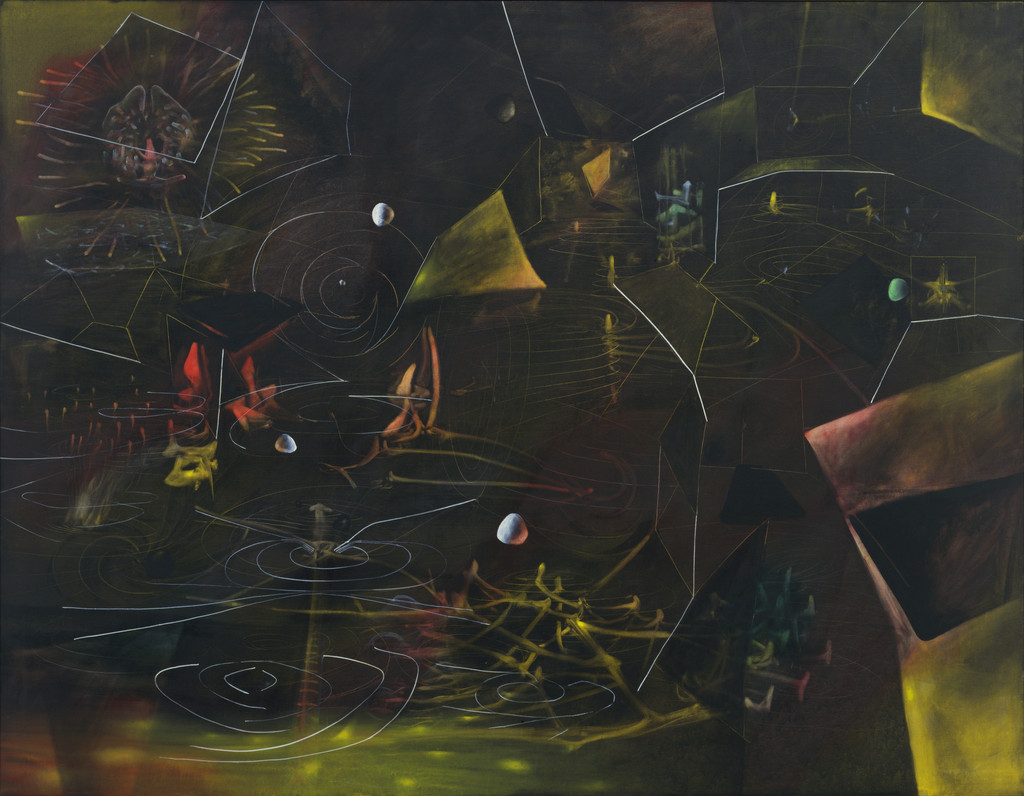
Роберто Себастьян МаттаЧили, 1911–2002
Без названия (Psychological Morphology)
Можно ли лицезреть?
Да, принимает

Чикагский институт искусств
Зал397Чикаго, США
Выставлена для публики.
- Проверено
- В этом положении с
- Источник
- Музей
О картине
Когда осенью 1938 года Матта представил сюрреалистам свою концепцию психологической морфологии, Андре Бретон, не поняв её, попросил изложить идеи письменно. Получившийся текст, озаглавленный «Психологическая морфология» (цит. по: Paris, Musée national d’arte moderne, Matta, 1985, каталог выставки, с. 30–31), показывает, что одним из его источников был Сальвадор Дали, чей собственный страстный интерес к морфологии неоднократно проявлялся в сюрреалистическом журнале «Минотавр» (см., например, “Première loi morphologique sure les poils dans les structures molles,” Minotaure 9 [1936], с. 60–61). Морфология — наука о структурах, гомологиях и метаморфозах формы у животных, растений и даже в языке — была естественной ареной для сюрреалистов и богатым источником вдохновения для связанных с этим движением художников-изобразителей.
Читать дальше
В широком смысле, вместо того чтобы разрабатывать нравственные и психологические следствия разделения Дали форм на твёрдые и мягкие, Матта стремился передать предельное слияние форм — идею, выраженную в характерных языковых слияниях и неологизмах его текстов: «объект при каждой опасности взаимопроникновения может колебаться от точки-объёма к мгновению-вечности, от притяжения-отталкивания к прошлому-будущему, от светотени к материи-движению» (Matta, “Morphologie psychologieque,” цит. по: Paris 1985, с. 30). Не только фигуры и предметы, но и пространство и время сотрясаются и пульсируют в этой новой «graphique des transformations» (графическое искусство трансформаций; там же).
Матта впитывал идеи из многих источников. На него повлияли общая теория относительности Альберта Эйнштейна и «Tertium Organum» (1911) русского философа-мистика П. Д. Успенского, которые Матта и Гордон Онслоу Форд читали одновременно (см. Paris 1985, с. 27–28). Успенский определил четыре стадии духовного развития, связанные с разным восприятием пространственного измерения. Четвёртую и высшую стадию восприятия он описал в выражениях, которые не могли не привлечь Матту с его интересом к пространству как к психологическому измерению: «Чувство четырёхмерного пространства. Новое чувство времени. Живая вселенная. Космическое сознание. Реальность бесконечного» (Ouspensky, цит. по: Charlotte Douglas, “Beyond Reason: Malevich, Matiushin, and Their Circles,” в: Los Angeles County Museum of Art, The Spiritual in Art: Abstract Painting, 1890–1985, 1986–87, каталог выставки, с. 187).
Отзвуки всех этих источников слышны в коротком тексте Матты «Чувственная математика — архитектура времени», ответе на «Разумную математику» Ле Корбюзье; в нём он предлагал архитектурные пространства и предметы, которые формируются и деформируются человеческими психологическими потребностями и желаниями, а не обусловлены рациональными и утилитарными соображениями. Матта описал неожиданные психологические измерения мягких пространств: «Нам нужны стены, как мокрые простыни, которые теряют форму и соединяются с нашими психологическими страхами» (Matta Echaurren, “Mathématique sensible – architecture du temps,” Minotaure 11 [Spring 1938], с. 43).
Матту и Онслоу Форда также завораживали математические объекты, сфотографированные Ман Рэем, которые были включены в «Сюрреалистическую выставку предметов» в галерее Шарля Ратона в Париже в 1936 году (Paris, Musée national d’arte moderne, André Breton: La Beauté convulsive, 1991, каталог выставки, с. 302, ил.) и которые Бретон назвал по этому случаю «поразительными конкретизациями самых тонких проблем геометрии в пространстве» (там же, с. 229). Но речь шла не о простом переводе научных, псевдонаучных или мистических идей в визуальную форму. Психологические морфологии и «внутренние пейзажи» Матты по существу визуальны: лишь на холсте эти умственные и физические вселенные могут обрести бытие.
Двухэтапный процесс, приводивший к таким картинам, был описан Онслоу Фордом применительно к холсту, тесно связанному с картиной из коллекции Бергманов, ныне известному как «Морфология желания» (1938, Gordon Onslow Ford, на временном хранении в Музее искусства Сан-Франциско; Paris 1985, с. 90–91, ил.), но воспроизведённому в 1939 году как «Психологическая морфология 37» (André Breton, “Des tendences les plus récentes de la peinture surréaliste,” Minotaure 12–13 [May 1939], ил. между с. 17 и 23): на первой стадии «холст начинали с разноцветных мазков мастихином и быстрого манипулирования краской, чтобы за несколько минут создать автоматическую основу.
Вторая стадия: автоматический фон рассматривался неспешно, и на протяжении дней и недель сюжет обретал форму [s’esquissa] в картине и выводился на свет, раскрывая студенистое поле синего пространства-времени-материи, где между персонажами и предметами разыгрывалась драма» (Onslow Ford, in Paris 1985, с. 29). В картине из коллекции Бергманов Матта лишь слегка проработал первоначальное автоматическое манипулирование краской — по сравнению с другими картинами того периода: сексуальные образы видны в мужских и женских формах (например, вертикальная форма справа и отверстие в нижней части по центру), а другие предметы едва различимы, такие как дерево в левом верхнем углу и женский профиль в левом нижнем. Эти прочтения не претендуют на окончательность, ибо конфигурации в этой и других картинах того периода должны оставаться двусмысленными.
Скорее, они свидетельствуют о сложности образности Матты, свободно переходящей между абстракцией и фигуративным вызыванием предметов, людей и пейзажей; именно в напряжении между этими способами изображения и возникающими образами, как вспоминал Онслоу Форд (там же, с. 28), можно было найти «jamais vu» (никогда не виденное).
— Статья каталога: Dawn Ades, Surrealist Art: The Lindy and Edwin Bergman Collection at the Art Institute of Chicago, 1997, с. 188-89.
Чикагский институт искусств · перевод ART WIKICC BY 4.0
Словами музея — на английском
When Matta presented his concept of psychological morphology to the Surrealists during the autumn of 1938, an uncomprehending André Breton requested that he put his ideas in writing. The resulting text, entitled “Morphologie psychologique” (cited in Paris, Musée national d’arte moderne, Matta, 1985, exh. cat., pp. 30–31), shows that one of his sources was Salvador Dalí, whose own passionate interest in morphology was expressed on a number of occasions in the Surrealist journal Minotaure (see, for example, “Première loi morphologique sure les poils dans les structures molles,” Minotaure 9 [1936], pp. 60–61). Morphology – the study of the structures, homologies, and metamorphoses of form in animals, plants, and even language – was a natural arena for the Surrealists and a rich source of inspiration for the visual artists associated with the movement.
Читать дальше
Broadly speaking, rather than pursuing the moral and psychological implications of Dalí’s division of forms into hard and soft, Matta tried to convey a maximum conflation of forms, an idea expressed in the characteristic linguistic mergings and neologisms of his writing: “the object, at each risk of interpenetration may oscillate from pointvolume to momenteternity, from attractionrepulsion to pastfuture, from lightshadow to mattermovement” (Matta, “Morphologie psychologieque,” cited in Paris 1985, p. 30). Not only figures and objects, but also space and time are convulsed and pulsate in this new “graphique des transformations” (graphic art of transformations; ibid.).
Matta absorbed ideas from many sources. He was influenced by Albert Einstein’s General Theory of Relativity and by the Russian mystical philosopher P. D. Ouspensky’s Tertium Organum (1911), which Matta and Gordon Onslow Ford read at the same time (see Paris 1985, pp. 27–28). Ouspensky defined four stages of spiritual development related to different perceptions of spatial dimension. He described the fourth and highest stage of perception in terms that must have appealed to Matta’s interest in space as a psychological dimension: “A feeling of four-dimensional space. A new sense of time. The live universe. Cosmic consciousness. Reality of the infinite” (Ouspensky, cited in Charlotte Douglas, “Beyond Reason: Malevich, Matiushin, and Their Circles,” in Los Angeles County Museum of Art, The Spiritual in Art: Abstract Painting, 1890–1985, 1986–87, exh. cat., p. 187).
There are echoes of all these sources in Matta’s short text, “Mathématique sensible – architecture du temps,” a response to Le Corbusier’s Mathématique raisonnable; in it he proposed architectural spaces and objects formed and deformed by human psychological needs and desires, rather than conditioned by rational and utilitarian considerations. Matta described the unexpected psychological dimensions of soft spaces: “We need walls like wet sheets which lose their form and wed our psychological fears” (Matta Echaurren, “Mathématique sensible – architecture du temps,” Minotaure 11 [Spring 1938], p. 43).
Matta and Onslow Ford were also fascinated by the mathematical objects photographed by Man Ray, which were included in the Exposition surréaliste d’objets at the Charles Ratton Gallery, Paris, in 1936 (Paris, Musée national d’arte moderne, André Breton: La Beauté convulsive, 1991, exh. cat., p. 302, ills.), and which Breton described on this occasion as “surprising concretizations of the most delicate problems of geometry in space” (ibid., p. 229). But it was not a matter of simply translating scientific, pseudoscientific, or mystical ideas into visual form. Matta’s psychological morphologies and “inscapes” are essentially visual: only on canvas can these mental and physical universes come into being.
The two-stage process that led to paintings such as this was described by Onslow Ford in relation to a canvas closely related to the Bergman painting, now known as Morphology of Desire (1938, Gordon Onslow Ford, on deposit at the San Francisco Museum of Art; Paris 1985, pp. 90–91, ill.), but reproduced in 1939 as Morphologie psychologique 37 (André Breton, “Des tendences les plus récentes de la peinture surréaliste,” Minotaure 12–13 [May 1939], ill. between pp. 17 and 23): in the first stage, “the canvas was begun with multicolored marks of the palette knife and the rapid manipulation of paint, to create in a few minutes an automatic base.
Second stage: the automatic ground was considered at leisure and, over days and weeks, the subject took shape [s’esquissa] in the painting and was brought to light to reveal a gelatinous field of blue-space-time-matter where a drama was played out between personages and objects” (Onslow Ford, in Paris 1985, p. 29). In the Bergman painting, Matta has only lightly worked over the initial automatic manipulation of paint, compared to other paintings of the period: sexual imagery is visible in male and female forms (for instance, the vertical shape at right and the opening at lower center), and other objects are faintly detectable, such as a tree at upper left and a female profile at lower left. These readings are not intended as definitive, for the configurations in this and other paintings of the period are meant to remain ambiguous.
Rather, they are indications of the complexity of Matta’s imagery, which shifts freely between abstraction and the figurative evocation of objects, people, and landscapes; it was in the tension between these modes of representation and the ensuing images that the “jamais vu” (the never seen), as Onslow Ford recalled (in ibid., p. 28), might be found.
— Entry, Dawn Ades, Surrealist Art: The Lindy and Edwin Bergman Collection at the Art Institute of Chicago, 1997, p. 188-89.
Чикагский институт искусствCC BY 4.0
Сведения
- Инвентарный номер
- 2018.297
В каталоге
Источники
- Чикагский институт искусств
- Изображение: Чикагский институт искусств — © автор или правообладатель