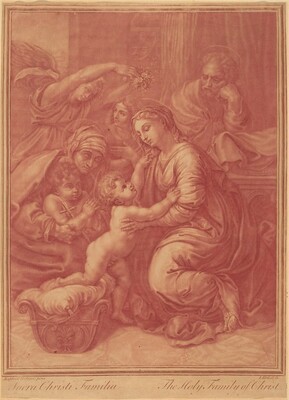
 RaphaelThe Holy Family
Browse
Mezzotint
Mezzotint is a printmaking method that usually begins with a metal plate roughened to print black. Scraping and polishing selected areas brings out lighter tones, allowing a face or cloud to emerge without a net of drawn lines. Its dark passages can look almost furry. The tool that prepares them, a curved blade with tiny teeth, is called a rocker.
6,751 works from 43 museums32 on view nowClear all
RaphaelThe Holy Family Maurits Cornelis EscherPlane Filling I
 Rembrandt van RijnJan Uytenbogaert
 Rembrandt van RijnThe Burgomaster
 Anthony van DyckGeorge Duke of Buckingham with his Brother Francis
 Joseph Mallord William TurnerKingston Bank, No.2
 Joseph Mallord William TurnerThe Timber Raft on the Rhine
 Prinz RuprechtThe Great Lansquenet
 Joseph Mallord William TurnerThe Evening Gun
 Joseph Mallord William TurnerBridge and Monument
 Joseph Mallord William TurnerPaestum
 Joseph Mallord William TurnerSt. Michael's Mount
 Rembrandt van RijnRembrandt's Wife
 Hans HolbeinErasmus
 Joseph Mallord William TurnerRispah
 Anthony van DyckEdward Lyttelton, Baron of Mounslow
 Joseph Mallord William TurnerCalm
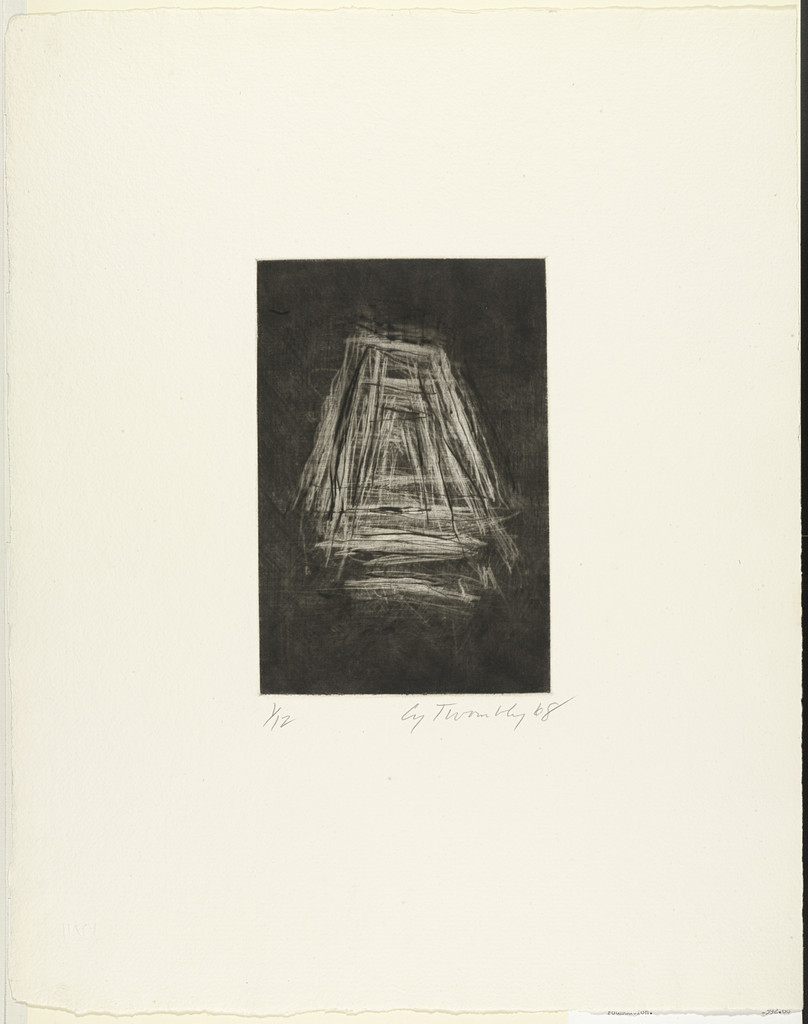 Cy TwomblyUntitled
 Prinz RuprechtThe Standard Bearer
 John ConstableSummer Afternoon, after a Shower
 John ConstableMill near Brighton
 John ConstableHadleigh Castle (Small Plate)
 John ConstableA Dell, Helmingham Park, Suffolk
 Edvard MunchThree Faces
 Joseph Mallord William TurnerThe Mouth of the Thames—Isle of Sheppey in Distance
 Joseph Mallord William TurnerCalm
 Anthony van DyckAchilles as Pyrrha with Cupid
 Maurits Cornelis EscherMummified Frog
 John Everett MillaisOphelia (Shakespeare, Hamlet, Act 4, Scene 7)
 Maurits Cornelis EscherEye
 Maurits Cornelis EscherEye
 Maurits Cornelis EscherDusk
 Maurits Cornelis EscherDrop
 Maurits Cornelis EscherGallery
 Joseph Mallord William TurnerShields Lighthouse
 Joseph Mallord William TurnerShields Lighthouse
 Peter Paul RubensThe Gerbier Family
 Rembrandt van RijnRembrandt, Self-Portrait
 Maurits Cornelis EscherSea-shells
 Joseph Mallord William TurnerMoonlight on a River
 Maurits Cornelis EscherCrystal
 John ConstableA Heath
 John ConstableRiver Stour, Suffolk
 John ConstableHadleigh Castle
 Joseph Mallord William TurnerPeat Bog, Scotland
 Prinz RuprechtThe Magdalen
 Joseph Mallord William TurnerThe Evening Gun
 Joseph Mallord William TurnerShip in a Storm
Mezzotint
A useful invention need not be shared willingly. Prince Rupert showed the new mezzotint process to the diarist John Evelyn in 1661. Evelyn later published a small specimen, yet kept the practical explanation obscure. According to the National Portrait Gallery’s research, the engraver William Faithorne was apparently refused a demonstration. Gentlemen could enjoy the secret; a professional who might earn his living from it was another matter. Eventually the process escaped that narrow circle.
Why does mezzotint start with darkness?
The familiar method prepares a copper plate with a rocker, a curved, toothed tool moved repeatedly across the metal. Its teeth create a dense texture of pits and burrs that retain ink. A fully prepared plate can print a continuous dark field. This preliminary labour comes before the visible image: the maker has first equipped the surface to produce darkness everywhere, including where the brightest light will later appear.
Scrapers reduce the roughness; a burnisher smooths selected passages further. Those places hold less ink and print more lightly. The finest whites require a smooth surface. Between that white and the untouched ground lies a scale of greys, controlled through degrees of scraping and polishing. A cheek can turn gradually toward shadow without being enclosed by a hard outline. Mezzotint is especially persuasive where an edge is supposed to disappear.
Ink is worked into the plate and the excess wiped away before printing. The image therefore belongs to the intaglio family, whose ink is held in worked recesses, rather than to relief printing from raised shapes. No acid is necessary to create the standard mezzotint ground. An etched outline can nevertheless be combined with it. A museum label naming two processes may describe a deliberate division between firm structure and soft tone.
From a guarded secret to printed portraits
The beginnings were less uniform than a modern technical demonstration suggests. Ludwig von Siegen’s portrait of 1642, generally treated as the first mezzotint, used a roulette and appears to have developed from light toward dark. Rupert helped establish the rocker-based approach. His own prints still show an experimental roughness; the smooth ground associated with later mezzotints was a subsequent achievement. The method arrived through tinkering with tools, not as a finished recipe.
English portrait publishing offered it a ready occupation. Silk, skin and shining armour could be translated into tone, carrying the pleasures of a painted portrait into a printed sheet. Peter Lely supported the development of this market, while printmakers and publishers supplied the specialised work. By the late seventeenth century, John Smith was an important practitioner. A portrait’s painter, plate maker and publisher might all have different reasons for wanting its face to circulate.

