Caspar David FriedrichGerman, 1774–1840
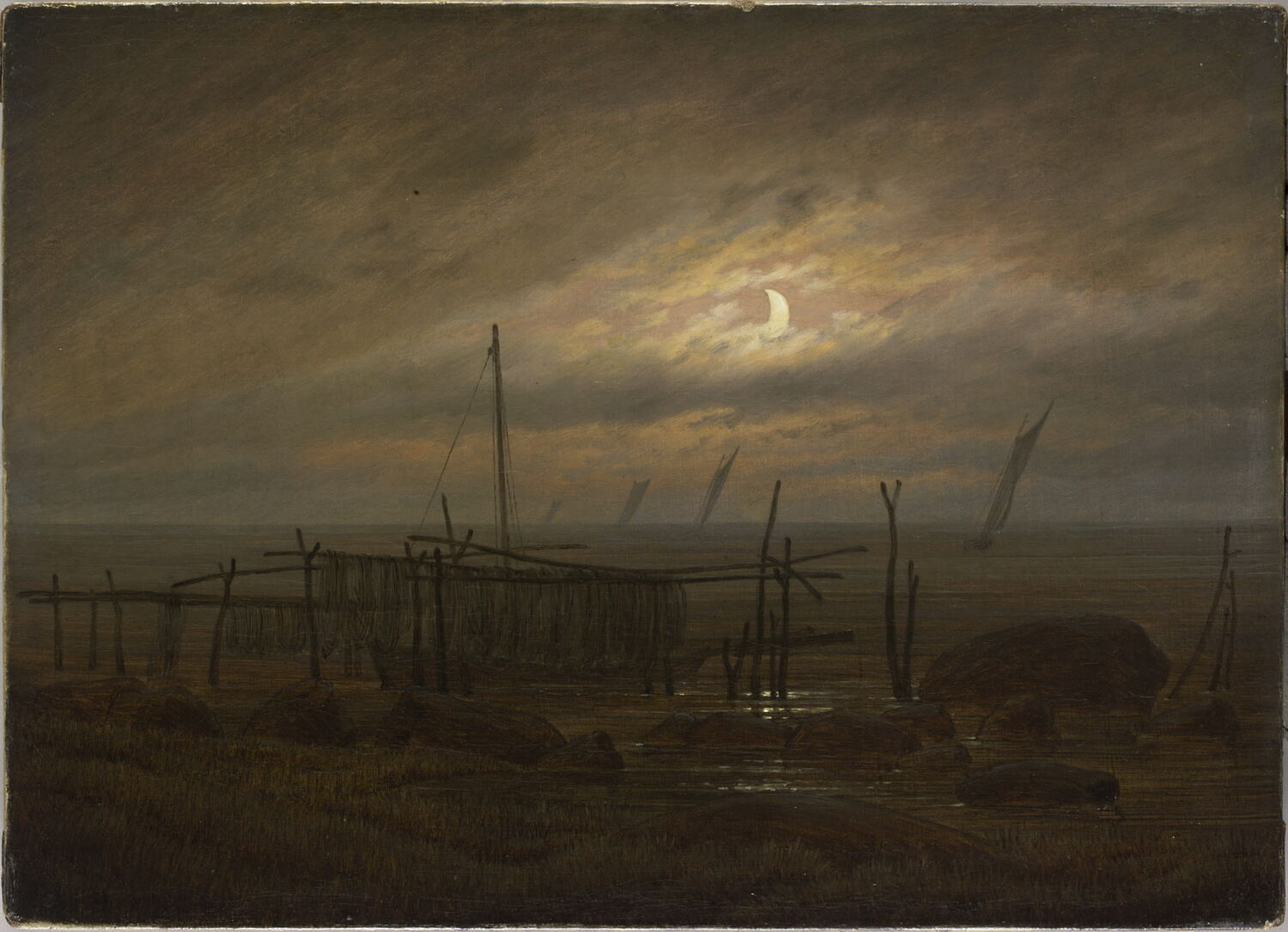
Sea Shore (Fishing-Nets)
May one see it?
Not receiving at present

Saint Petersburg, Russia
It belongs to the collection, but is not on display at present.
- Checked
- In this state since
- Source
- The museum
Particulars
- Accession number
- ГЭ-6480
In the catalog
Sources
- State Hermitage Museum
- Image: State Hermitage Museum — Museum open access
Meanwhile, in the life of Caspar David Friedrich
The whole life1825–1840
The fading of his fame
Over the last fifteen years of his life Friedrich’s reputation steadily declines: as the ideals of early Romanticism go out of fashion he comes to be seen as an eccentric and melancholy figure out of touch with the times, and his patrons gradually fall away. Towards the end he lives in relative poverty and spends long periods, often beginning before sunrise, walking alone through woods and fields.
1830
Aphorisms on art
Friedrich sets down a collection of aphorisms on aesthetics, the sum of his written commentary on art. The artist, he holds, must match natural observation with scrutiny of his own personality: close the bodily eye in order to see the picture first with the spiritual eye, and then bring to the light of day what was seen in the darkness.
1835
Money from the Russian royal family and a cure at Teplitz
Soon after his stroke the Russian royal family purchases a number of his earlier works, and the proceeds allow him to travel to Teplitz, in today’s Czech Republic, to recover.
June 1835
His first stroke
Friedrich’s first stroke leaves him with minor limb paralysis and greatly reduces his ability to paint: he can no longer work in oil and is limited to watercolour, sepia and reworking older compositions. His vision remains strong, but his hand has lost its full strength.
by 1838
Small formats only and the help of friends
By 1838 Friedrich can work only in a small format; he and his family live in poverty and depend increasingly on the charity of friends. In his final years he is close to the Norwegian painter Johan Christian Dahl, and the support of Zhukovsky proves invaluable to the ailing and impoverished artist.
7 May 1840
Died