 Edgar DegasFrench, 1834–1917
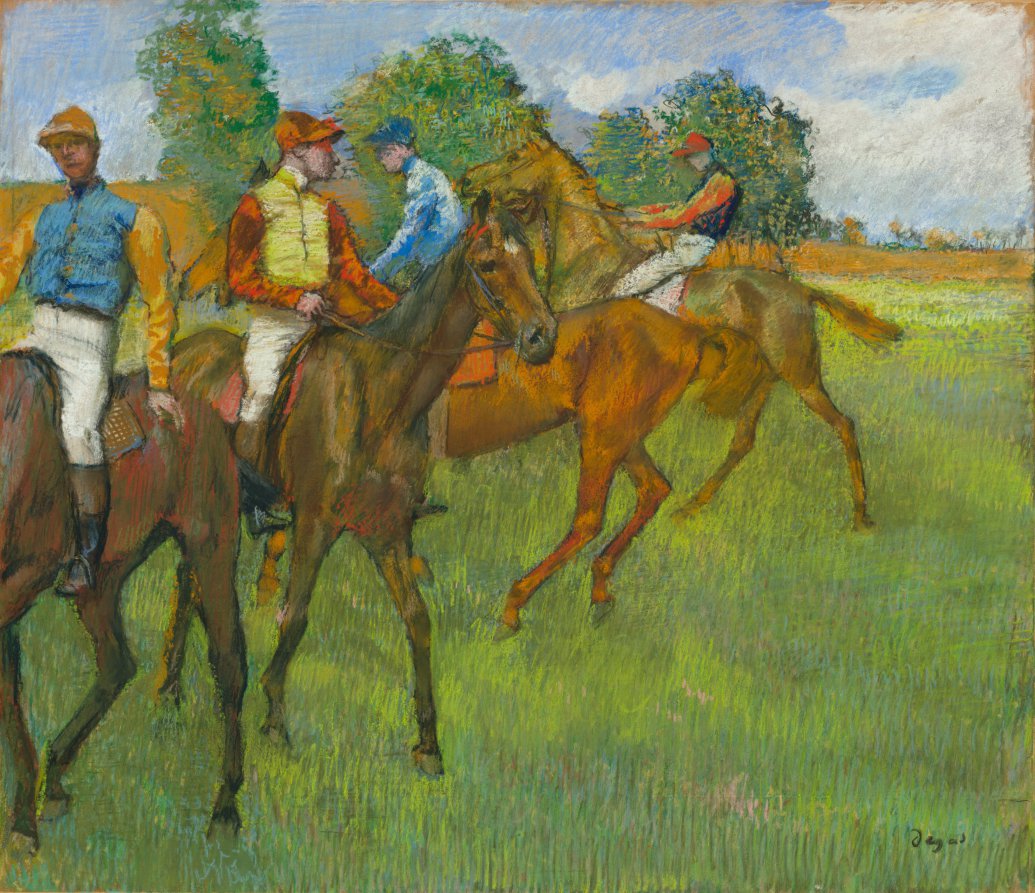
Before the Race
May one see it?
Not receiving at present

The Cleveland Museum of Art
Cleveland, United States
It belongs to the collection, but is not on display at present.
- Checked
- In this state since
- Source
- The museum
About the work
Degas returned to the theme of horse and rider time and again throughout his career. Scholars believe that he executed the first version of this composition of four jockeys on horseback in a charcoal and pastel drawing. Several years later, he traced the composition, reversing its orientation to create the highly finished Cleveland pastel. The palette is intensified, the distance between the second and third jockeys is increased, and the foliage along the horizon has been added to suggest a lush spring day.
The Cleveland Museum of Art
Particulars
- Accession number
- 1958.27
In the catalog
Sources
- The Cleveland Museum of Art
- Image: The Cleveland Museum of Art — Museum open access
Meanwhile, in the life of Edgar Degas
The whole life1886
The eighth exhibition: pastel nudes, and the end of the group
At the last Impressionist exhibition Degas showed a suite of pastel nudes, which drew more critical writing than anything else in his lifetime, mostly laudatory. The group broke up, partly through rancour over the inclusion of non-Impressionists such as Forain and Raffaëlli.
after 1886
Into the shadows: he stops exhibiting
After 1886 Degas stopped exhibiting and sold his pictures at high prices through a narrow circle of agents. By the end of the decade he had in effect fulfilled his wish to be “famous and unknown”, withdrawing among close friends.
late 1880s
A passion for photography
Degas photographed his friends, often by lamplight, as in the double portrait of Renoir and Mallarmé. Photographs of dancers and nudes served as references for his drawings and paintings.