Albrecht DürerGerman, 1471–1528
Melencolia I
Can I see it?
Yes, on view now
Where is “Melencolia I” now? National Gallery of Art, 101B Prints & Drawings, Washington, D.C. Yes, on view now. Checked September 29, 2026.

Closed· opens tomorrow at 10:00 AM
On public display.
- Checked
- In this state since
- Source
- The museum
About the work
Melencolia I is a large 1514 engraving by the German Renaissance artist Albrecht Dürer. Its central subject is an enigmatic and gloomy winged female figure thought to be a personification of melancholia. Holding her head in her hand, she stares past the busy scene in front of her. The area is strewn with symbols and tools associated with craft and carpentry, including an hourglass, weighing scales, a hand plane, a claw hammer, and a saw. Other objects relate to alchemy, geometry or numerology. Behind the figure is a structure with an embedded magic square, and a ladder leading beyond the frame. The sky contains a rainbow, a comet or planet, and a bat-like creature bearing the text that has become the print's title.
Read on
Dürer's engraving is one of the most well-known extant old master prints, but, despite a vast art-historical literature, it has resisted any definitive interpretation. Dürer may have associated melancholia with creative activity; the woman may be a representation of a Muse, awaiting inspiration but fearful that it will not return. As such, Dürer may have intended the print as a veiled self-portrait. Other art historians see the figure as pondering the nature of beauty or the value of artistic creativity in light of rationalism, or as a purposely obscure work that highlights the limitations of allegorical or symbolic art.
The art historian Erwin Panofsky, whose writing on the print has received the most attention, detailed its possible relation to Renaissance humanists' conception of melancholia. Summarizing its art-historical legacy, he wrote that "the influence of Dürer's Melencolia I—the first representation in which the concept of melancholy was transplanted from the plane of scientific and pseudo-scientific folklore to the level of art—extended all over the European continent and lasted for more than three centuries."
In the museum's words
Although the title indentifies the subject as melancholy, the means by which Dürer demonstrates this emotional state is complex, making Melencolia I the most analyzed and discussed of Dürer’s works. Dürer personifies melancholy as a formidable female—her power originates in her ability to alter a man’s temperament into a melancholic state. Immobilized by her lack of creativity, the winged goddess sits dispiritedly surrounded by the tools and instruments she has lost the inspiration to use. Among intellectuals, melancholy was often associated with introspective, educated people, even genius. Because artists were especially prone to melancholy, this image has been interpreted as Dürer’s spiritual self-portrait, implying that the artist identified with her creative plight.
National Gallery of Art
Details
- Accession number
- 1949.1.17
What it shows
In the catalog
Display history
On view · 101B Prints & Drawings
National Gallery of Art · Sep 29, 2026 — now · Verified
Was on view · 101B Prints & Drawings
The Cleveland Museum of Art · Sep 29, 2026 — Sep 29, 2026 · Verified
Was on view · 101B Prints & Drawings
National Gallery of Art · Sep 29, 2026 — Sep 29, 2026 · Verified
Was on view · 101B Prints & Drawings
The Cleveland Museum of Art · Sep 28, 2026 — Sep 29, 2026 · Verified
Was on view · 101B Prints & Drawings
National Gallery of Art · Sep 28, 2026 — Sep 28, 2026 · Verified
Was on view · 101B Prints & Drawings
The Cleveland Museum of Art · Sep 27, 2026 — Sep 28, 2026 · Verified
Was on view · 101B Prints & Drawings
National Gallery of Art · Sep 25, 2026 — Sep 27, 2026 · Verified
Was on view · 101B Prints & Drawings
The Cleveland Museum of Art · Aug 19, 2026 — Sep 25, 2026 · Verified
Sources
- The Cleveland Museum of Art
- Image: National Gallery of Art — Museum open access
In the life of Albrecht Dürer
The whole life1507–1528 · Workplace
Nuremberg
1512
Emperor Maximilian I becomes his chief patron
From 1512 Emperor Maximilian I was Dürer's chief patron. For him Dürer and his workshop produced the Triumphal Arch, a giant woodcut 295 × 357 cm printed from 192 blocks and modelled on the triumphal arches of ancient Rome.
3 January 1512
Nuremberg's privilege against forgeries
Nuremberg's city council granted Dürer a privilege for the sale of his prints, with penalties for anyone who forged them.
1513–1516
Three years without painting
Complaining that painting did not pay enough to justify the time compared with his prints, Dürer produced no paintings from 1513 to 1516.
1514
Death of his mother
In the year of Melencolia I and St Jerome in His Study, the artist's mother, Barbara Holper, died.
1515
A life pension from the emperor
The perpetually cash-strapped Maximilian could not pay on time and offered to exempt the artist from city taxes, which the Nuremberg Council opposed. At Dürer's request the emperor granted him a life pension of 100 guilders a year from the sums Nuremberg paid into the imperial treasury.
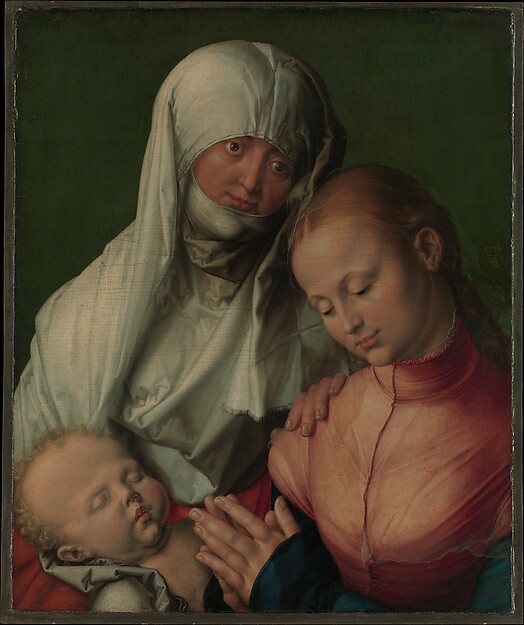
![Madonna and Child [obverse], Albrecht Dürer, c. 1496/1499](https://api.nga.gov/iiif/878db7e6-10ae-4cae-ba5d-6d6f5c413ae8/full/!2400,2400/0/default.jpg)
![Lot and His Daughters [reverse], Albrecht Dürer, c. 1496/1499](https://api.nga.gov/iiif/7565a449-f82a-414b-9bda-c93f55a51b4d/full/!2400,2400/0/default.jpg)