 Edgar DegasFrench, 1834–1917
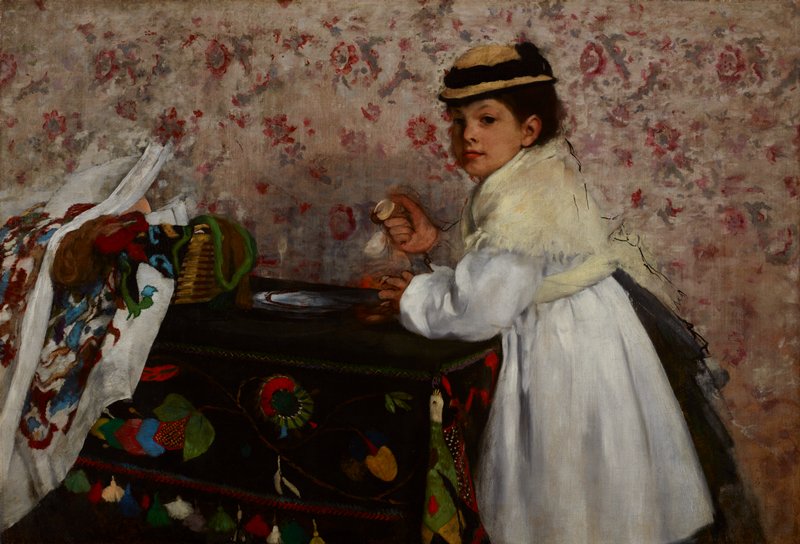
Portrait of Mlle. Hortense Valpinçon
May one see it?
Yes, receiving visitors

Minneapolis Institute of Art
RoomG351Minneapolis, United States
On public display.
- Checked
- 4 hours ago
- In this state since
- Sep 25, 2026
- Source
- The museum's own collection data
About the painting
Throughout his life, Degas was a frequent guest at Ménil-Hubert, the country estate of his childhood friend Paul Valpinçon. Located in Normandy, Ménil-Hubert offered the artist a pleasant change of scenery and a family of captive yet willing models, whom he depicted on numerous occasions. This portrait of his host’s eldest child and only daughter, Hortense, ranks among the most memorable products of those visits and stands as the most winning depiction of a child from Degas’s long career.
Read on
The circumstances surrounding the portrait’s creation were documented in the 1930s during an interview with Hortense, then Madame Jacques Fourchy. She said that, having come to Ménil-Hubert in haste, Degas was without proper canvas and was given a remnant of mattress ticking as a substitute. This account was dismissed by later art historians as a faded anecdote. However, the accuracy of Hortense’s memory was substantiated in 1996 when a pattern of blue-and-white striping was discovered at the taped edges of the canvas.
The portrait remained in the Valpinçon family until 1930, when Hortense sold it to Wildenstein & Co., from whom The Minneapolis Institute of Arts acquired it in 1947.
Minneapolis Institute of Art
Particulars
- Accession number
- 48.1
In the catalog
Sources
- Minneapolis Institute of Art: the museum's own open data · fetched 4 days ago
- Image: Minneapolis Institute of Art — public domain
Meanwhile, in the life of Edgar Degas
The whole lifelate 1860s
The turn to modern life: racecourses, milliners, laundresses
By the late 1860s Degas had moved from history painting to an original observation of contemporary life: racecourse scenes let him paint horses and riders in a modern setting, and then he turned to women at work — milliners and laundresses.
late 1860s
Begins modelling in wax
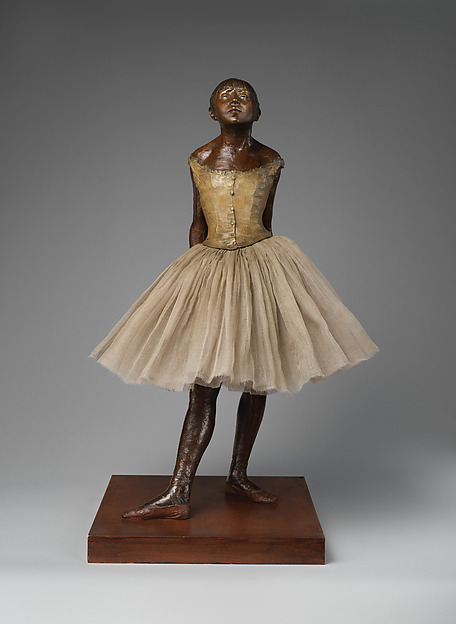
Degas modelled small wax figures of dancers, bathers and jockeys for himself, in place of studies. He never worked in bronze or stone; he valued wax for its changeability, and his sculptor friend Bartholomé encouraged him.
1870
A volunteer in the war; a flaw in his eyesight
When the Franco-Prussian War broke out Degas volunteered; at the first shooting practice it turned out that he saw poorly with his right eye. It was the first sign of the macular degeneration that left him almost blind at the end of his life; he was transferred to the artillery and served there to the end of the war.
early 1870s
Meets Durand-Ruel
Degas met the dealer Durand-Ruel, later the most prominent of the trusted dealers with whom he planned his strategy at auctions.
October 1872 – March 1873 · Residence
New Orleans
1873–1874
His brother's debts: he sells his house and collection
After his father's death Degas learned that his brother René had run up enormous business debts. To save the family's reputation he sold his house and an inherited art collection and for the first time in his life depended on sales of his own work.