 Edgar DegasFrench, 1834–1917
The Dance Class
May one see it?
Yes, receiving visitors

The Metropolitan Museum of Art
Room815New York, United States
On public display.
- Checked
- 4 hours ago
- In this state since
- Sep 26, 2026
- Source
- The museum's own collection data
About the painting
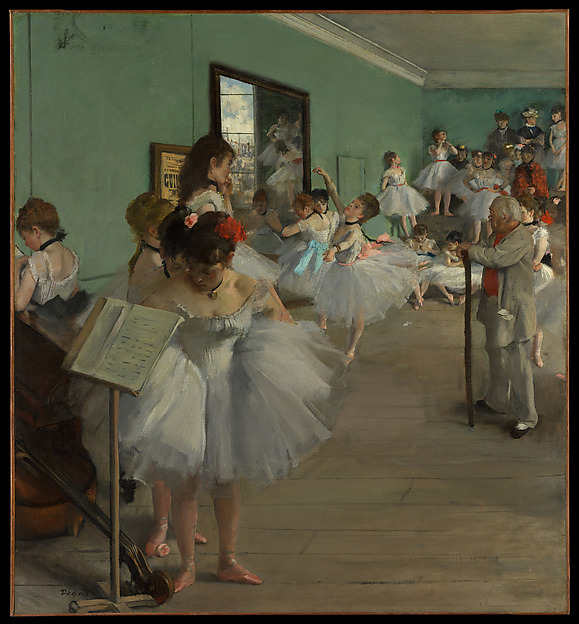
The Dance Class is an 1874 oil painting on canvas by the French artist Edgar Degas. It is in the collection of the Metropolitan Museum of Art, in New York.
The painting and its companion work in the Musée d'Orsay, Paris, are amongst the most ambitious works by Degas on the theme of ballet. The imaginary scene depicts a dance class being held under the supervision of Jules Perrot, a famous ballet master, in the old Paris Opera, which had actually burnt down the previous year.
The poster on the wall for Rossini's Guillaume Tell is a tribute to the operatic singer Jean-Baptiste Faure, who had commissioned the work.
The painting is on view in the Metropolitan Museum's Gallery 815 as of December 2023.
Particulars
- Accession number
- 1987.47.1
What it shows
Sources
- The Metropolitan Museum of Art: the museum's own open data · fetched 4 days ago
- Image: The Metropolitan Museum of Art — Open Access (CC0)
Meanwhile, in the life of Edgar Degas
The whole lifeearly 1870s
Meets Durand-Ruel
Degas met the dealer Durand-Ruel, later the most prominent of the trusted dealers with whom he planned his strategy at auctions.
1870s
From “de Gas” back to plain “Degas”
The archives disproved the legend of an ancient noble line: the artist's paternal ancestors were bakers, and the name “de Gas” was invented by his father, who commissioned a false genealogy. In the 1870s Edgar returned to the plain spelling, Degas.
October 1872 – March 1873 · Residence
New Orleans
1873–1874
His brother's debts: he sells his house and collection
After his father's death Degas learned that his brother René had run up enormous business debts. To save the family's reputation he sold his house and an inherited art collection and for the first time in his life depended on sales of his own work.
1874
The first Impressionist exhibition
Disenchanted with the Salon, Degas joined a group of young artists organizing an independent exhibiting society. He took a leading role in organizing the eight shows of 1874–1886 and exhibited in all but one, despite constant conflicts with the group.
13 February 1874
Goncourt notes Degas's laundresses and dancers
Edmond de Goncourt wrote in his diary that Degas had chosen laundresses and dancers as his chief modern subjects, finding in their fabrics an occasion for light and delicate tones. After visiting the studio he called Degas the man who best caught the soul of modern life.