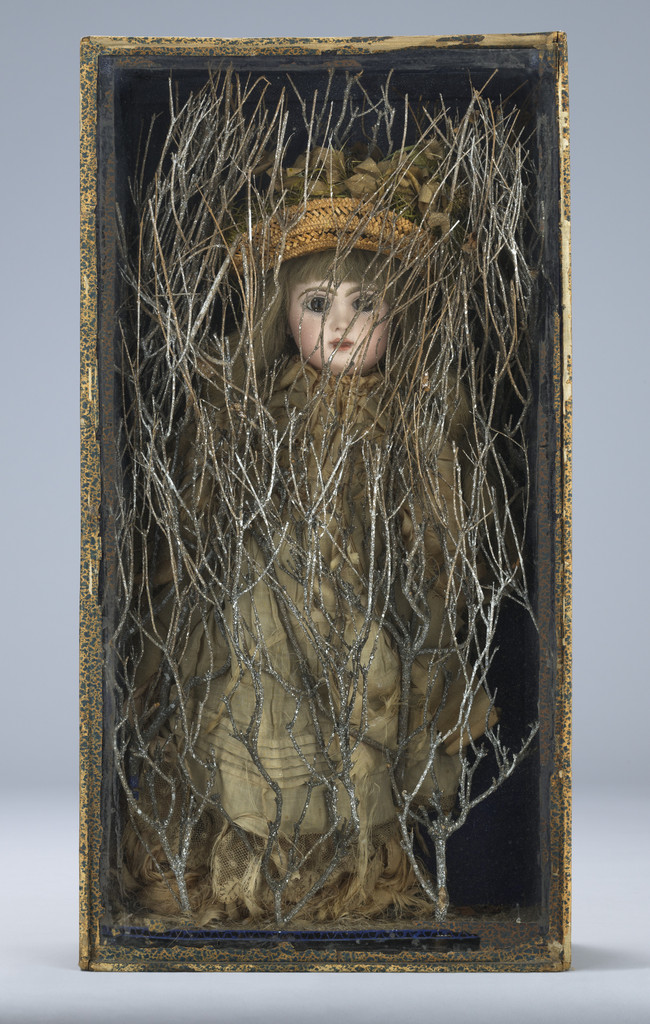
Soap Bubble Set
Можно увидеть?
Да, выставлена
Где сейчас «Soap Bubble Set»? Чикагский институт искусств, Зал 397, Чикаго. Да, выставлена. Проверено 16 ноября 2026 г.

Чикаго, США
Закрыто· откроется в 11:00
Выставлена для публики.
- Проверено
- Этот статус с
- Источник
- Музей
О работе
«Набор мыльных пузырей» (1936, Хартфорд, Атенеум Уодсворта; New York 1980–82, pl. 1) был частью первой «тематической» инсталляции Корнелла в выставке Альфреда Барра «Фантастическое искусство, дада, сюрреализм» в Музее современного искусства в Нью-Йорке в 1936-37 годах. Корнелл назвал инсталляцию «Элементы натуральной философии»; она состояла из стеклянной витрины с восемьюдесятью семью предметами в общей сложности, включая саму коробку. Корнелл описывал этот ящик 1936 года как «настоящего „первенца“ того типа ящика, который должен был стать моей признанной средой» (Joseph Cornell, memorandum to Hans Huth, 1953, Archives, The Art Institute of Chicago). В нём уже присутствуют спиральные связи между трубкой и «пузырями», которые Корнелл превращал в планетарные тела, в данном случае в луну.
Читать дальше
В нынешнем «Наборе мыльных пузырей» белый шар напоминает либо луну, либо пузырь. Фрагмент коралла в стакане вводит идею пляжа и выброшенного на берег дерева; Корнелл часто обшаривал пляж в поисках обломков и плавника, выброшенных приливами, находя там, по-видимому, даже глиняные трубки и стаканы (verbal communication to the author from Elizabeth Cornell Benton, Cornell‘s sister, in 1980). Многие голландские глиняные трубки, которые он использовал в своих ящиках, Корнелл приобрёл на Всемирных выставках в Нью-Йорке 1939 и 1940 годов (Lynda Roscoe Hartigan, in New York 1980–82, p. 100). Тёмно-синий бархат, покрывающий заднюю стенку ящика, одновременно создаёт обстановку ночного неба для шаров-планет и намекает на просцениум старомодного театра, обитого бархатом.
Этот ящик впервые был показан на выставке, организованной Уильямом Коплеем в его галерее в Беверли-Хиллз в 1948 году, всё содержимое которой он купил у Корнелла. Выставка, по словам Коплея, была «колоссальным провалом». Коплей объяснял это тем, что его инсталляция превратила галерею в один большой ящик. Оклеив стены и потолок сине-белыми каталогами и рассыпав глиняные трубки среди ящиков, выставленных на стеклянных полках, он создал цельное произведение, которое, по его мнению, мешало публике входить (см. Bill Copley, “Joseph Cornell,” in New York, Castelli, Feigen, Corcoran, Joseph Cornell Portfolio, 1976, exh. cat., n. pag.). Судя по каталогу выставки 1948 года, было показано по меньшей мере четыре «Набора мыльных пузырей». В кратких заметках в каталоге Корнелл писал:
«Наборы мыльных пузырей
Теневые ящики становятся поэтическими театрами или декорациями, в которых преображаются элементы детской забавы. Хрупкие, мерцающие шарики становятся мерцающими, но более долговечными планетами — коннотация луны и приливов — ассоциация воды менее тонка, когда куски плавника [sic] составляют просцениум, оттеняющий ослепительную белизну морской пены и пышного облака, кристаллизованных в причудливой трубке».
Когда эта работа была показана Коплеем в 1948 году, она получила подзаголовок «Спиртовой уровень». Хотя синий и белый шары на нижней полке напоминают небесные тела, вроде луны и планеты, одиночный синий шарик на верхней полке действительно напоминает пузырёк спиртового уровня — устройства для определения или поддержания горизонтальной поверхности, состоящего из пузырька, подвешенного в стеклянной трубке с жидкостью. Пузырёк в спиртовом уровне крайне чувствителен к малейшим сдвигам ориентации, как и шары, свободно перекатывающиеся по своим стеклянным полкам в нынешнем ящике. Возможно, идея спиртового уровня была подсказана Корнеллу его тревогой по поводу смещения, или, как он выражался, «расстройства» предметов в этой конструкции, беспокойства, которое он выразил в двух напечатанных на машинке ярлыках на обороте ящика (см. илл. 4). Подзаголовок «Спиртовой уровень» может, таким образом, намекать на действия наклона, выравнивания и выпрямления ящика, с постоянной возможностью сместить его тонко расположенное содержимое, что составляет как умственный, так и физический процесс.
— Статья каталога, Доун Адес, Surrealist Art: The Lindy and Edwin Bergman Collection at the Art Institute of Chicago, 1997, p.50-51.
Чикагский институт искусств · перевод ART WIKICC BY 4.0
Словами музея — на английском
A soap bubble set box (1936, Hartford, Wadsworth Atheneum ; New York 1980–82, pl. 1) was part of Cornell‘s first “theme” installation, in AIfred Barr’s exhibition Fantastic Art, Dada, Surrealism at The Museum of Modern Art, New York, in 1936-37. Cornell called the installation The Elements of Natural Philosophy; it consisted of a glass showcase containing eighty-seven pieces in all, including the box itself. Cornell described this 1936 box as “a real ‘first-born‘ of the type of case that was to become my accepted milieu” (Joseph Cornell, memorandum to Hans Huth, 1953, Archives, The Art Institute of Chicago). In it the spiraling connections between the pipe and “bubbles,” which Cornell metamorphosed into planetary bodies, in this case the moon, are already present.
Читать дальше
In the present Soap Bubble Set, the white ball resembles either the moon or a bubble. The fragment of coral in the glass introduces the idea of a beach and driftwood; Cornell frequently scoured the beach for flotsam and jetsam thrown up by the tides, even finding there, it seems, clay pipes and glasses (verbal communication to the author from Elizabeth Cornell Benton, Cornell‘s sister, in 1980). Cornell acquired many of the Dutch clay pipes he used in his boxes from the New York World’s Fairs of 1939 and 1940 (Lynda Roscoe Hartigan, in New York 1980–82, p. 100). The deep-blue velvet that covers the box‘s rear wall both creates a night-sky setting for the balls/planets and hints at the proscenium setting of an old-fashioned, velvet-hung theater.
This box was first shown in an exhibition William Copley organized at his Beverly Hills gallery in 1948, the entire contents of which he had bought from Cornell. The show was, in Copley’s words, an “enormous failure.” Copley attributed this to the fact that his installation transformed the gallery into one large box. Plastering the walls and ceiling with the blue-and-white catalogues and scattering clay pipes among the boxes displayed on glass shelves, he created a whole artwork, which he felt inhibited the public from entering (see Bill Copley, “Joseph Cornell,” in New York, Castelli, Feigen, Corcoran, Joseph Cornell Portfolio, 1976, exh. cat., n. pag.). Judging from the catalogue of the 1948 show, at least four Soap Bubble Sets were displayed. In the brief catalogue notes, Cornell wrote:
"Soap Bubble Sets
Shadow boxes become poetic theatres or settings wherein are metamorphosed the elements of a childhood pastime. The fragile, shimmering globules become the shimmering but more enduring planets—a connotation of moon and tides – the association of water less subtle, as when driftwood [sic] pieces make up a proscenium to set off the dazzling white of sea-foam and billowy cloud crystalized in a pipe of fancy."
When this work was shown by Copley in 1948, it was given the subtitle Spirit Level. While the blue and the white balls on the lower shelf recall heavenly bodies, like moon and planet, the isolated blue marble on the upper shelf indeed recalls the bubble of a spirit level, a device to determine or maintain a level surface, consisting of a bubble suspended in a glass tube full of liquid. The bubble in a spirit level is highly sensitive to minute shifts of orientation, like the balls that roll freely on their glass shelves in the present box. Perhaps the idea of a spirit level was prompted in Cornell‘s mind by his anxiety about the displacement or, as he put it, the “derangement” of the objects in this construction, a concern he expressed in the two typewritten labels on the back of the box (see fig. 4). The subtitle Spirit Level may thus allude to the actions of tilting, adjusting, and straightening the box, with the constant possibility of displacing its delicately disposed contents, in what amounts to a mental as well as physical process.
— Entry, Dawn Ades, Surrealist Art: The Lindy and Edwin Bergman Collection at the Art Institute of Chicago, 1997, p.50-51.
Чикагский институт искусствCC BY 4.0
Сведения
- Инвентарный номер
- 1982.1861
В каталоге
Источники
- Чикагский институт искусств
- Изображение: Чикагский институт искусств — © автор или правообладатель