Vasily KandinskyFrench, 1866–1944
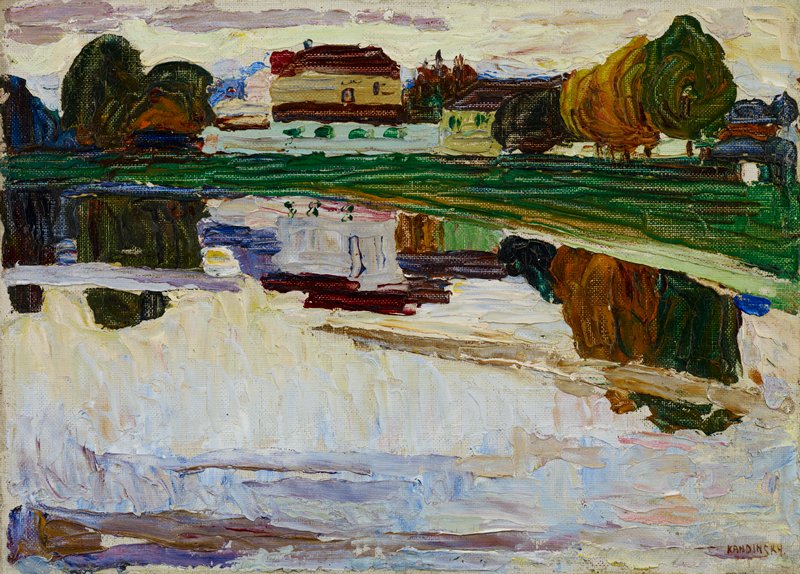
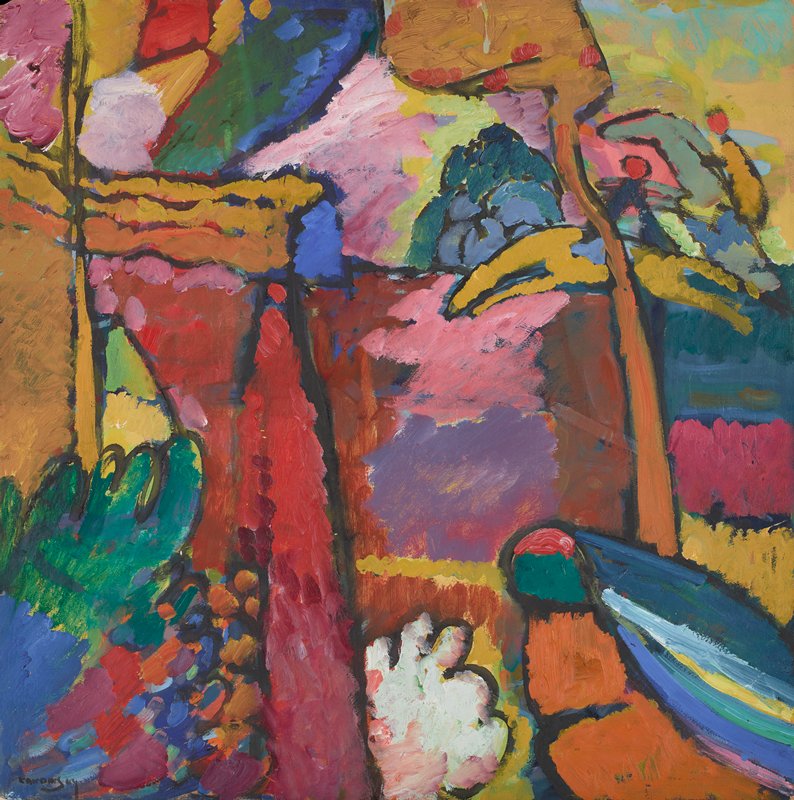
View of Murnau
Can I see it?
Unknown
Where is “View of Murnau” now? Collection: State Hermitage Museum, Saint Petersburg. Unknown.

Saint Petersburg, Russia
The owner is known; whether it is on view today is not.
- Source
- The museum
Details
- Accession number
- ГЭ-8943
In the catalog
Sources
- State Hermitage Museum
- Image: State Hermitage Museum — Museum open access
In the life of Vasily Kandinsky
The whole life1906–1908
Years of travel across Europe; the Blue Rose
From 1906 to 1908 Kandinsky travelled a great deal across Europe, was an associate of the Moscow symbolist group the Blue Rose, and then settled in the small Bavarian town of Murnau.
1908–1909
“Thought-Forms” and the Theosophical Society
In 1908 Kandinsky bought a copy of “Thought-Forms” by Annie Besant and Charles Webster Leadbeater, and in 1909 he joined the Theosophical Society.
1908–1909
Murnau and Münter's “Russian House”
Gabriele Münter bought a summer house in Murnau, where the couple happily entertained colleagues; it is still known as the “Russenhaus”. Later Münter used its basement to hide many works by Kandinsky and others from the Nazis.
1909
President of the Neue Künstlervereinigung München
Kandinsky helped found the Neue Künstlervereinigung München and became its president. The group dissolved in late 1911: it could not reconcile the radical approach of Kandinsky and others with conventional ideas of art.
1909
Budapest: Unkovskaya's system of colour hearing
At the Theosophical Congress in Budapest Kandinsky heard Aleksandra Unkovskaya present her system of music education based on sound-to-colour synesthesia; it led to his own discoveries, and he formulated the chain “emotion — sensation — the work of art — sensation — emotion”.
1910–1911
The treatise “Concerning the Spiritual in Art”
The treatise defended and promoted abstract art and affirmed that all forms of art are equally capable of reaching spirituality; colour in a painting can be autonomous, apart from the depiction of an object. Kandinsky distinguished three kinds of painting: impressions, improvisations and compositions.
_MET_DP236124.jpg?width=1280)