 Данте Габриэль РоссеттиАнглия, 1828–1882
The Raven
Можно увидеть?
Сейчас не выставлена
Где сейчас «The Raven»? Собрание: Музей Виктории и Альберта, Лондон. Сейчас не выставлена. Проверено 25 сентября 2026 г.

Лондон, Великобритания
Числится в собрании, но в залах её сейчас нет.
- Проверено
- Этот статус с
- Источник
- Музей
О работе
Словами музея — на английском
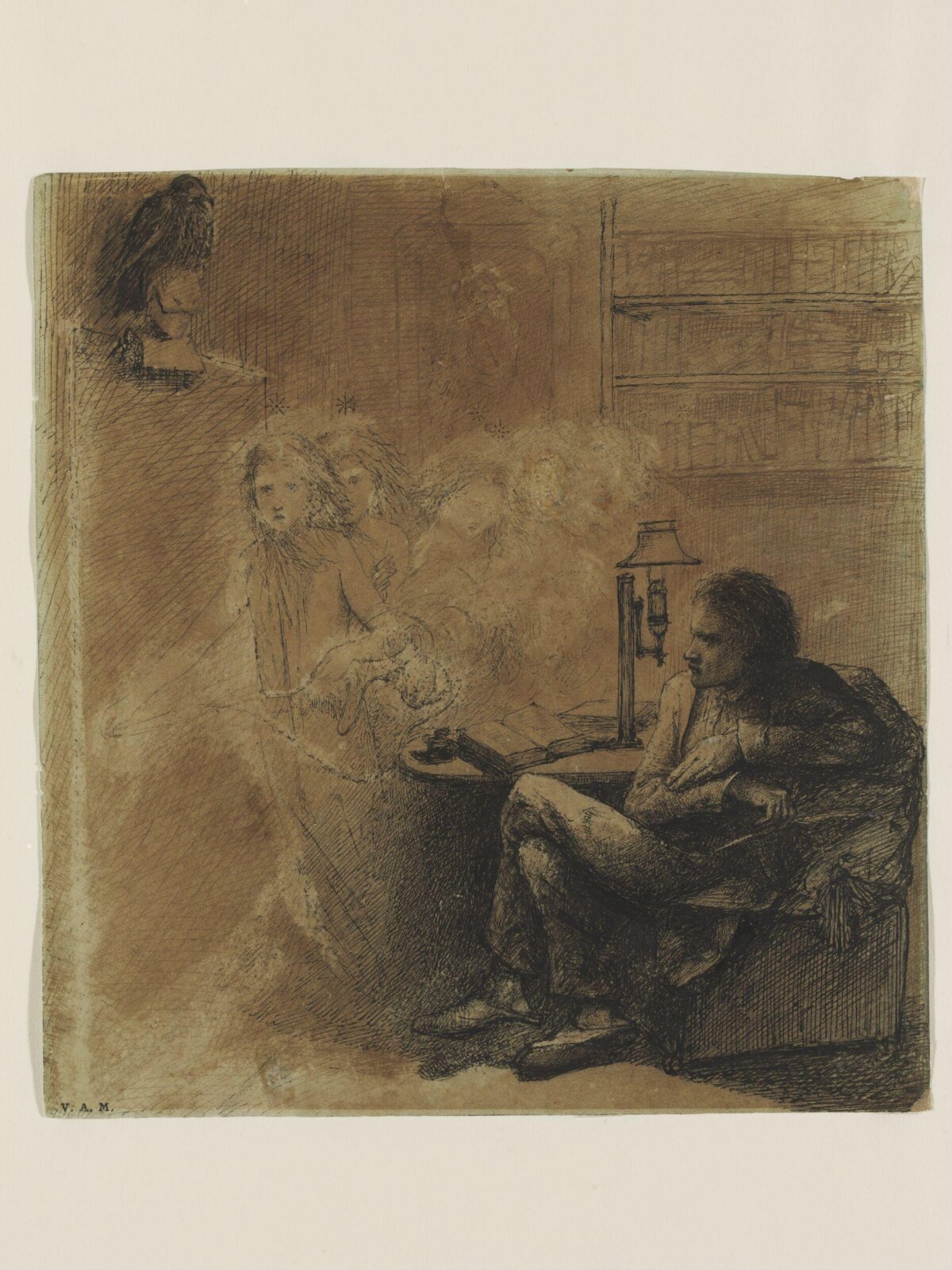
Literature was a key source of inspiration for Pre-Raphaelite artists and they regarded certain writers and poets with the greatest respect. Some, including Shakespeare, Dante, Chaucer, and Goethe, even earned a mention in their list of ‘Immortals’, a canon of prominent figures across religion, visual art, literature, and politics. American writer and poet Edgar Allen Poe, known for his haunting verse, vivid imagery, and fascination with the uncanny, also earned his spot. This drawing is one of four known works by Dante Gabriel Rossetti in response to Poe’s poem 'The Raven'. Completed only a few short years after the poem’s initial publication in the New York Mirror in 1845, this drawing illustrates stanza fourteen of the eerie tale:
Then, methought, the air grew denser,
perfumed from an unseen censer
Swung by Seraphim whose foot-falls
tinkled on the tufted floor.
Читать дальше
The censer is ‘swung’ by seraphim, celestial beings found in religious texts, particularly in Jewish and Christian traditions. They descend into the room, and the narrator observes the delicate, bell-like sound made by their footsteps, adding to the dreamlike atmosphere. In the foreground, the main subjects—the narrator and the seraphim—dominate the scene, while a faint portrait of the narrator’s lost lover, Lenore, occupies the far wall in the background. Above the door, the raven perches atop a bust of Pallas Athene, bridging the foreground and background elements of the composition.
The work holds an undeniable narrative richness, engaging with a subject that has inspired imaginative and artistic responses from other nineteenth-century artists such as Gustave Doré, Édouard Manet, and John Tenniel. Alongside this, it demonstrates a material resonance through a combination of unique techniques, revealing a deeply tactile creative process for the artist. Rossetti demonstrates exceptional technical skill in depicting the tension between corporeal presence and ethereal absence, evoking a disturbing sense of disquiet. The pale green paper support is coated with a light brown wash.
What initially appears to be a white or lightly toned media applied over delicately rendered spectral figures is actually the result of the artist using a sponge to remove the light brown wash and expose the substrate (Susan Owens, The Art of Drawing: British Masters and Methods Since 1600, London, V&A Publishing, 2013, pp. 130–131). Dense ink lines, rendered with a cross-hatching technique, reflect the man’s physicality. By contrast, the seraphim appear weightless and may be understood as created through an inverse technique: achieved by removing media rather than applying it, a process of erasure—almost alchemical—that visually reveals the spectral. There is yet another removal process applied to the third, fourth, and fifth seraphim, which is considerably more abrasive.
The lack of brown wash is more pronounced, and their facial features are gradually obscured, but they are also highly textured, heavily worked, and scraped out. Scraping was a technique also used in Rossetti’s watercolours, as confirmed by Charles Fairfax Murray, an assistant in the artist’s studio. With the use of backlight, it becomes clear that the paper support is significantly thinned, specifically across the eyes and mouths of the last three seraphim—an effect which mirrors the ephemeral and thin nature of the seraphim themselves. Given how deliberate this effect is, focused on the eyes and mouths of the angels, one might assume it was created using a metal scraper, a tool also used by Rossetti’s contemporary Edward Burne-Jones (Christiana Payne, et al. Pre-Raphaelites: Drawings & Watercolours, Oxford, Ashmolean Museum, 2021, p. 44).
Rossetti’s illustrations to Poe were intensely personal and likely never meant for publication, with this particular drawing being a gift to Irish poet and editor William Allingham. They show a profound regard for Poe’s poetry, which persisted into the very last months of Rossetti’s life. British novelist and playwright Hall Caine, who was a companion to the artist in his final years, recalls how he would recite verses from Poe’s 'The Raven' and reflect on how it influenced his poetic feat, 'The Blessed Damozel'. Written as a reversal of 'The Raven', it changes the perspective: instead of a distraught earthbound narrator mourning a lost lover, Rossetti depicts a heavenly woman longing to be reunited with her lover on earth.
He is quoted as saying: ‘that Poe had done the utmost it was possible to do with the grief of the lover on earth, and so I determined to reverse the conditions, and give utterance to the yearning of the loved one in heaven.’ (T. Hall Caine, Recollections of Dante Gabriel Rossetti, London, Elliot Stock, 1882, p. 284). Such recollections offer an intimate reading of Rossetti’s series of drawings related to 'The Raven'.
Музей Виктории и Альберта
Сведения
- Инвентарный номер
- E.3415-1922
В каталоге
Источники
- Музей Виктории и Альберта
- Изображение: Музей Виктории и Альберта — © Музей Виктории и Альберта
В жизни художника
Вся жизнь целиком1848
Знакомство с Холманом Хантом и Милле
В 1848 году на выставке Королевской академии Россетти познакомился с Уильямом Холманом Хантом, который помог ему, ещё недостаточно владевшему живописной грамотой, закончить «Юность Девы Марии»; Хант познакомил его с Джоном Эвереттом Милле.
1848
Основание Братства прерафаэлитов
В 1848 году Россетти вместе с Уильямом Холманом Хантом и Джоном Эвереттом Милле основал Братство прерафаэлитов, поставив целью обновить английское искусство: отказаться от «механистичного» подхода, принятого после Рафаэля и Микеланджело, и от академической школы Джошуа Рейнолдса и вернуться к обилию деталей, ярким краскам и сложным композициям итальянского и фламандского кватроченто. Они писали чистыми красками по белому грунту и нередко работали на открытом воздухе ради подлинности.
после 1848
Ученик Форда Мэдокса Брауна
Оставив Королевскую академию, Россетти стал учиться у Форда Мэдокса Брауна, с которым сохранил близкие отношения на всю жизнь.
1850
Знакомство с Элизабет Сиддал
В 1850 году Россетти познакомился с поэтессой Элизабет Сиддал, ставшей любимой моделью прерафаэлитов; в течение следующего десятилетия она была его музой, ученицей и страстью. Уже тогда она болела туберкулёзом, а Россетти сделал множество её зарисовок, из которых некоторые стали эскизами к картинам.
1850
Критика «Благовещения» и поворот к акварели
Задетый критикой второй большой картины, «Благовещения», выставленной в 1850 году, и всё более яростной реакцией критиков на прерафаэлитизм в тот год, Россетти обратился к акварели, которую можно было продавать частным образом; позднее его работы поддержал Джон Рёскин, но выставлялся Россетти уже редко.
начало 1850
«Росток»: «Блаженная дамозель» и рассказ о художнике
В начале 1850 года в первом номере журнала братства «Росток» (The Germ) Россетти опубликовал стихотворение «Блаженная дамозель» и рассказ о вымышленном итальянском художнике, вдохновлённом видением женщины, которая призывает его соединить в своём искусстве человеческое и божественное.