 Constantin BrancusiRomania, 1876–1957
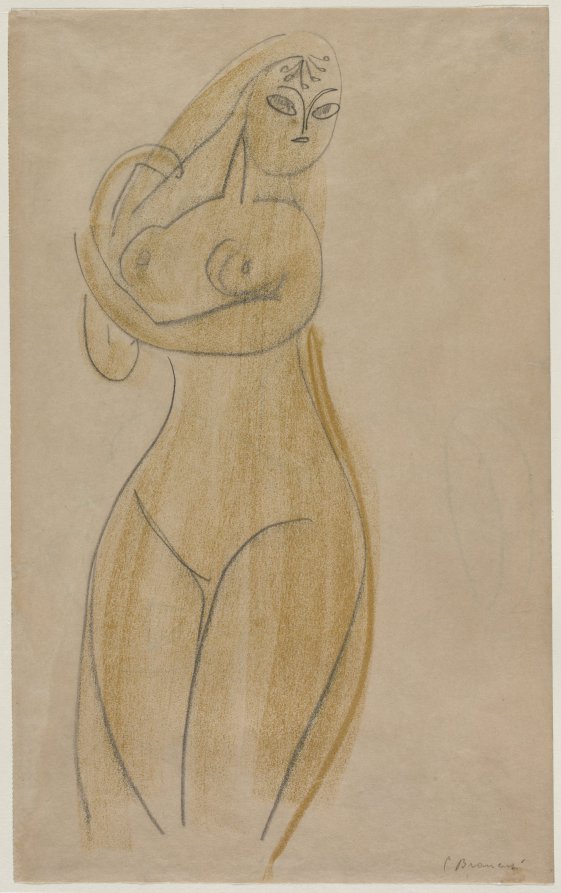
Study for Princess X (recto)
Si può ammirare?
Al momento non riceve

Cleveland Museum of Art
Cleveland, Stati Uniti
Appartiene alla collezione, ma al momento non è esposta.
- Verificato
- 7 ore fa
- Ultimo cambio di stato
- 19 ago 2026
- Fonte
- I dati di collezione del museo stesso
Sull’opera
Brancusi produced very few drawings and these were not preparatory for sculpture. His complaint, "There are too many lines," implies that for him the purest distillation of form can be achieved only in three dimensions. Drawing for pleasure, Brancusi's freely executed, graceful line describes the rounded silhouette of a voluptuous woman. Linear rhythms energize the figure, which seems to float on the blank page.
Cleveland Museum of Art
Scheda
- Numero di inventario
- 1982.373.a
In catalogo
Fonti
- Cleveland Museum of Art: the museum's own open data · acquisita 6 giorni fa
- Immagine: Cleveland Museum of Art — © Artists Rights Society (ARS), New York
Nel frattempo, nella vita di Constantin Brancusi
Tutta la vitaautumn 1912
The Grand Palais aviation show with Duchamp and Léger
In the fall of 1912 Brâncuși visits an aviation exhibition at the Grand Palais with Marcel Duchamp and Fernand Léger; the three stop before an airplane propeller, and its mechanical precision leads them into a conversation about machine-made forms and the direction sculpture might take. In May of that year he had rented a second studio at 47 rue du Montparnasse, across from the first.
17 February 1913
The Armory Show in New York: five sculptures
In December 1912 the Armory Show organisers Arthur Bowen Davies, Walt Kuhn and Walter Pach visit Paris in search of works; the catalogue lists five sculptures by Brâncuși — “The Kiss”, “Sleeping Muse”, “A Muse”, “Mademoiselle Pogany” and “Torso”. The exhibition opens in New York on 17 February 1913 and travels to Chicago and Boston; his compact forms provoke laughter, caricatures and arguments in the press, and “Mademoiselle Pogany” is compared to an egg.
1914
The patron John Quinn
The lawyer and collector John Quinn, a supporter of the Armory Show, buys works from Brâncuși and remains in contact with him until his death in 1924; in 1914 he acquires a version of “Mademoiselle Pogany” from 291.
12 March – 4 April 1914
His first US solo show at the gallery 291
Edward Steichen selects the works for Brâncuși’s first solo exhibition in the United States: eight sculptures, including “Măiastra” and “Mademoiselle Pogany”, are shown at 291, the gallery run by Alfred Stieglitz. Agnes and Eugene Meyer pay for their transportation and begin buying works directly from Brâncuși.
1915–1917
The First World War: a refusal to serve
Brâncuși stays in Paris after the outbreak of World War I; in 1915 he donates works to an exhibition at Bernheim-Jeune that raises money for Polish artists affected by the war. As a Romanian citizen he remains liable for military service, but he refuses to serve in 1916 and receives a permanent exemption on 8 November 1917.
early 1916
Moving into the Impasse Ronsin
In early 1916 Brâncuși moves into number 8 Impasse Ronsin and later occupies number 11 as well, cutting openings through the walls to join first two studios and then three; in 1936 and 1941 he adds rooms for unfinished works, his workbench and his tools. He furnishes the studio with pieces he makes himself — a large stone slab as a table, a fireplace recalling rural houses in Oltenia — and cooks his own food, serving Romanian dishes to friends.