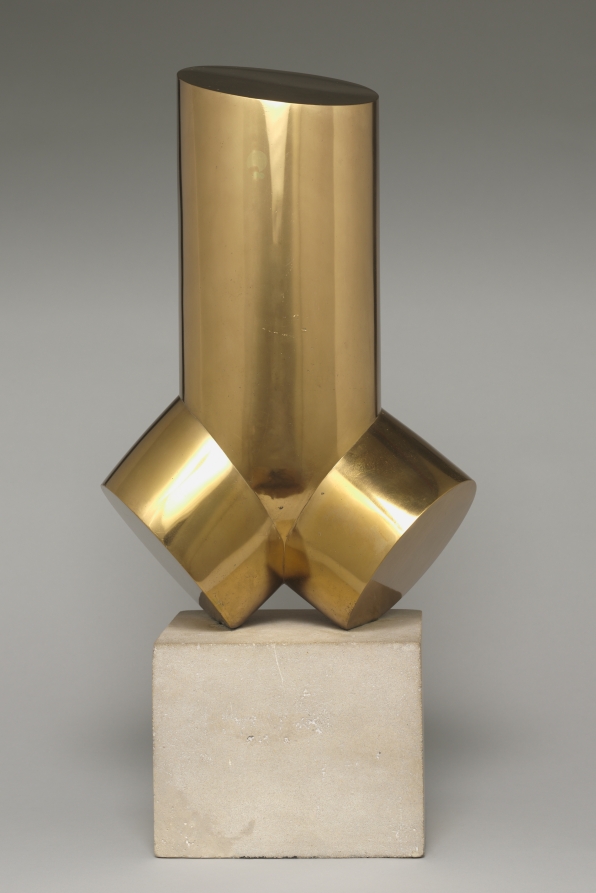
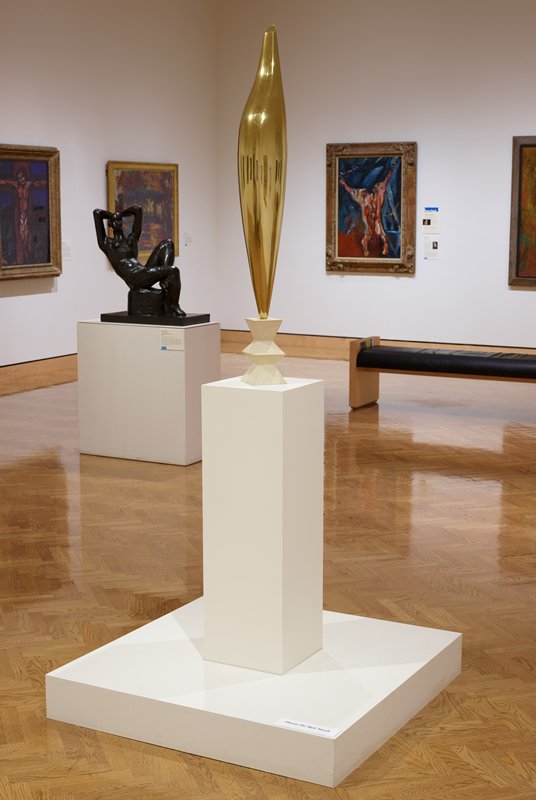
Golden Bird
Sulla scultura
Trained in both folk and academic traditions, Constantin Brancusi sought his own path for sculpture around 1907. Breaking with the currents of the time, he adopted direct carving, combined different materials for single works, and simplified form in his search for his subjects’ essential characters. His works have profoundly influenced the development of twentieth-century abstraction.
Continua a leggere
More than any other theme, Brancusi’s series Bird summarizes his quest for a self-sufficient form. “All my life, I have sought to render the essence of flight,” the artist once said. He began the first of twenty-seven Bird sculptures around 1910 and completed the last in the 1940s. He called the earliest variations Maiastra, referring to a bird in Romanian folklore that leads a prince to his princess. In the Art Institute’s Golden Bird, details such as feet, a tail, and an upturned crowing beak are only suggested in an elegant, streamlined silhouette. Brâncusi perched this refined shape on a rough-hewn, geometric base, contrasting the disembodied, light-reflective surface with an earthbound mass. The central polyhedron was cut from the middle of a tree trunk, and its circles (indicating the tree’s age) rotate like a sun, as if radiating light over the bird.
Art Institute of ChicagoCC BY 4.0

Scheda
- Numero di inventario
- 1990.88
Nel frattempo, nella vita di Constantin Brancusi
Tutta la vita1910s
“Mobile groups”: rearranging the sculptures
During the 1910s Brâncuși arranges sculptures and pedestals in changing compositions that he calls “mobile groups”: he moves the works and watches how each change alters the space around them. When he sells a sculpture he often puts a plaster version in the same position, and by the 1920s the studio is also an exhibition space whose arrangement forms part of the work.
1915–1917
The First World War: a refusal to serve
Brâncuși stays in Paris after the outbreak of World War I; in 1915 he donates works to an exhibition at Bernheim-Jeune that raises money for Polish artists affected by the war. As a Romanian citizen he remains liable for military service, but he refuses to serve in 1916 and receives a permanent exemption on 8 November 1917.
November 1919
Meeting Erik Satie
The writer Henri-Pierre Roché brings the composer Erik Satie, exactly ten years older than Brâncuși, to his studio together with Marcel Duchamp, beginning a friendship that lasts from 1919 to 1925. After dinner Brâncuși plays the violin for his guest, and Satie, in Roché’s words, teaches him verbal fencing, self-belief and clarity of thought.
January 1920
“Princess X” excluded from the Salon des Indépendants
In January 1920 the organizers of the Salon des Indépendants exclude “Princess X” (1915–1916) because they regard its shape as phallic. Fernand Léger and other friends of Brâncuși protest, the sculpture is returned to the exhibition, and the dispute leads to the manifesto “Pour l’indépendance de l’art”, signed by more than seventy artists and writers; Erik Satie signed the protest petition on 25 February 1920.