 Constantin BrancusiRomania, 1876–1957
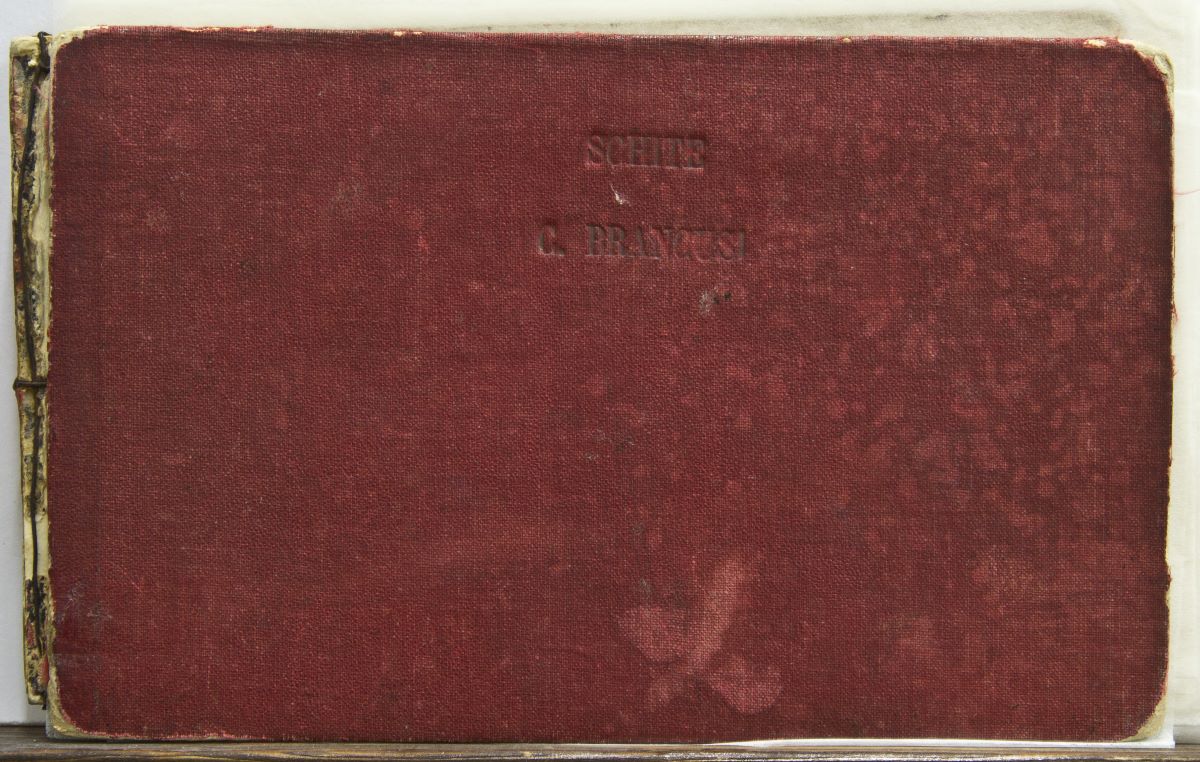
Carnet de schițe (conține 71 de file)
Si può vedere?
Non si sa
Dove si trova «Carnet de schițe (conține 71 de file)» oggi? Collezione: Museo nazionale d'arte della Romania, Bucharest. Non si sa.

Bucharest, Romania
Il proprietario è noto; non si sa se oggi sia esposta.
- Ultimo cambio di stato
- Fonte
- Il museo
Sull’opera
Con le parole del museo — in rumeno
Carnet de schițe: conține 71 de file între două coperți din carton îmbrăcate în pânză de culoare roșie. Pe prima copertă, mențiunea realizată prin procedeul imprimării în relief: Shițe C. Brâncuși
Museo nazionale d'arte della Romania
Scheda
Che cosa raffigura
In catalogo
Fonti
- Museo nazionale d'arte della Romania
- Immagine: Museo nazionale d'arte della Romania — CC BY-SA 4.0
Nella vita di Constantin Brancusi
Tutta la vita1898–1903
Bucharest: “Laocoön”, anatomy with Gerota, the “Écorché”
In 1898 Brâncuși enters the National School of Fine Arts in Bucharest: for the entrance examination he makes a charcoal drawing of a plaster “Laocoön and His Sons” (which he studies again in clay and plaster in 1900). His training includes anatomy lessons with the physician Dimitrie Gerota, under whose direction he completes the “Écorché”, a man without skin exposing the musculature, exhibited at the Romanian Athenaeum in 1903.
1903 – 14 July 1904
On foot from Bucharest to Paris
Later in 1903 Brâncuși leaves Bucharest for Western Europe, walking much of the way and working along the road to support himself; passing through Vienna, Munich and Basel, where he stays for a time, he arrives in Paris on 14 July 1904. Other accounts put his departure in 1902 and name poverty, indifference to his work and the coarse manners of his compatriots as the reasons.
1904
The first months in Paris: a dishwasher
During his first months in Paris Brâncuși works as a dishwasher at the Brasserie Chartier; when money is scarce, he assists at services in the Romanian Orthodox church on rue Jean-de-Beauvais.