 John Everett MillaisRoyaume-Uni, 1829–1896
Paix conclue
Peace Concluded
Peut-on la contempler ?
Oui, elle reçoit

Minneapolis Institute of Art
SalleG357Minneapolis, États-Unis
Présentée au public. Qui s’en porte garant est indiqué ci-dessous.
- Vérifié
- Dans cet état depuis
- Source
- Les données de collection du musée lui-même
About the painting
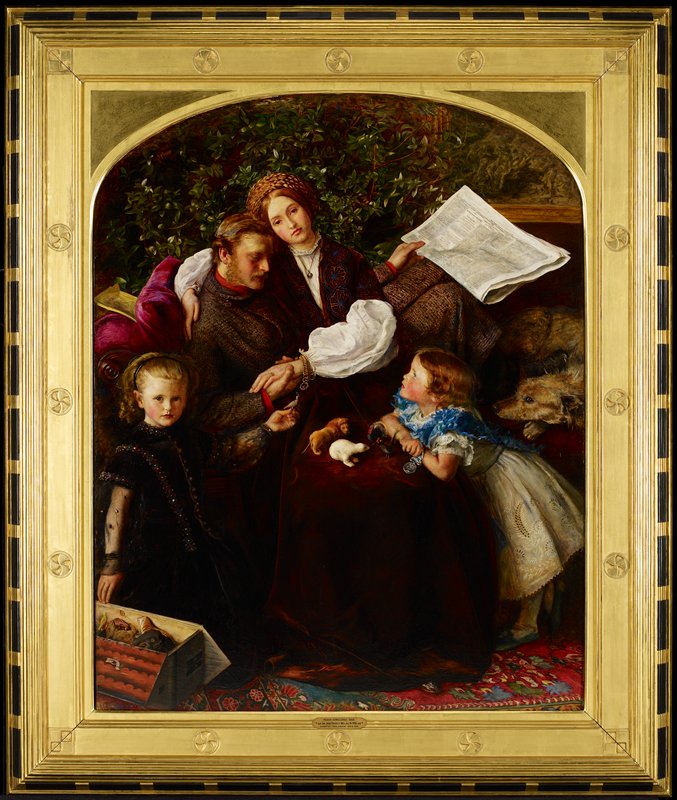
Paix conclue – ou en anglais Peace Concluded – est un tableau réalisé par le peintre britannique John Everett Millais en 1856. Cette huile sur toile est une scène de genre s'apparentant comme un portrait de famille.
La peinture représente un officier de retour parmi les siens alors que le Times vient de lui apprendre la fin de la guerre de Crimée. Tandis que son épouse l'enlace, leurs deux fillettes jouent avec des figurines animales qui symbolisent les participants au conflit qui s'achève: un lion pour le Royaume-Uni, un ours blanc pour la Russie, un dindon pour l'Empire ottoman et un coq pour la France, la colombe au rameau d'olivier évoquant quant à elle la paix retrouvée.
Read on
Exposée à la Royal Academy of Arts l'année de sa création, l'œuvre enthousiasme John Ruskin, qui compare alors l'artiste à Titien. Elle est désormais conservée au Minneapolis Institute of Art, à Minneapolis, dans le Minnesota, aux États-Unis.
In the museum's words
At first glance this appears to be a family portrait complete with realistic details of middle-class English decor. In fact, it is a staged scene of domestic harmony, celebrating the end of the Crimean War. The father, a wounded officer, holds a copy of the Times announcing the war's end. One daughter clasps his combat medal. On the mother's lap, four animals from the toy Noah's Ark represent the four belligerents: Britain (lion), Russia (bear), the Ottoman Empire (turkey), and France (rooster). The girl at the left holds a dove with an olive branch in its beak, a symbol of peace. Millais belonged to a group of English painters called the Pre-Raphaelite Brotherhood. Their work emphasized close observation of nature and the depiction of contemporary events.
Minneapolis Institute of Art
Notice
- Numéro d’inventaire
- 69.48
Au catalogue
Sources
- Minneapolis Institute of Art: the museum's own open data · obtenue il y a 7 jours
- Image : Minneapolis Institute of Art — public domain
Pendant ce temps, chez John Everett Millais
La vie entière3 juillet 1855
Married: Effie Gray
1855–1857
After his marriage he changes manner: faster and dearer
Marriage changed Millais: to support his growing family he began to paint more quickly and in greater quantity and to sell his pictures dearly, moving away from Pre-Raphaelite principles. Effie became a powerful promoter of his work, and together they secured commissions and widened their circle; he gained great popularity and a fortune (up to £30,000 a year), while William Morris and other critics accused him of selling out.
30 mai 1856
Son born: Sir Everett Millais, 2nd Baronet
1857
Ruskin calls “Sir Isumbras” a catastrophe
Ruskin called Sir Isumbras (1857), in which Millais had departed sharply from Pre-Raphaelite technique, not even a failure but a catastrophe.
19 septembre 1857
Son born: George Gray Millais
28 novembre 1858
Daughter born: Effie Gray Millais