
 John Everett MillaisRoyaume-Uni, 1829–1896
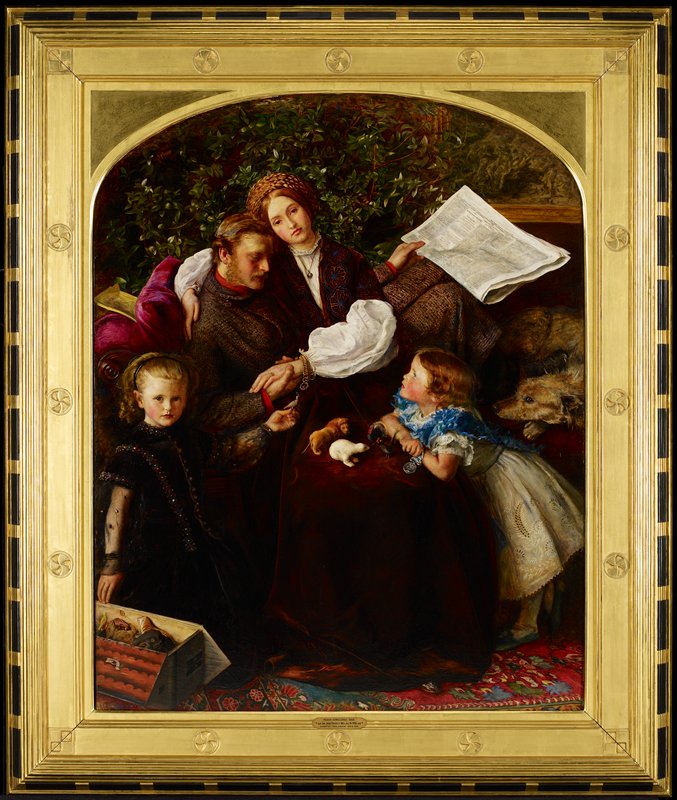
L'Ordre d'élargissement
The Order of Release
Peut-on la voir ?
Inconnu
Où est « L'Ordre d'élargissement » aujourd’hui ? Collection: National Gallery, Londres. Inconnu.

Londres, Royaume-Uni
Le propriétaire est connu ; on ignore si l’œuvre est exposée aujourd’hui.
- Dans cet état depuis
- Source
- Le musée
À propos du tableau
L'Ordre d'élargissement — en anglais The Order of Release, 1746 — est un tableau réalisé par le peintre britannique John Everett Millais en 1852-1853. De format vertical, cette huile sur toile est une peinture d'histoire préraphaélite qui représente la libération par son épouse d'un soldat jacobite blessé puis fait prisonnier à la bataille de Culloden, en 1746 en Écosse.
Lire plus
Vêtu d'un kilt des Highlands, l'homme y figure la tête posée sur l'épaule droite de la jeune femme qu'il retrouve, et qu'il enlace du bras gauche, l'autre étant immobilisé par une écharpe blanche. Le visage impassible, elle lui serre la main en portant une fillette endormie qui tient quant à elle une fleur jaune. Elle tend surtout à son geôlier, sur le bord gauche de la composition, l'ordre d'élargissement qui permet, la guerre finie, la reconstitution de la famille. Celle-ci réjouit leur chien, qui s'est dressé sur ses pattes arrière, au premier plan.
Don d'Henry Tate en 1898, l'œuvre est conservée à la Tate Britain, à Londres, en Royaume-Uni.
Notice
- Numéro d’inventaire
- NG1657
Au catalogue
Sources
- Wikidata
- Image : National Gallery — John Everett Millais · Public domain · Wikimedia Commons
Dans la vie de John Everett Millais
La vie entière1850
The scandal over “Christ in the House of His Parents”
Christ in the House of His Parents (1850) was judged excessively realistic, showing a working-class Holy Family in a messy carpentry workshop, and The Times called it outrageous. Millais was undaunted: the critic John Ruskin saw his outstanding talent at once and backed him, and his works were always accepted for the Academy’s exhibitions, however radical.
1853
Elected an associate member of the Royal Academy
In 1853 Millais was elected an associate member of the Royal Academy of Arts.
summer 1853
A summer at Glenfinlas: falling in love with Effie Ruskin
In the summer of 1853 John Ruskin and his wife Effie invited Millais to spend the summer with them at Glenfinlas, where Millais and Effie fell in love. Effie modelled for his The Order of Release; her marriage to Ruskin, which had lasted several years, was annulled after her parents realised something was wrong and she filed for annulment, and Millais and Effie then married.
3 juillet 1855
Married: Effie Gray
1855–1857
After his marriage he changes manner: faster and dearer
Marriage changed Millais: to support his growing family he began to paint more quickly and in greater quantity and to sell his pictures dearly, moving away from Pre-Raphaelite principles. Effie became a powerful promoter of his work, and together they secured commissions and widened their circle; he gained great popularity and a fortune (up to £30,000 a year), while William Morris and other critics accused him of selling out.
1857
Ruskin calls “Sir Isumbras” a catastrophe
Ruskin called Sir Isumbras (1857), in which Millais had departed sharply from Pre-Raphaelite technique, not even a failure but a catastrophe.



![Study of a Pottery Jug [recto], John Everett Millais, c. 1842](https://api.nga.gov/iiif/bd3617b6-ebda-468c-9b54-142851ab029e/full/!2400,2400/0/default.jpg)


