Frederic RemingtonEstados Unidos, 1861–1909
The Mexican Major
¿Se puede contemplar?
Por ahora no recibe

Instituto de Arte de Chicago
Chicago, Estados Unidos
Pertenece a la colección, pero ahora mismo no está expuesta.
- Comprobado
- En este estado desde
- Fuente
- El museo
Sobre el cuadro
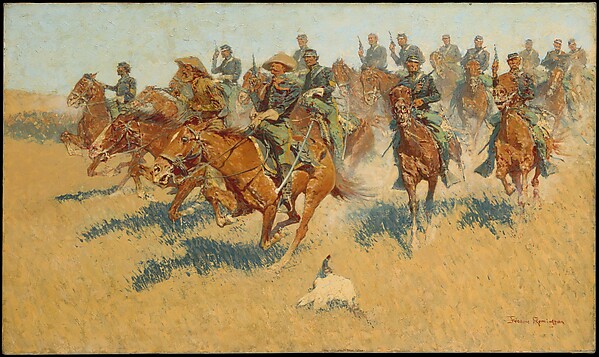
Frederic Remington was greatly impressed by the Mexican army, which he observed during a six-week visit to Mexico in 1889 in preparation for an article in Harper’s Weekly magazine. The Mexican Major is an elaborate, multifigural composition, designed to convey the professionalism, discipline, and “immensely picturesque” appearance of the officer and his regiment. Remington enjoyed the soldiers' ornate costumes, and he emphasized these through the use of rhythmic, flashing colors and the depiction of brilliant light. The line of horsemen stretches off into the far distance—a sign of honor, strength, and dignity.
Instituto de Arte de ChicagoCC BY 4.0
Ficha
- Número de inventario
- 1982.804
Lo que muestra
En el catálogo
Fuentes
- Instituto de Arte de Chicago
- Imagen: Instituto de Arte de Chicago — CC0
Mientras tanto, en la vida de Frederic Remington
La vida entera1887
Eighty-three illustrations for Theodore Roosevelt's book
He receives a commission to do eighty-three illustrations for Theodore Roosevelt's book Ranch Life and the Hunting Trail, to be serialized in The Century Magazine. The 29-year-old Roosevelt had a Western adventure similar to Remington's, losing money on a ranch in North Dakota the previous year. The assignment gives Remington's career a big boost and forges a lifelong connection with Roosevelt.
1887–1889
“Return of the Blackfoot War Party” at the National Academy
His full-colour oil painting Return of the Blackfoot War Party is exhibited at the National Academy of Design, and the New York Herald comments that Remington will one day be listed among America's great painters. Not all critics admire him, but his work is deemed distinctive and modern.
1889
A second-class medal at the Paris Exposition
He wins a second-class medal at the Paris Exposition: the American committee chose him to represent American painting over Albert Bierstadt, whose majestic large-scale landscapes with tiny figures of pioneers and Indians were by then considered passé. His status as the new trendsetter in Western art is solidified.
1890
At the scene of the Wounded Knee massacre
He arrives on the scene just after the massacre at Wounded Knee on the Pine Ridge Indian Reservation in South Dakota, in which about 150 Sioux, mostly women and children, were killed. In his report, “The Sioux Outbreak in South Dakota”, he hails the Army's “heroic” actions toward the Indians.
1890
First solo show at the American Art Galleries
Remington's first one-man show, twenty-one paintings at the American Art Galleries, is very well received. With success all but assured, he becomes established in society: his personality, his “pseudo-cowboy” manner of speaking and his “Wild West” reputation are strong social attractions. His biography falsely promoted some of the myths he encouraged about his Western experiences.
1890
Moves to New Rochelle: the house “Endion”
He and his wife move to New Rochelle, New York, for more living space and studio facilities and in the hope of getting more exercise; the town is close to New York's publishers and galleries yet rural enough for horseback riding. Remington calls their substantial Gothic revival house at 301 Webster Avenue, on Lathers Hill, Endion, an Ojibwa word meaning “the place where I live”; their neighbours in the artists' colony include writers, actors and artists.