Frederic RemingtonEstados Unidos, 1861–1909
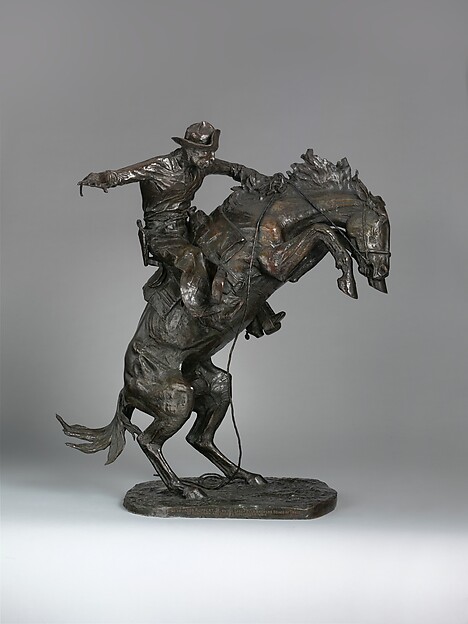
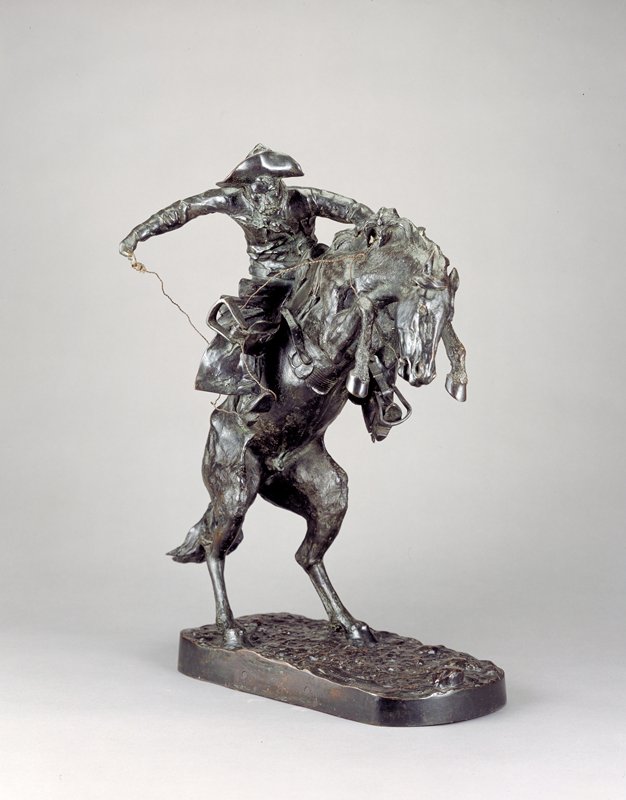
The Bronco Buster
¿Se puede contemplar?
Sí, recibe visitas

Instituto de Arte de Chicago
Sala161Chicago, Estados Unidos
Expuesta al público. Quién lo avala figura más abajo.
- Comprobado
- En este estado desde
- Fuente
- El museo
Sobre la escultura
A technical achievement in bronze, this composition of a cowboy attempting to tame a horse portrays an idea of the Western United States in dramatic and violent terms: white settler-colonialists in the act of subduing nature and flesh. As a painter and illustrator, Frederic Remington garnered success by crafting mythic, romanticized views of frontier life; The Bronco Buster was his first attempt to do so in sculpture. For white audiences living east of the Mississippi River at the turn of the 20th century, the artist's triumphant figures came to represent a singular—and distorted—vision of an unfamiliar American West.
Instituto de Arte de ChicagoCC BY 4.0
Ficha
- Número de inventario
- 1982.808
Lo que muestra
En el catálogo
Fuentes
- Instituto de Arte de Chicago
- Imagen: Instituto de Arte de Chicago — CC0
Mientras tanto, en la vida de Frederic Remington
La vida enteraSeptember 1893
“The Evolution of the Cowpuncher” with Owen Wister
In September 1893 Harper’s Monthly publishes “The Evolution of the Cowpuncher”, Remington’s collaboration with Owen Wister — the first statement of the mythical cowboy in American literature, which spawned the whole genre of Western fiction, films and theatre that followed. Remington supplied the concept, the factual content and the illustrations; Wister supplied the stories, sometimes altering Remington’s ideas.
January 1897
To Cuba as a correspondent for Hearst's paper
His association with Roosevelt, then New York City Police Commissioner, pays off: the artist is hired as a war correspondent and illustrator for William Randolph Hearst's New York Journal and sent to Cuba with the celebrity journalist Richard Harding Davis. Cuba's apparent peacefulness leaves them nothing to report; in a famous but probably apocryphal exchange of telegrams, Remington says there will be no war and he wishes to return, and Hearst replies that the artist should furnish the pictures and he will furnish the war. Remington returns to New Rochelle while Davis remains.
12 February 1897
The “Olivette Incident”: a sensational illustration
Shocked by the story of Clemencia Arango, who said she had been deported from Cuba for her revolutionary activities and strip-searched before boarding the Olivette, Davis dispatches the news to Hearst. The front page of the Journal for 12 February is dominated by Remington's sensationalist illustration, run across five columns, of Arango stripped naked on the ship's deck, surrounded by three Spanish officials; Hearst dubs it the “Olivette Incident”. The issue sells a record number of copies, almost a million, and the next day Arango calls Remington's version largely a fabrication, saying that only a single female police matron had inspected her, in a private setting.
1898
At war in Cuba: a heroic image shattered
As the Spanish–American War takes shape, he returns to Cuba to see military action for the first time and goes through the most wrenching, disillusioning experience of his life. Witnessing the assault on San Juan Hill by American forces, including those led by Roosevelt, he sees his heroic conception of war shattered by the actual horror of jungle fighting and the deprivations of camp. His reports and illustrations on his return focus not on heroic generals but on the troops.
1898
A bronze “Bronco Buster” as a gift to Roosevelt from the Rough Riders
When the Rough Riders return to the US they present their courageous leader Roosevelt with Remington's bronze statuette The Bronco Buster, which the artist calls the greatest compliment he ever had — after this everything will be mere fuss; Roosevelt replies that there could have been no more appropriate gift from such a regiment.
1900
Harper's drops him; he writes a novel
As an economy move, Harper's drops Remington as its star artist. To compensate for the lost work he writes and illustrates a full-length novel, The Way of an Indian, intended for serialization by a Hearst publication; his protagonist, a Cheyenne named Fire Eater, is a prototype Native American as viewed by Remington and many of his time.