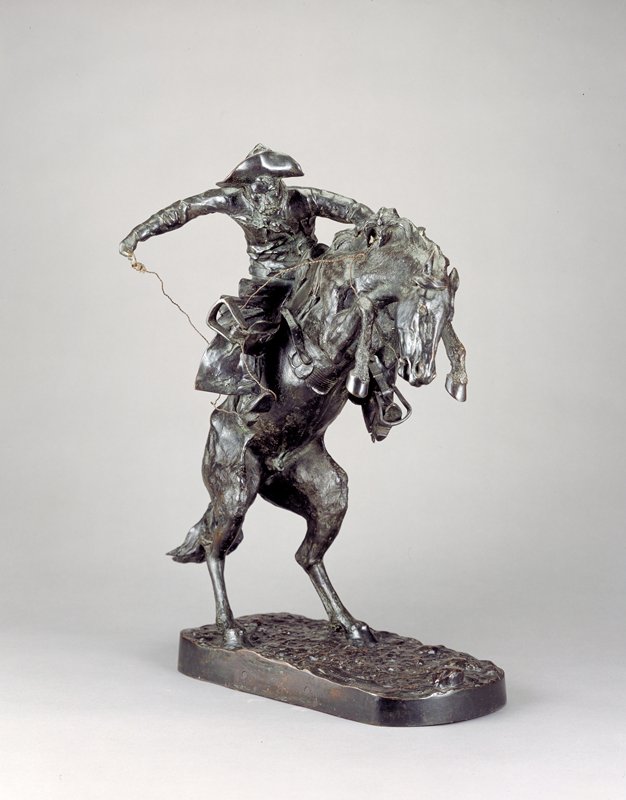
Frederic RemingtonEstados Unidos, 1861–1909
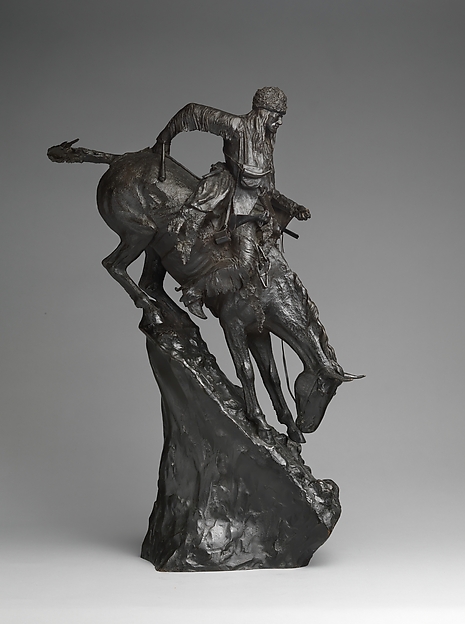
The Bear at Bay
¿Se puede contemplar?
Por ahora no recibe

Chicago, Estados Unidos
Pertenece a la colección, pero ahora mismo no está expuesta.
- Comprobado
- En este estado desde
- Fuente
- El museo
Ficha
- Número de inventario
- 1982.780
En el catálogo
Idas y venidas
Ahora no está expuesta
Instituto de Arte de Chicago · 28 sept 2026 — hoy · Verificado
Se desconoce si estaba expuesta
Instituto de Arte de Chicago · Sin confirmar
Fuentes
- Instituto de Arte de Chicago
- Imagen: Instituto de Arte de Chicago — © the artist or rights holder
Mientras tanto, en la vida de Frederic Remington
La vida entera1890s
From chronicler of the West to its historian
Gradually he transitions from the premier chronicler-artist of the Old West to its most important historian-artist. He forms an effective partnership with Owen Wister, who becomes the leading writer of Western stories of the time, and, more confident of his craft, writes that his drawing is done entirely from memory and that he no longer uses a camera: the interesting never occurs in nature as a whole but in pieces, and it is more what he leaves out than what he adds. He rarely depicts the gambling-hall and dance-hall scenes typical of Western movies and avoids frontier women; A Misdeal (1897) is a rare instance of indoor cowboy violence.
September 1893
“The Evolution of the Cowpuncher” with Owen Wister
In September 1893 Harper’s Monthly publishes “The Evolution of the Cowpuncher”, Remington’s collaboration with Owen Wister — the first statement of the mythical cowboy in American literature, which spawned the whole genre of Western fiction, films and theatre that followed. Remington supplied the concept, the factual content and the illustrations; Wister supplied the stories, sometimes altering Remington’s ideas.
1895
A busy year: a patent, boredom and a letter to Pyle
In this busy year Remington becomes further immersed in military matters, inventing a new type of ammunition carrier, but the War Department does not accept his patented invention. His favourite subject for magazine illustration is now military scenes, though he admits that cowboys are cash to him; he is growing bored with routine illustration and writes to Howard Pyle that he has done nothing but potboil of late (earlier, in a gesture of mutual respect, the two had exchanged paintings: Pyle's dead pirate for Remington's rough and ready cowpuncher). He works seven days a week, and is further irritated by the lack of his acceptance to regular membership by the Academy, likely because of his image as a popular, cocky artist.
1895
Grizzly hunting with Montague Stevens
He hunts grizzly bears with Montague Stevens in New Mexico.
1897
To Cuba as a correspondent for Hearst's paper
His association with Roosevelt, then New York City Police Commissioner, pays off: the artist is hired as a war correspondent and illustrator for William Randolph Hearst's New York Journal and sent to Cuba with the celebrity journalist Richard Harding Davis. Cuba's apparent peacefulness leaves them nothing to report; in a famous but probably apocryphal exchange of telegrams, Remington says there will be no war and he wishes to return, and Hearst replies that the artist should furnish the pictures and he will furnish the war. Remington returns to New Rochelle while Davis remains.
12 February 1897
The “Olivette Incident”: a sensational illustration
Shocked by the story of Clemencia Arango, who said she had been deported from Cuba for her revolutionary activities and strip-searched before boarding the Olivette, Davis dispatches the news to Hearst. The front page of the Journal for 12 February is dominated by Remington's sensationalist illustration, run across five columns, of Arango stripped naked on the ship's deck, surrounded by three Spanish officials; Hearst dubs it the “Olivette Incident”. The issue sells a record number of copies, almost a million, and the next day Arango calls Remington's version largely a fabrication, saying that only a single female police matron had inspected her, in a private setting.