ART WIKI32.963 en sala
MapaColecciónArtistasMuseosExposicionesRevista
Acceder

ART WIKI

Dónde cuelga la obra maestra y cuándo le dejan pasar.

Colecciones: Galería Nacional de Arte, Galería Nacional de Dinamarca, Galería Nacional de Retratos, Galería Tretiakov, Harvard Art Museums, Instituto de Arte de Chicago, Instituto de Artes de Mineápolis, MoMA, Museo de Arte de Cleveland, Museo de Victoria y Alberto, Museo del Hermitage, Museo del Louvre, Museo Estatal Ruso, Museo Hirshhorn y Jardín de Esculturas, Museo J. Paul Getty, Museo Metropolitano de Arte, Museo Pushkin, Museo Smithsoniano de Arte Americano, Museo Whitney de Arte Estadounidense, National Museum of Asian Art, Rijksmuseum, Villa Getty, Catálogo Estatal del Fondo Museístico de Rusia (274 museos), Europeana (19 museos), Wikidata (6 museos), Paris Musées (12 museos) y Joconde, la base de museos del Ministerio de Cultura de Francia (495 museos). Las imágenes pertenecen a sus titulares de derechos.

Secciones

  • Mapa
  • Búsqueda
  • Colección
  • Obras maestras
  • Expuestas ahora
  • Artistas

Más

  • Museos y galerías
  • Exposiciones
  • Revista
  • De dónde salen los datos
  • Privacidad y cookies
InicioMapaCatálogo
  1. Colección/
  2. Instituto de Arte de Chicago/
  3. Slave Market
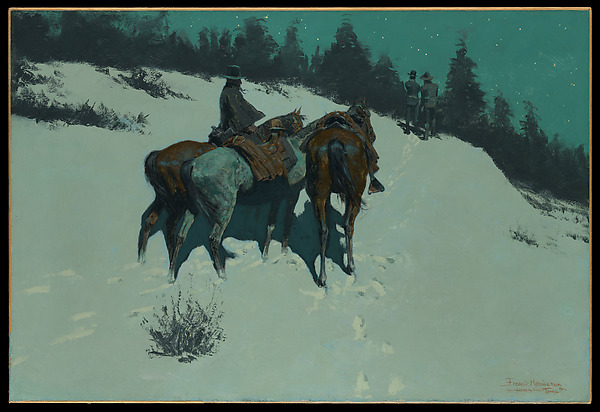
Slave Market, Frederic Remington, 1893
Frederic Remington, retratoFrederic RemingtonEstados Unidos, 1861–1909

Slave Market

1893 · Painting

¿Se puede contemplar?

Por ahora no recibe

Instituto de Arte de Chicago

Chicago, Estados Unidos

Pertenece a la colección, pero ahora mismo no está expuesta.

Comprobado
hace 3 días
En este estado desde
19 ago 2026
Fuente
El museo
En el mapaPágina del museo

Ficha

1893 · a los 32 años
18611909
Número de inventario
1982.800

En el catálogo

PinturaÓleoPintura estadounidenseImpresionismoSiglo XIXEstados Unidos

Fuentes

  • Instituto de Arte de Chicago
  • Imagen: Instituto de Arte de Chicago — CC0

Mientras tanto, en la vida de Frederic Remington

La vida entera
  1. 1890s

    From chronicler of the West to its historian

    Gradually he transitions from the premier chronicler-artist of the Old West to its most important historian-artist. He forms an effective partnership with Owen Wister, who becomes the leading writer of Western stories of the time, and, more confident of his craft, writes that his drawing is done entirely from memory and that he no longer uses a camera: the interesting never occurs in nature as a whole but in pieces, and it is more what he leaves out than what he adds. He rarely depicts the gambling-hall and dance-hall scenes typical of Western movies and avoids frontier women; A Misdeal (1897) is a rare instance of indoor cowboy violence.

  2. September 1893

    “The Evolution of the Cowpuncher” with Owen Wister

    In September 1893 Harper’s Monthly publishes “The Evolution of the Cowpuncher”, Remington’s collaboration with Owen Wister — the first statement of the mythical cowboy in American literature, which spawned the whole genre of Western fiction, films and theatre that followed. Remington supplied the concept, the factual content and the illustrations; Wister supplied the stories, sometimes altering Remington’s ideas.

  3. 1895

    A busy year: a patent, boredom and a letter to Pyle

    In this busy year Remington becomes further immersed in military matters, inventing a new type of ammunition carrier, but the War Department does not accept his patented invention. His favourite subject for magazine illustration is now military scenes, though he admits that cowboys are cash to him; he is growing bored with routine illustration and writes to Howard Pyle that he has done nothing but potboil of late (earlier, in a gesture of mutual respect, the two had exchanged paintings: Pyle's dead pirate for Remington's rough and ready cowpuncher). He works seven days a week, and is further irritated by the lack of his acceptance to regular membership by the Academy, likely because of his image as a popular, cocky artist.

  4. 1895

    Grizzly hunting with Montague Stevens

    He hunts grizzly bears with Montague Stevens in New Mexico.

  5. 1895

    To Florida to see the “Florida crackers”

    He heads south, and his illustrations and article on the “Florida crackers” (cowboys) are published in Harper's magazine.
Más obras de Frederic Remington

Todas las obras
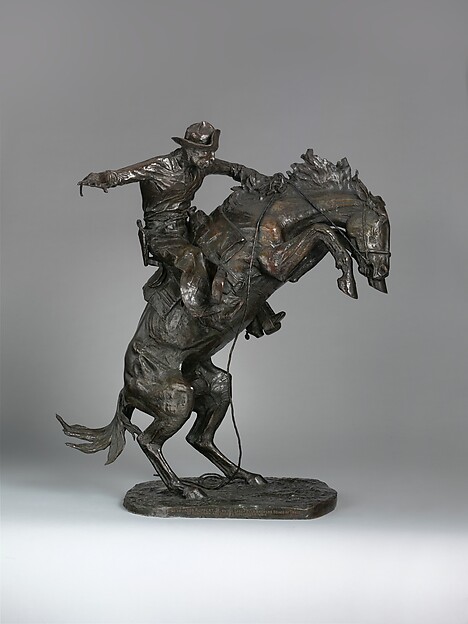
The Broncho Buster, Frederic Remington, 1895, revised 1909, cast by November 1910

The Broncho Buster

1895, revised 1909, cast by November 1910 · Museo Metropolitano de Arte

A Reconnaissance, Frederic Remington, 1902

A Reconnaissance

1902 · Museo Metropolitano de Arte

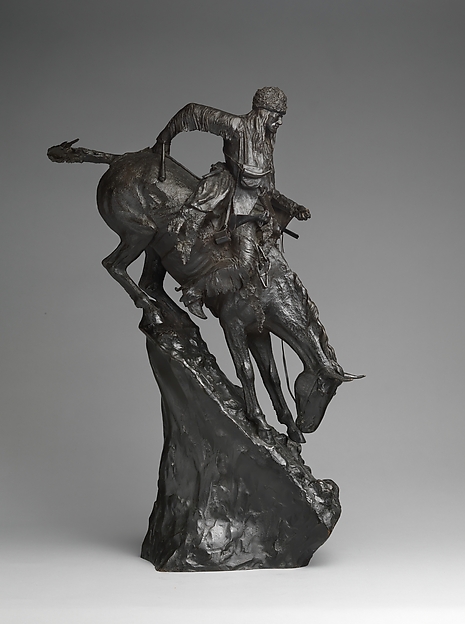
The Mountain Man, Frederic Remington, 1903, cast by March 1907

The Mountain Man

1903, cast by March 1907 · Museo Metropolitano de Arte

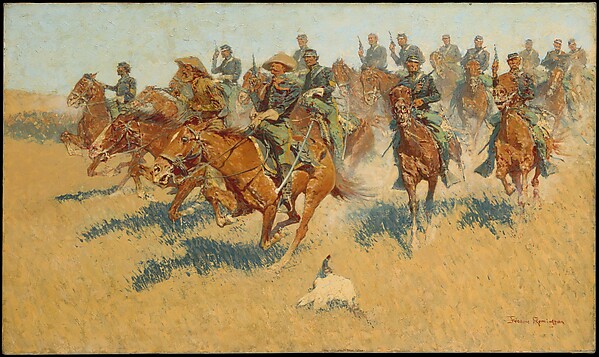
On the Southern Plains, Frederic Remington, 1907

On the Southern Plains

1907 · Museo Metropolitano de Arte

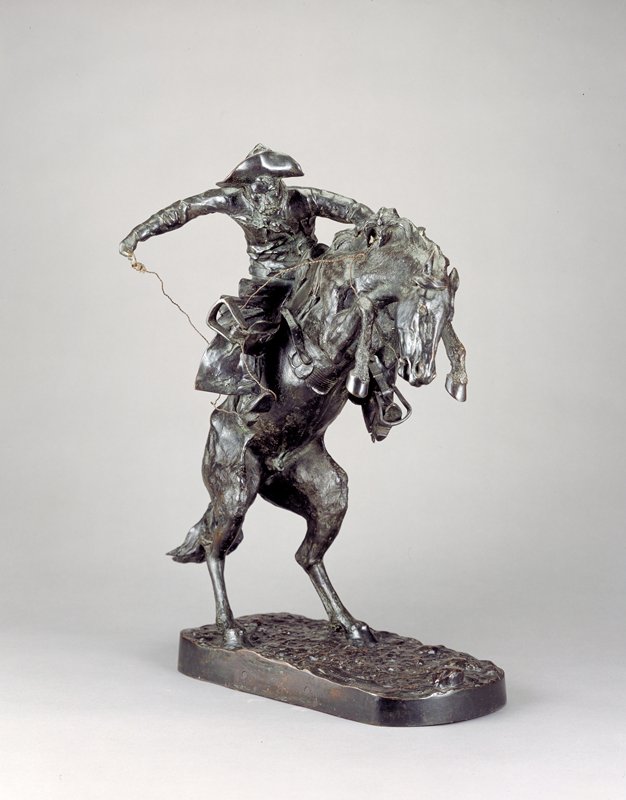
The Bronco Buster, Frederic Remington, Modeled 1895, cast 1899

The Bronco Buster

Modeled 1895, cast 1899 · Instituto de Arte de Chicago

Bronco Buster, Frederic Remington, 1895 (cast 1918 or later)

Bronco Buster

1895 (cast 1918 or later) · Instituto de Artes de Mineápolis

On the Bridle Path, Central Park, New York, Frederic Remington, 1889

On the Bridle Path, Central Park, New York

1889 · No expuesta · Galería Nacional de Arte

Off the Range (Coming Through the Rye), Frederic Remington, model 1902, cast 1903

Off the Range (Coming Through the Rye)

model 1902, cast 1903 · No expuesta · Galería Nacional de Arte

Bajo el mismo techo: Instituto de Arte de Chicago

Página del museo
The Bedroom, Vincent van Gogh, 1889

Vincent van Gogh

The Bedroom, 1889

A Sunday on La Grande Jatte — 1884, Georges Seurat, 1884–86, border added 1888–89

Georges Seurat

Tarde de domingo en la isla de la Grande Jatte, 1884–86, border added 1888–89

Paris Street; Rainy Day, Gustave Caillebotte, 1877

Gustave Caillebotte

Calle de Paris, dia de lluvia, 1877

Two Sisters (On the Terrace), Pierre-Auguste Renoir, 1881

Pierre-Auguste Renoir

En la terraza, 1881

The Basket of Apples, Paul Cézanne, c. 1893

Paul Cézanne

Cesto de manzanas, c. 1893

Stacks of Wheat (End of Summer), Claude Monet, 1890–91

Claude Monet

Stacks of Wheat (End of Summer), 1890–91

American Gothic, Grant Wood, 1930

Grant Wood

American Gothic, 1930

Nighthawks, Edward Hopper, 1942

Edward Hopper

Noctámbulos, 1942