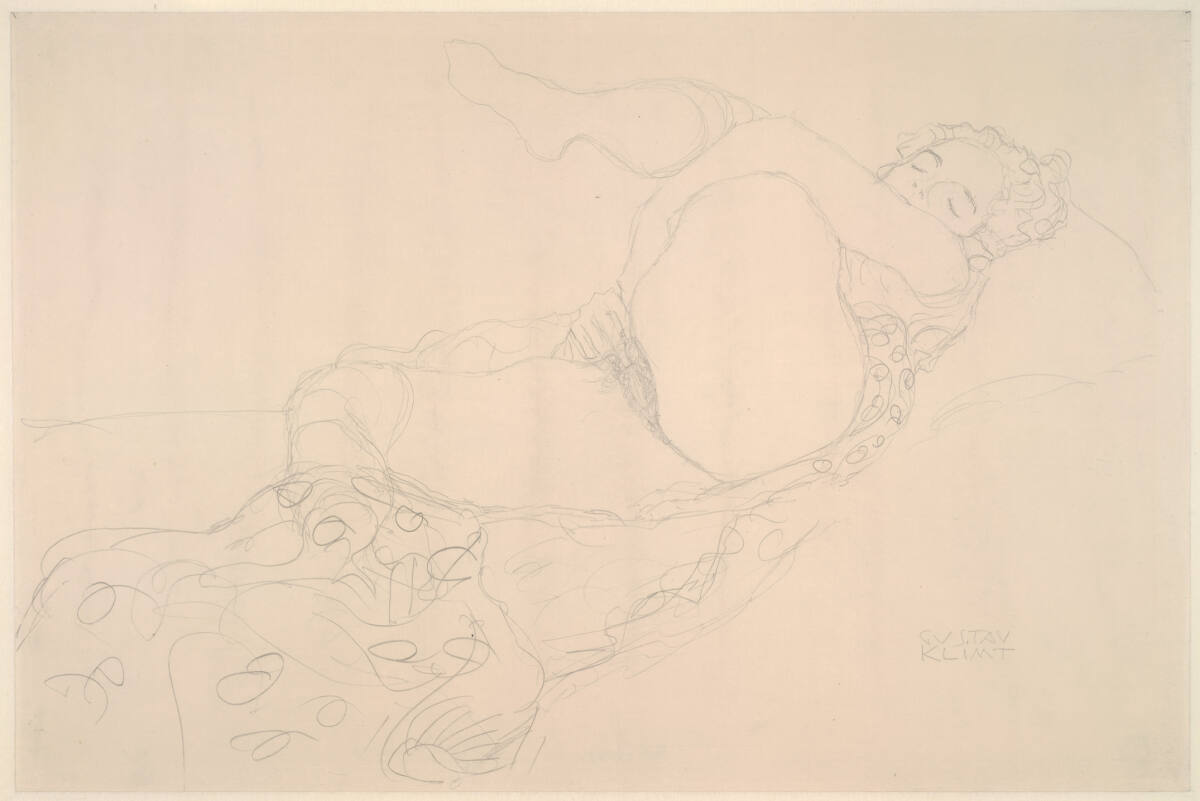
 Gustav KlimtAustria, 1862–1918
Liegender Halbakt
¿Se puede contemplar?
Se desconoce

Viena, Austria
Se conoce el propietario; no se sabe si hoy está expuesta.
- En este estado desde
- Fuente
- El museo
Ficha
En el catálogo
Fuentes
- Albertina
- Imagen: Albertina — Public Domain Mark 1.0
Mientras tanto, en la vida de Gustav Klimt
La vida entera1897–1917
Society portraits of Viennese ladies
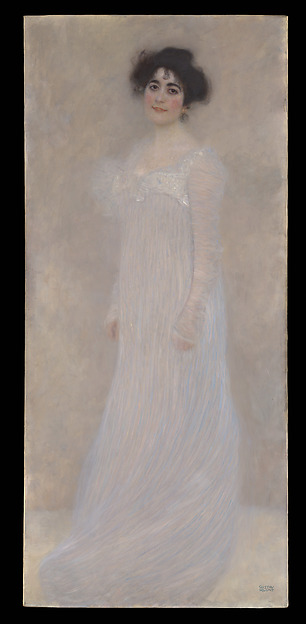
Over twenty years Klimt painted nearly twenty society portraits of women, which gave him financial independence; Carl Moll introduced him to many of the sitters, most of them from the Jewish upper bourgeoisie. In the portraits the ladies are hidden in sumptuous clothing, their heads and hands seeming to float detached from reality.
1908–1914
Galerie Miethke: a portfolio of reproductions of Klimt's work
Galerie Miethke, headed by Carl Moll and Klimt's exclusive agent, began after the 1908 Kunstschau to issue a portfolio of reproductions to promote Klimt abroad — five instalments of ten plates each. Klimt chose the works and approved the quality of the reproductions himself; the fifth instalment was never produced.
1910
Klimt at the Venice Biennale
Klimt's exhibition at the 1910 Venice Biennale influenced the artistic scene of Venice; the Italian Liberty artists Galileo Chini and Vittorio Zecchin were among those he influenced.
1911
“Death and Life”: first prize in Rome
At the world exhibition in Rome “Death and Life” won first prize. In 1915 Klimt reworked the painting, changing the gold background to blue.
1911
A studio in Hietzing
Klimt moved his studio closer to nature, to a one-storey house near Schönbrunn Park; he recorded its garden in “The Rose Garden” (1912). Here, among woodcuts, Japanese costumes and samurai armour, he began a new period and worked for the last six years of his life.
1915
Death of his mother
His mother, Anna Klimt, died; Gustav continued to live on Westbahnstrasse with his two unmarried sisters.