 Gustav KlimtAustria, 1862–1918
Esperanza II
Hope, II
¿Se puede contemplar?
Sí, recibe visitas

Expuesta al público. Quién lo avala figura más abajo.
- Comprobado
- Fuente
- El museo
Sobre el cuadro
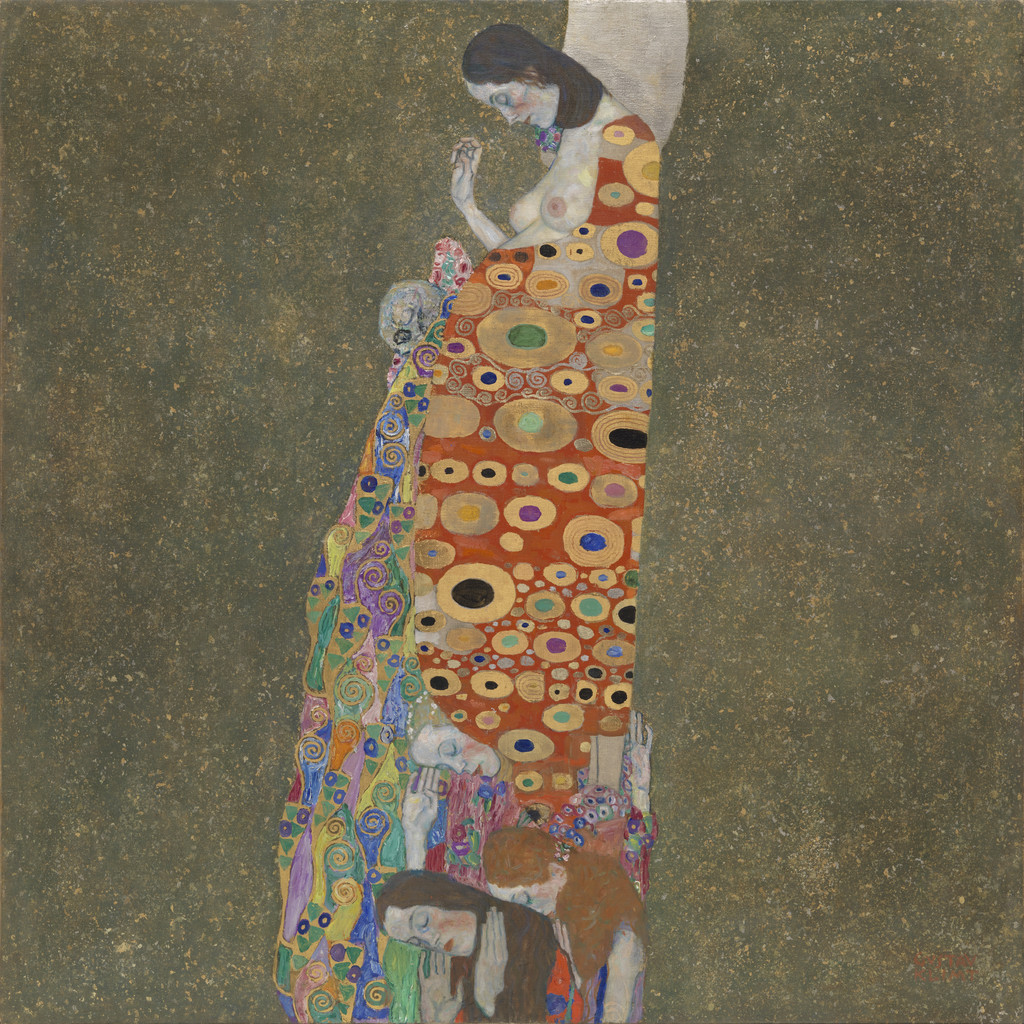
Esperanza II (en alemán, Die Hoffnung II) es una pintura de Gustav Klimt, realizada en 1907–08. Fue el segundo trabajo de Klimt centrado en una mujer embarazada, ambos describiendo a Herma, una de sus modelos favoritas. Fue titulado Visión por Klimt, pero es más conocido como Esperanza II después del trabajo anterior Esperanza, que se denomina Esperanza I. Esperanza II fue adquirido por el Museo de Arte Moderno de Nueva York en 1978.
Seguir leyendo
Klimt muestra a Herma en Esperanza I de 1903, desnuda en avanzado estado de gestación. En Esperanza II, lleva un vestido largo o manto decorado con formas geométricas. Tiene el cabello castaño, liso y arrollado al cuello y los ojos cerrados, inclinando la cabeza con gesto resignado hacia sus pechos desnudos y vientre prominente. Un cráneo humano incongruente aparece sobre él – quizás una señal de los peligros del embarazo y parto, o más probablemente un memento mori (en Esperanza I, es también acompañada por un esqueleto y varias figuras tétricas). A sus pies, tres mujeres se perciben sobre la tela también inclinando sus cabezas y las manos alzadas, como rogando o meditando.
La pintura cuadrada mide 110,5 por 110,5 centímetros. Las mujeres ocupan el tercio central de la pintura, con un fondo de oro oscuro moteado a cada lado. La ropa de la mujer, decorada con pan de oro como una obra de arte bizantina y ricamente pintada y estampada, pero plana como un icono ortodoxo, contrasta con el naturalismo de los rostros humanos y la pálida carne delicadamente pintados, y también con el tono más oscuro del fondo. Un contraste típico en sus obras de la etapa "dorada".
Esperanza II fue exhibido en la primera Viena Kunstschau en 1908. Debido al crudamente escandaloso desnudo de su figura central, Esperanza I no fue exhibido hasta la segunda Viena Kunstschau el año siguiente.
La pintura fue comprada por Eugenie Primavesi antes de diciembre de 1914, y fue vendido a finales de los años 1930 a la Neue Galerie de Otto Kallir o a su sucesora Vita Künstler. Permaneció en colecciones privadas hasta 1978, cuando fue vendido por Hans Barnas al Museo de Arte Moderno (MOMA) de Nueva York.
Ficha
- Número de inventario
- 468.1978
Mientras tanto, en la vida de Gustav Klimt
La vida entera1900–1907
He returns the advance and keeps the paintings
The state commission refused to accept the three “Faculty Paintings”; Klimt told the minister he would return the 60,000-krone advance, refused to work for the Austrian state again and kept the pictures. The ministry demanded them, but Klimt did not open the door to the removal men — and the affair ended in his victory.
1905
Klimt and his group leave the Secession
Klimt and his “stylist” followers, who held that art should enter every sphere of life, fell out with the “naturalists”; the decision against Klimt's group was carried by a single vote. For the next three years the group had no joint exhibitions.
1906
The “Kunstschau” group
A year after the split Klimt formed the “Kunstschau” group, or “Klimt group”, which included Carl Moll, Otto Wagner and other leading Austrian artists.
1908
Klimt defends Kokoschka
The public and critics fell on the debutant Oskar Kokoschka so fiercely that the scandal of the “Faculty Paintings” came to mind; Klimt did not turn away from his pupil and defended his place in the show even if it were to be closed. Hevesi granted him talent but denied him taste; Klimt replied that art has nothing to do with taste.
1 June – 16 November 1908
The first Vienna Art Show
For the sixtieth anniversary of Franz Joseph's reign pavilions with 54 rooms were built on a temporary site and over 900 works shown. Room 22, which Peter Altenberg called “the church of modern art named after Gustav Klimt”, held “The Kiss”, “Adele Bloch-Bauer I”, “Danaë” and “The Three Ages of Woman”.