Camille CorotFrench, 1796–1875
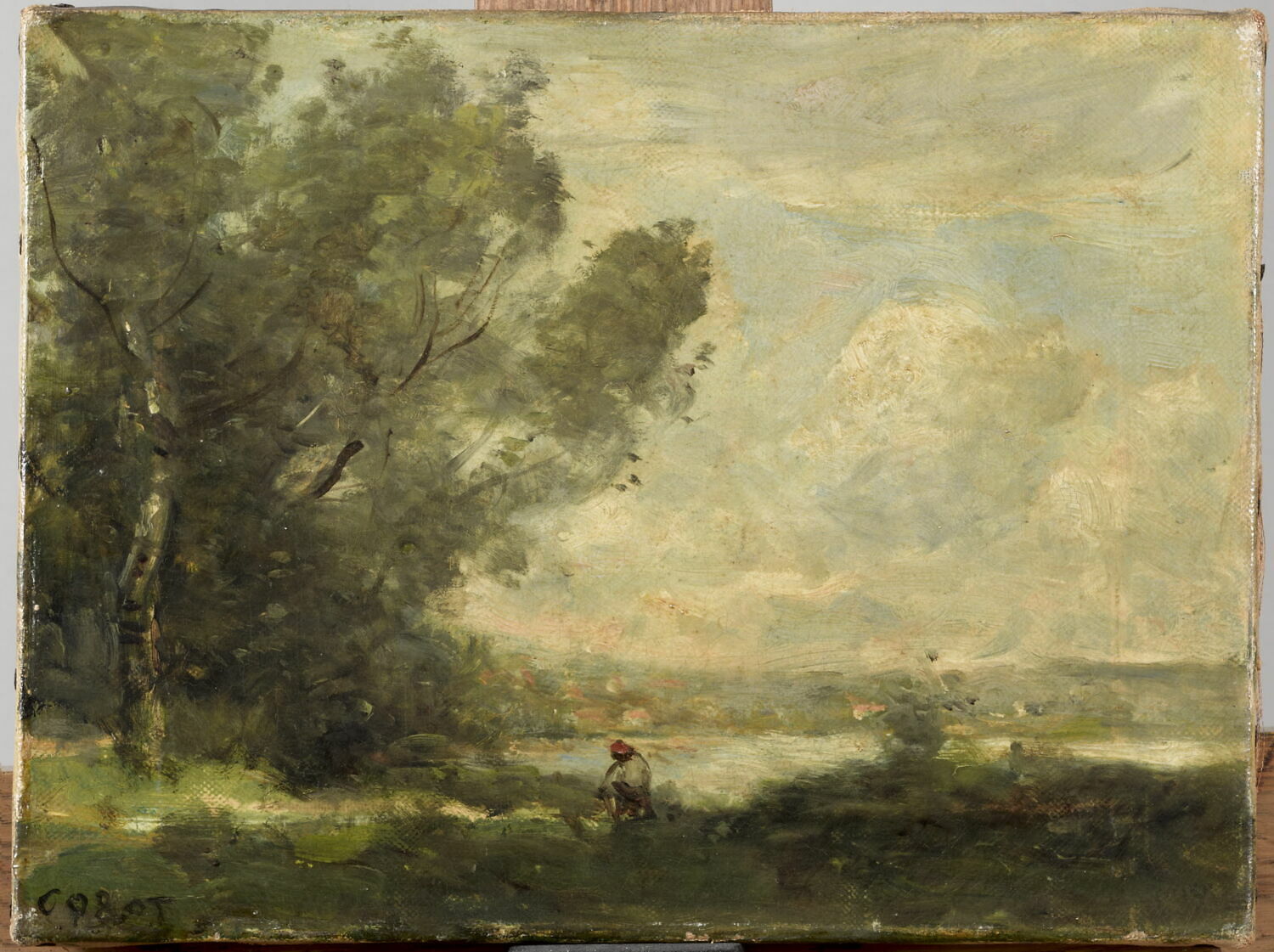
Evening
Can I see it?
Not on view at present
Where is “Evening” now? Collection: State Hermitage Museum, Saint Petersburg. Not on view at present. Checked August 29, 2026.

Saint Petersburg, Russia
It belongs to the collection, but is not on display at present.
- Checked
- In this state since
- Source
- The museum
About the painting
Museum text in Russian
Камиль Коро занимает особое место во французском искусстве XIX в. Продолжая традиции западноевропейской пейзажной живописи, он оказал влияние на формирование творчества импрессионистов - Моне, Сислея, Писсарро. "Вечер" - одна из типичных работ Коро. В ней соединились классическая ясность композиционного решения, романтическая эмоциональность восприятия природы и реалистические наблюдения в передаче эффектов освещения. Композиция картины построена на контрасте между погруженным в полумрак передним планом и светлой далью. Высокие деревья, выделяясь темными силуэтами на фоне розовато-желтых облаков, образуют кулисы, в просвете между которыми открывается далекая панорама. Теплый свет заходящего солнца скользит по листве деревьев и окрашивает небо на горизонте в жемчужно-золотистые тона. Маленькие фигуры в произведениях Коро (в пейзаже "Вечер" - собирательницы хвороста) связывают творчество художника с работами Жана-Франсуа Милле, Гюстава Курбе и живописцев барбизонской школы.
State Hermitage Museum
Details
- Accession number
- ГЭ-3890
In the catalog
Sources
- State Hermitage Museum
- Image: State Hermitage Museum — Museum open access
In the life of Camille Corot
The whole life1807–1812 · Education
Lycée Pierre-Corneille
1822
His father consents to an artist's career
At 26 Corot won his father's consent to adopt the profession of art; he later recalled telling his father that business and he were simply incompatible and that he was getting a divorce.
1825–1828
First trip to Italy
With his parents' support Corot went to Italy to study the Renaissance masters and draw the crumbling monuments of antiquity; his parents' condition was that he paint a self-portrait for them, his first. In three years he completed over 200 drawings and 150 paintings, worked and travelled with several young French painters, and spent most of his time around Rome and in the Italian countryside.
1827
Salon debut: “View at Narni”
In 1827 Corot sent his first painting to the Salon, “View at Narni”. He transformed a quick study of a ruined Roman aqueduct in bright sun into an idyllic pastoral setting with giant shade trees and green lawns, a conversion meant to appeal to the Neoclassical jurors.
1835
A sensation at the Salon: “Hagar in the Wilderness”
In 1835 Corot created a sensation at the Salon with his biblical painting “Hagar in the Wilderness”, showing Hagar and the child Ishmael dying of thirst until saved by an angel; his bold, fresh statement of the Neoclassical ideal succeeded with the critics. The biblical and mythological subjects that followed did not succeed as well, as the critics found him wanting in comparison with Poussin.
22 February 1875
Died