Camille CorotFrench, 1796–1875
Hagar in the Wilderness
May one see it?
Yes, receiving visitors

The Metropolitan Museum of Art
Room802New York, United States
On public display.
- Checked
- 4 hours ago
- In this state since
- Sep 26, 2026
- Source
- The museum's own collection data
About the painting
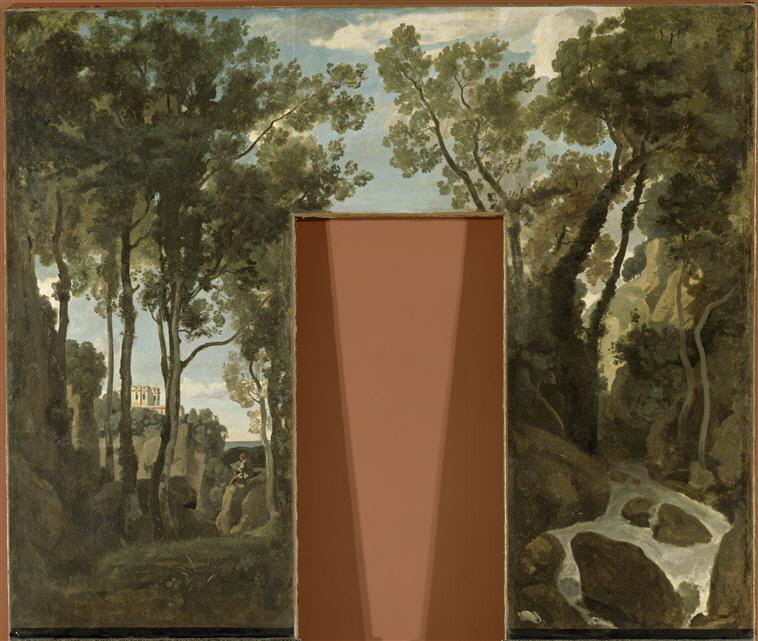
Hagar in the Wilderness is an oil-on-canvas painting by the French artist Camille Corot, created in 1835. The picture was displayed at the Salon of 1835 held in Paris. It is in the collection of the Metropolitan Museum of Art, in New York.
Particulars
- Accession number
- 38.64
What it shows
Sources
- The Metropolitan Museum of Art: the museum's own open data · fetched 4 days ago
- Image: The Metropolitan Museum of Art — Open Access (CC0)
Meanwhile, in the life of Camille Corot
The whole life1828–1834
Chasing the Salon: Normandy, portraits and first commissions
Between his first and second Italian trips Corot concentrated on preparing large landscapes for the Salon, often adapting his Italian oil sketches, reworked in the studio, according to Neoclassical principles. Away from the studio he travelled throughout France, returned to the Normandy coast and to Rouen, painted portraits of friends and relatives and received his first commissions; one of the most successful, a portrait of his niece Laure Sennegon in powder blue, was later donated to the Louvre.
1831–1833
A cool reception at the Salon and a decision to return to Italy
Corot exhibited one portrait and several landscapes at the Salon in 1831 and 1833. The critics received them coolly, and having failed to satisfy them with his Neoclassical themes, he decided to return to Italy.
1834
Second trip to Italy
In 1834 Corot made his second trip to Italy. The study “Morning in Venice”, dated to the same year, is now in the Pushkin Museum of Fine Arts.
1835
A sensation at the Salon: “Hagar in the Wilderness”
In 1835 Corot created a sensation at the Salon with his biblical painting “Hagar in the Wilderness”, showing Hagar and the child Ishmael dying of thirst until saved by an angel; his bold, fresh statement of the Neoclassical ideal succeeded with the critics. The biblical and mythological subjects that followed did not succeed as well, as the critics found him wanting in comparison with Poussin.