 Rembrandt van RijnDutch, 1606–1669
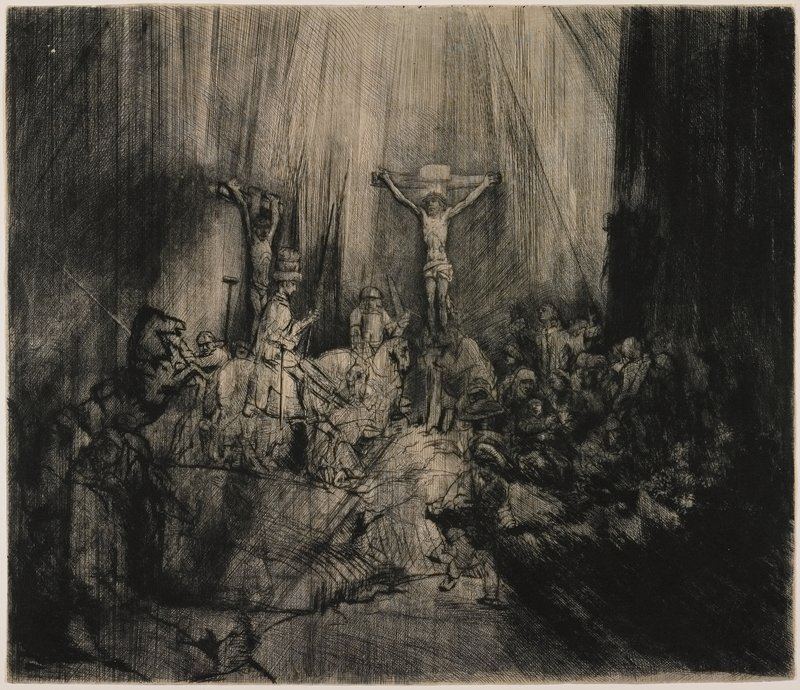
The Three Crosses
Can I see it?
Not on view at present
Where is “The Three Crosses” now? Collection: Minneapolis Institute of Art, Minneapolis. Not on view at present. Checked October 12, 2026.

Minneapolis, United States
It belongs to the collection, but is not on display at present.
- Checked
- In this state since
- Source
- The museum
About the work
Rembrandt's grand interpretation of the Crucifixion probably developed in tandem with his Christ Presented to the People. It started out as an operatic extravaganza performed in a radiating cone of light. Rembrandt's revision of the Crucifixion scene was even more radical than his obliteration of the crowd in the judgment scene.
He changed many details of the image. The horse in the earlier version has been reversed and received a rider in this later one. The centurion no longer looks up at Christ; instead, he bows his head in remorse. But most dramatically, Rembrandt took his etching needle firmly in hand to lacerate the printing plate, throwing the scene into chaos and darkness. He had never executed anything like this before or after. In fact, nothing would truly compare until the advent of expressionist art in the 20th century.
Minneapolis Institute of Art
Details
- Accession number
- P.12, 614
In the catalog
Sources
- Minneapolis Institute of Art
- Image: Minneapolis Institute of Art — public domain
In the life of Rembrandt van Rijn
The whole life1631–1669 · Workplace
Amsterdam
1639–1658 · Residence
Rembrandt House Museum
1654
Birth of His Daughter Cornelia
In 1654 Rembrandt and Hendrickje's daughter Cornelia was born; the parish council censured Hendrickje for "sinful cohabitation" with the artist.
1654
Daughter born: Cornelia van Rijn
July 1656
Declaration of Insolvency
Under pressure from creditors, Rembrandt declared himself insolvent (cessio bonorum) in July 1656 and voluntarily surrendered his property; by that time he had already transferred the house to his son.
1657–1658
Sale of His Property and Collection
Rembrandt's property and art collection were sold at auction; the detailed inventory listed 363 items — paintings, prints, antique busts, weapons, textiles, and exotic objects.









