 Francisco de GoyaSpanish, 1746–1828
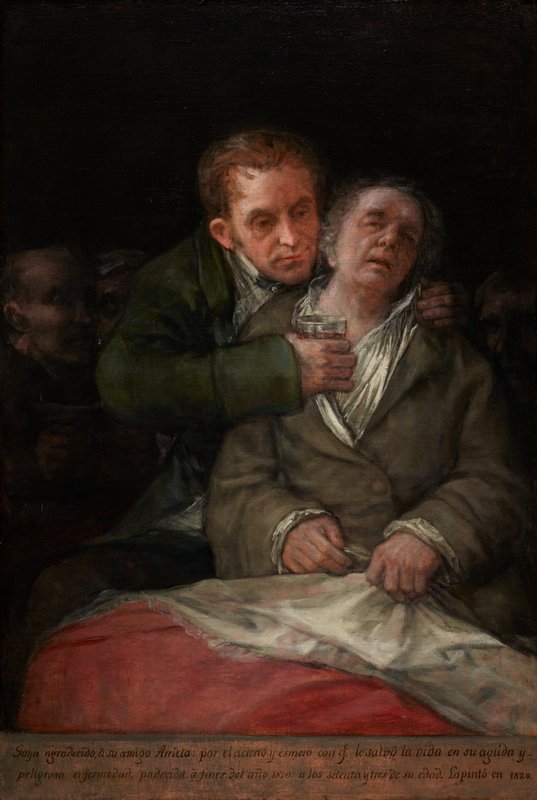
Self-Portrait with Dr. Arrieta
May one see it?
Yes, receiving visitors

Minneapolis Institute of Art
RoomG306Minneapolis, United States
On public display.
- Checked
- 4 hours ago
- In this state since
- Sep 25, 2026
- Source
- The museum's own collection data
About the painting
Self-Portrait with Dr Arrieta is the English title given to a painting by Spanish artist Francisco Goya. The work is an oil on canvas, painted in 1820, and is currently held in the Minneapolis Institute of Art, Minnesota. Many scholars have seen religious themes in the work. Other interpretations compare and contrast the painting with Goya's series of Black Paintings, contextualizing the work within his career at large.
In the museum's words
As court painter to both Charles III and Charles IV of Spain, Goya achieved considerable fame as a portraitist. Self-Portrait with Dr. Arrieta, the last of his many self-portraits, was executed late in his life. In 1819, Goya had fallen seriously ill and his doctor, Eugenio Garc’a Arrieta, nursed him back to health. On recovering, he presented Arrieta with this painting which shows the physician ministering to his patient. The words at the bottom read in translation, Goya gives thanks to his friend Arrieta for the expert care with which he saved his life from an acute and dangerous illness which he suffered at the close of the year 1819 when he was seventy-three years old. He painted it in 1820. This inscription gives the canvas the look of an ex-voto, a type of religious painting still popular in Spain, which expresses gratitude for deliverance from a calamity.
Minneapolis Institute of Art
Particulars
- Accession number
- 52.14
In the catalog
Sources
- Minneapolis Institute of Art: the museum's own open data · fetched 4 days ago
- Image: Minneapolis Institute of Art — public domain
Meanwhile, in the life of Francisco de Goya
The whole life1773–1823 · Workplace
Madrid
27 February 1819 – 1824 · Residence
Quinta del Sordo
early 1820
Grave illness
In early 1820 he fell seriously ill; on 4 April he attended a session of the Academy for the last time.