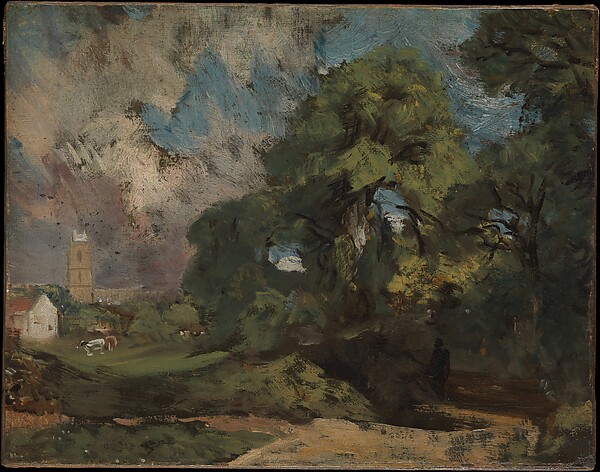
John ConstableBritish, 1776–1837
The Cornfield
Can I see it?
Yes, on view now
Where is “The Cornfield” now? The National Gallery, Room 40, London. Yes, on view now. Checked November 16, 2026.

London, United Kingdom
Closed· opens at 10:00 AM
On public display.
- Checked
- In this state since
- Source
- The museum's website
About the painting
The Cornfield is an oil painting by the English artist John Constable, completed from January to March 1826 in the artist’s studio. The painting shows a lane leading from East Bergholt toward Dedham, Essex, and depicts a young shepherd boy drinking from a pool in the heat of summer. The location is along Fen Lane, which the artist knew well. Constable referred to the piece as The Drinking Boy.
Read on
On the advice of Constable's friend, the botanist Henry Phillips, The Cornfield was painted with the trees and plants depicted as accurately as possible. Constable commissioned the engraver David Lucas to produce the plates of the painting for a book, Various Subjects of Landscape, Characteristic of English Scenery, first published in July 1830. The art historian Anthony Bailey considers The Cornfield to have "opened the gate through which a great number of people were to pass into Constable's country". It was exhibited at the Royal Academy of Arts in April 1826, under the title Landscape: Noon, and shown in Paris from early November to the spring of 1828. The painting was praised but Constable did not find a buyer. After the artist’s death, funds were raised to purchase the work for the National Gallery.
Details
- Accession number
- NG130
In the catalog
Display history
On view · Room 40
The National Gallery · Oct 12, 2026 — now · Verified
Whether it was on view is unknown
The National Gallery · Sep 29, 2026 — Oct 12, 2026 · Unconfirmed
Sources
- Wikidata
- Image: The National Gallery — John Constable · Public domain · Wikimedia Commons
In the life of John Constable
The whole life1824
The Paris Salon: a gold medal
The Anglo-French dealer John Arrowsmith bought The Hay Wain and other works, and in 1824 they were shown at the Paris Salon, where they caused a sensation. The Hay Wain was awarded a gold medal by Charles X.
1824
Delacroix repaints the background of “The Massacre at Chios”
After seeing Constable’s pictures at Arrowsmith’s gallery, Delacroix repainted the background of his Massacre at Chios, saying the paintings had done him a great deal of good. In his journal he noted that Constable’s meadow greens are a combination of many different shades.
1824–1828
The family in Brighton for Maria’s health
When Maria began to show symptoms of tuberculosis, Constable took lodgings for the family in Brighton in the hope that sea air would restore her health, dividing his time between Brighton and Charlotte Street in London. He was unsure at first that Brighton suited painting, and complained to Fisher that the beach was only Piccadilly by the sea.
1825
A quarrel with Arrowsmith: the French market is lost
In 1825 Constable quarrelled with Arrowsmith and lost his French outlet, perhaps partly from worry over his wife’s health, the uncongenial life at Brighton and the pressure of outstanding commissions. In a few years he had sold more than twenty pictures in France, more than he sold at home.
23 November 1828
The death of his wife Maria
After the birth of their seventh child the family returned to Hampstead, where Maria died of tuberculosis at the age of 41. “Hourly do I feel the loss of my departed Angel,” Constable wrote to his brother.
1828–1837
A widower with seven children
For the rest of his life Constable dressed in black and brought up his seven children alone; according to Leslie he was “a prey to melancholy and anxious thoughts”. Several of the children also painted, notably Lionel.