Joseph Mallord William TurnerBritish, 1775–1851
The Fighting Temeraire
May one see it?
Unknown: the museum keeps its counsel

The National Gallery
London, United Kingdom
The owner is known. Whether it is on view today, the museum does not say, and we were not trained to guess.
- In this state since
- Sep 29, 2026
- Source
- The museum's own collection data
About the painting
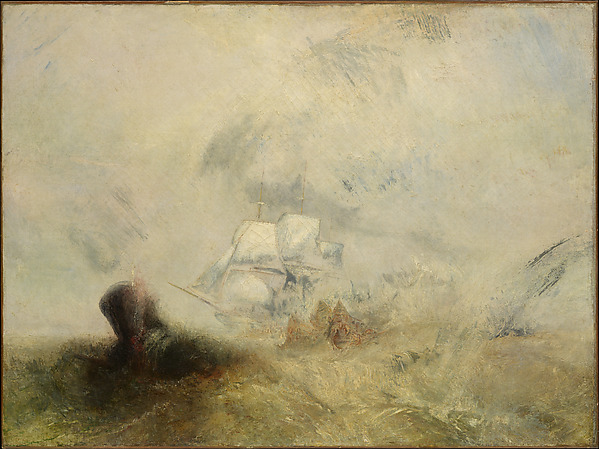
The Fighting Temeraire, tugged to her last berth to be broken up, 1838 is an oil-on-canvas painting by the English artist Joseph Mallord William Turner, painted in 1838 and exhibited at the Royal Academy in 1839.
The painting depicts the 98-gun HMS Temeraire, one of the last second-rate ships of the line to have played a role in the Battle of Trafalgar, being towed up the Thames by a paddle-wheel steam tug in 1838, towards its final berth in Rotherhithe to be broken up for scrap.
The painting hangs in the National Gallery, London, having been bequeathed to the nation by the artist in 1851, as part of the Turner Bequest. In a poll organised by BBC Radio 4's Today programme in 2005, it was voted the nation's favourite painting. In 2020 it was included on the new £20 banknote, along with the artist's 1799 self-portrait.
Particulars
- Accession number
- NG524
Sources
- Wikidata · fetched 3 days ago
- Image: The National Gallery — J. M. W. Turner · Public domain · Wikimedia Commons
Meanwhile, in the life of Joseph Mallord William Turner
The whole life1830–1840s
Criticism in the 1830s–1840s and Ruskin’s defence
His innovative works, bordering on abstraction, gave him a reputation for madness: the Victorian public preferred realism and sentimentality, and Queen Victoria refused to knight him. John Ruskin came to his defence, calling him “the greatest artist of all time”.
1838
A gold snuffbox from Louis-Philippe
Turner was a constant user of snuff; in 1838 King Louis-Philippe I of France gave him a gold snuffbox.
1840–1844
Last journeys: Venice and Switzerland
On a second trip to Venice (1840) he also visited Trieste and Coburg, and in 1841 and 1844 he made two final trips to Switzerland, in his sixties.