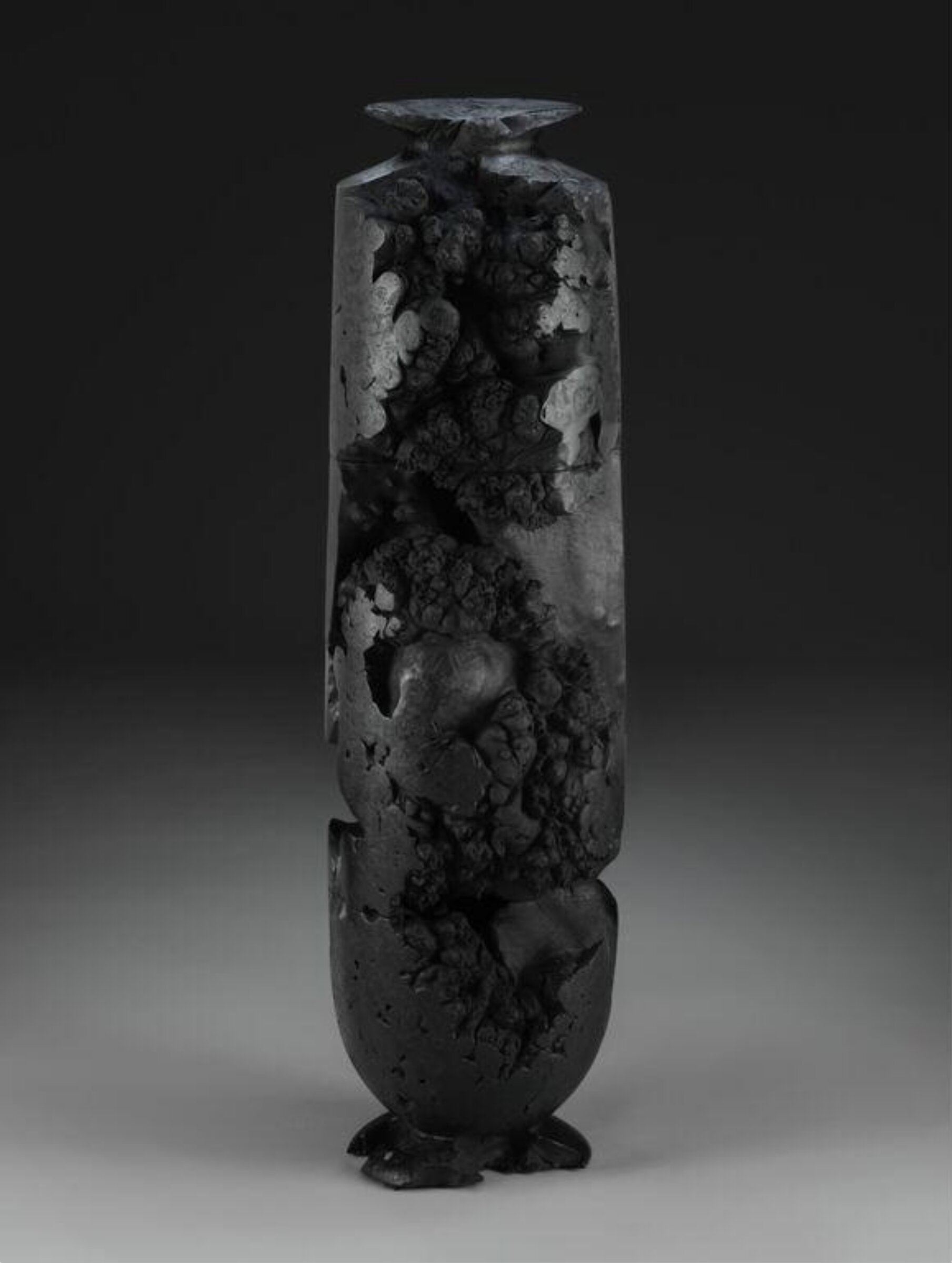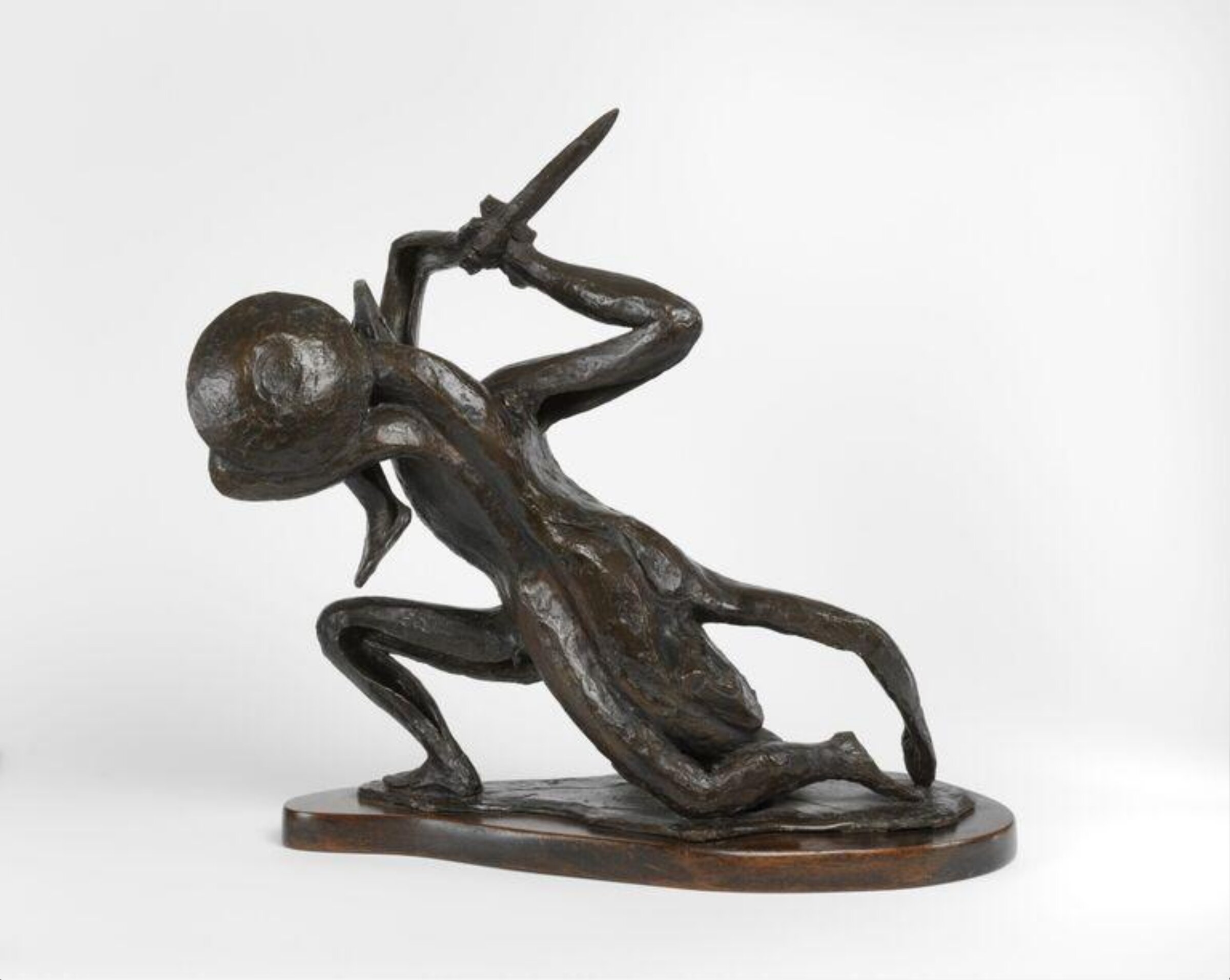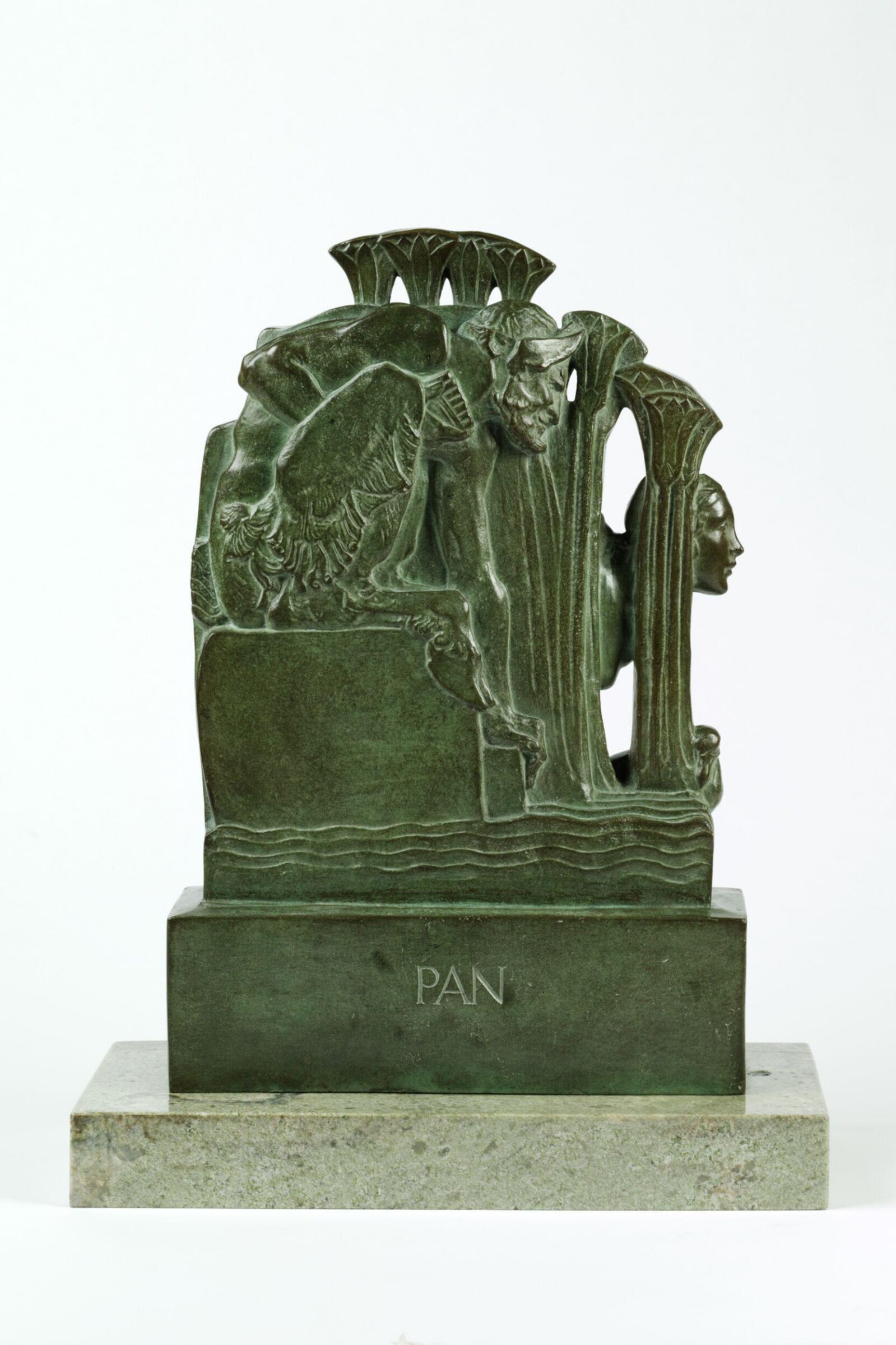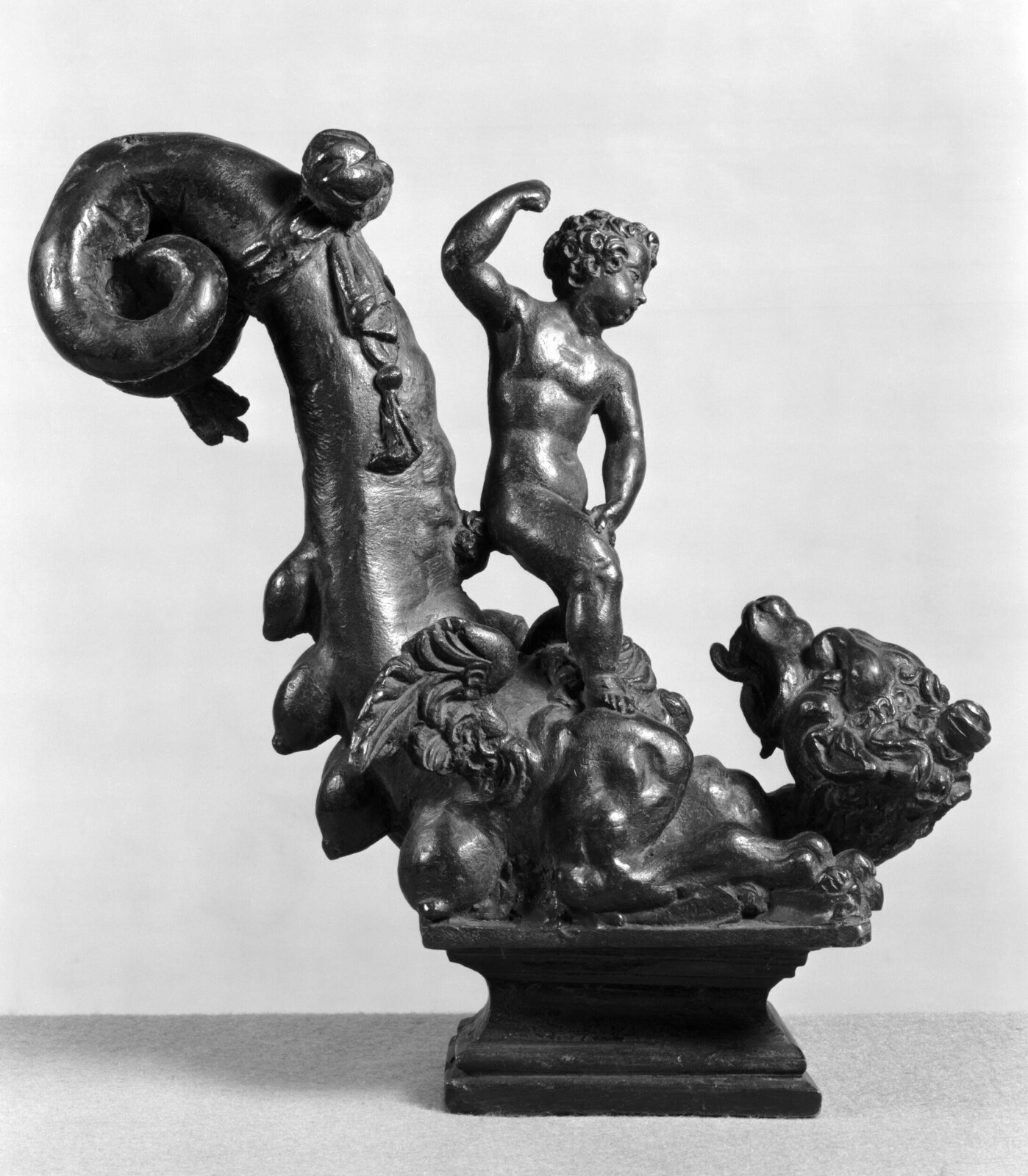
Putto (or boy) standing on a dragon
Can I see it?
Yes, on view now
Where is “Putto (or boy) standing on a dragon” now? Victoria and Albert Museum, Sculpture, Room 111, The Gilbert Bayes Gallery, London. Yes, on view now. Checked September 25, 2026.

Closed· opens tomorrow at 10:00 AM
On public display.
- Checked
- In this state since
- Source
- The museum
About the sculpture
This is a finial of a firedog with a putto (or boy) standing on a dragon, made possibly by Giuseppe de Levis or Nicolò Roccatagliata in about 1575-1600.
Lost-wax casting was an expensive and highly skilled process. It usually required collaboration between a sculptor and a foundry. Despite the careful finishing of the work, the bronze often retains traces of the casting process. Giorgio Vasari, writing in the 1550s, described how the craftsmen made "a core of clay" and "while kneading it to make it soft, they mix (in) horse dung and hair". There has been taken a sample of core from inside the firedog and it showed that it would have probably been made to a similar recipe.
Read on
Firedogs or andirons were placed within the fireplace and would have been used to hold utensials which were required for tending the fire. Often, firedogs do not even appear on inventories, which indicates their status as standard household objects, not necessarily worthy of particular note.
Giuseppe de Levis (1522-1611/14) was the most distinguished member of a famous dynasty of bell-founders active in Verona and became perhaps the most accomplished and versatile founder of bronze sculpture and artefacts in Northern Italy of his day. Relatively little is known about Roggatagliata (ca. 1560-1633/1636). He received his early training from Agostino Groppo, to whom he was apprenticed for nine years in 1571, and he was later an assistant to Agostino’s son, Cesare. He subsequently moved, possibly with his master, from his native Genoa to Venice, where he is first documented in 1593, when Cesare Groppo’s models were bequeathed to him. Numerous functional bronzes have been attributed to Roccatagliata, particularly those incorporating a particular type of putto, which has come to characterize his style.
He also made twenty-two sconces in 1593 for San Giorgio Maggiore in Venice and also the candelabra in the same church. His workshop produced a variety of functional bronzes that may have well continued in production long after the death of the master and his son Sebastian. However, we still know nothing about the location of the foundry itself.
Victoria and Albert Museum
Details
- Accession number
- 2454-1856
What it shows
In the catalog
Sources
- Victoria and Albert Museum
- Image: Victoria and Albert Museum — © Victoria and Albert Museum, London