 RaphaelItalian, 1483–1520
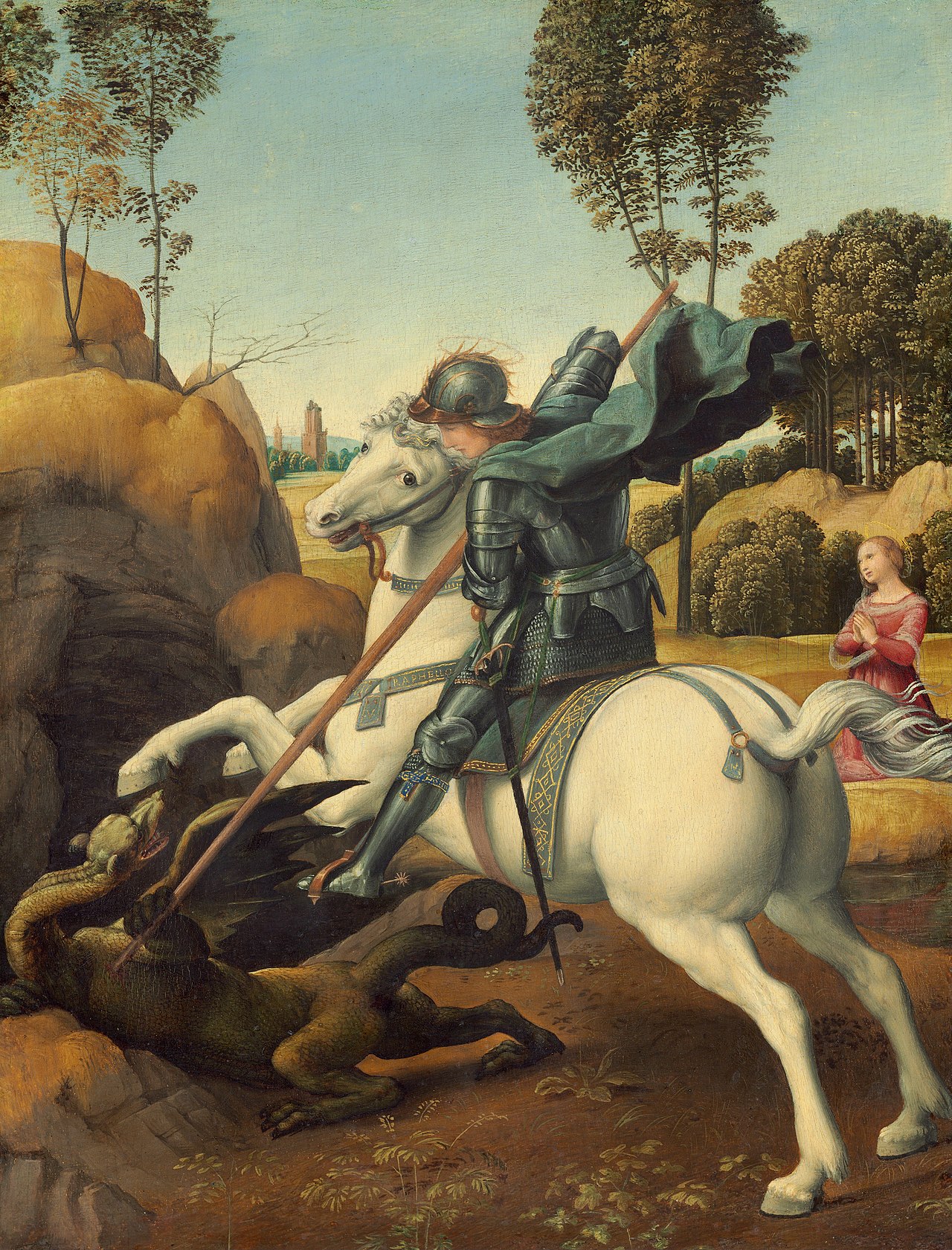
Saint George and the Dragon
May one see it?
Yes, receiving visitors

National Gallery of Art
Room20 · West Building, Main FloorWashington, D.C., United States
On public display.
- Checked
- 4 days ago
- In this state since
- Sep 29, 2026
- Source
- The museum's own collection data
About the painting
St. George and the Dragon is a small oil on wood cabinet painting by the Italian High Renaissance artist Raphael, painted c. 1505, and now in the National Gallery of Art in Washington, D.C. The saint wears the blue garter of the English Order of the Garter, reflecting the award of this decoration in 1504 to Raphael's patron Guidobaldo da Montefeltro, Duke of Urbino, by King Henry VII of England. The first word of the order's motto, "HONI" can be made out. The painting was presumably commissioned by the Duke, either to present to the English emissary who brought the regalia to Urbino, Sir Gilbert Talbot, or to Henry himself—recent scholarship suggests the latter. The honour paid to a minor Italian ruler reflected Henry's appreciation of the cultural prestige of Renaissance Italy as much as any diplomatic purpose.
Read on
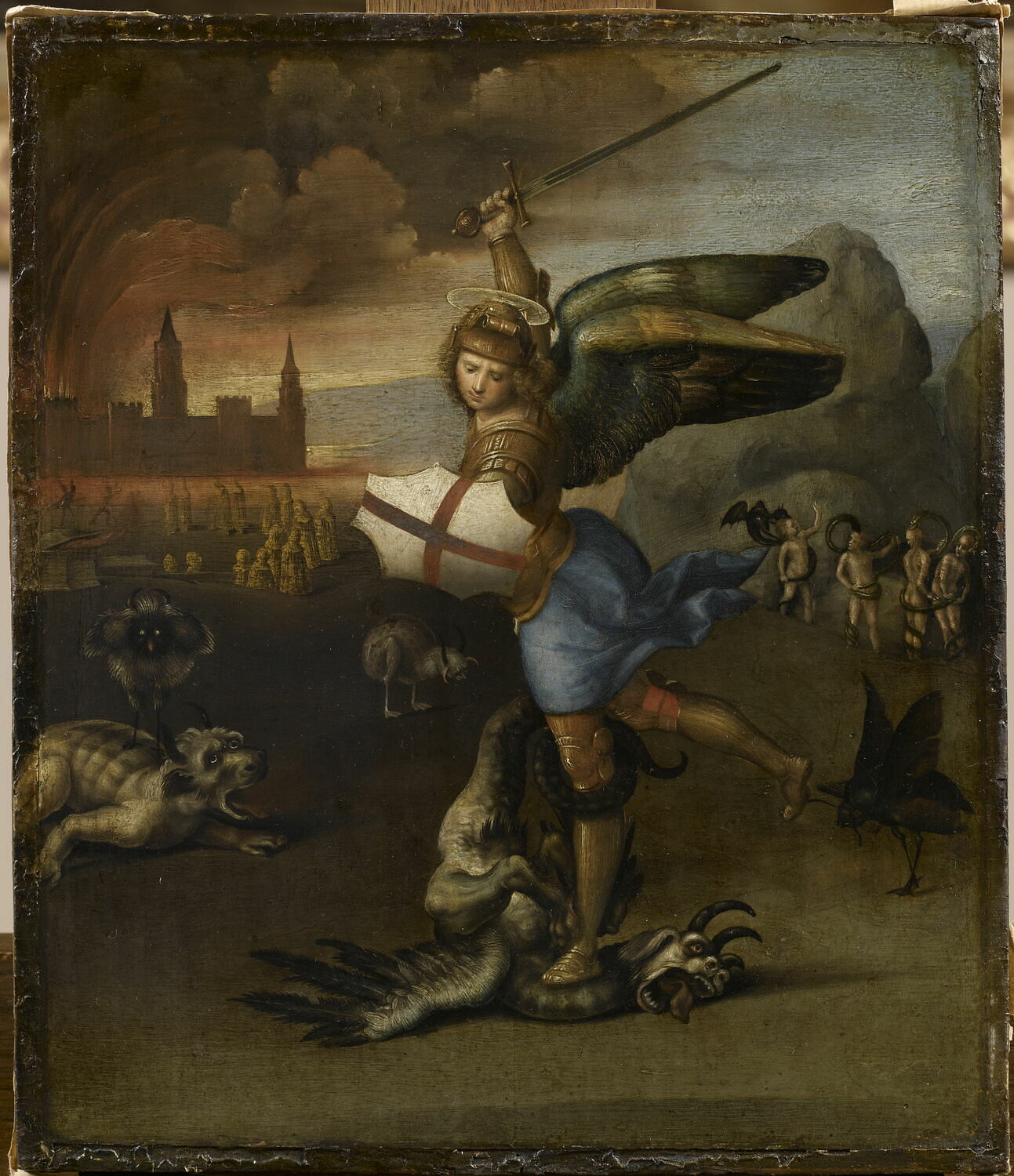
The traditional subject, Saint George and the Dragon, combining chivalry and Christianity, is appropriate for the occasion; like his father, Guidobaldo was a condottiero, or proprietor of a band of mercenary soldiers. In the early stages of his career Raphael painted a number of tiny cabinet paintings, including another St George in the Louvre, and the Vision of a Knight in the National Gallery in London.
Particulars
- Accession number
- 1937.1.26
What it shows
In the catalog
Comings and goings
On view · Gallery 20 · West Building, Main Floor
National Gallery of Art · Sep 29, 2026 — now · Verified
Was on view · Gallery 20 · West Building, Main Floor
National Gallery of Art · Sep 29, 2026 — Sep 29, 2026 · Verified
Was on view · Gallery 20 · West Building, Main Floor
State Hermitage Museum · Sep 28, 2026 — Sep 29, 2026 · Verified
Was on view · Gallery 20 · West Building, Main Floor
National Gallery of Art · Aug 30, 2026 — Sep 28, 2026 · Verified
Sources
- State Hermitage Museum: the museum's own open data · fetched 4 days ago
- Image: National Gallery of Art — Museum open access
Meanwhile, in the life of Raphael
The whole lifec. 1503 – c. 1504 · Workplace
Siena
late 1504
Meets Leonardo and Michelangelo
Having moved to Florence, Raphael met Leonardo da Vinci, Michelangelo and Bartolomeo della Porta and closely studied Leonardo's sfumato. His first Florentine commission, portraits of Agnolo Doni and his wife, was painted under the clear impression of the “Mona Lisa”.
1504
Friendship with Baldassare Castiglione
In Urbino Raphael met the philosopher, writer and patron Count Baldassare Castiglione; they formed a firm friendship and correspondence, including the famous letters about the fresco “The Triumph of Galatea”.
October 1504
To Florence, to study
The mother of the next Duke of Urbino gave Raphael a letter of recommendation to the Gonfaloniere of Florence: “The bearer of this will be found to be Raphael, painter of Urbino, who, being greatly gifted in his profession has determined to spend some time in Florence to study.” She called him “a sensible and well-mannered young man”.
c. 1504 – c. 1508 · Workplace
Florence
1507
Meets Donato Bramante
Raphael met the architect Donato Bramante, by an unproven account his relative. Bramante became his adviser and patron and later recommended him to Pope Julius II as the best candidate for work in the Vatican.




![Scenes from the Passion of Christ: The Descent into Limbo [right panel], Andrea Vanni, 1380s](https://api.nga.gov/iiif/4205a539-eadd-4486-89a7-3cff9c1ba428/full/!2400,2400/0/default.jpg)


