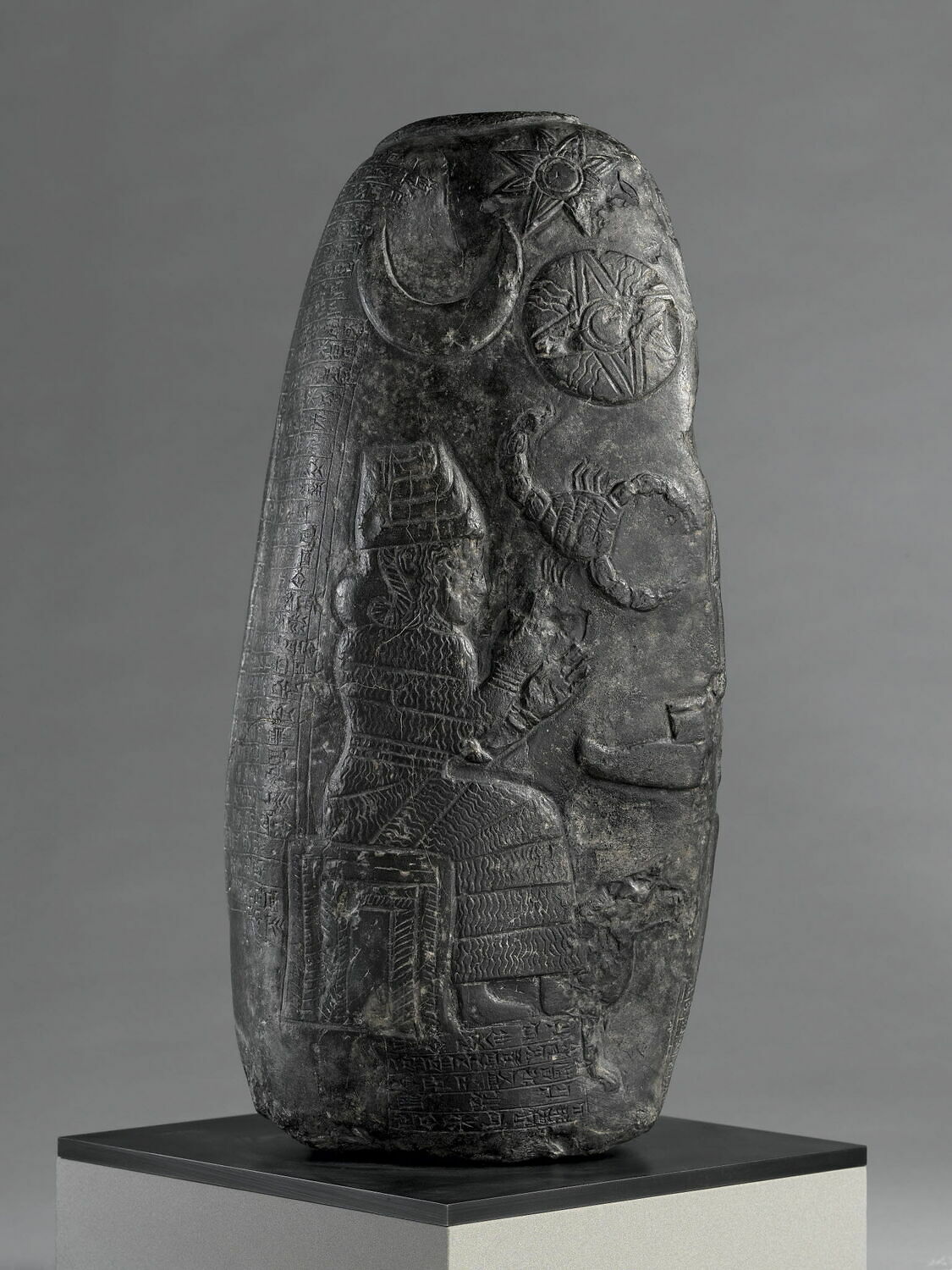
Kudurru de Nazimaruttash
May one see it?
Unknown: the museum keeps its counsel

Musée du Louvre
Paris, France
The owner is known. Whether it is on view today, the museum does not say, and we were not trained to guess.
- In this state since
- Source
- The museum's own collection data
About the sculpture
The Nazimaruttash kudurru stone is a boundary stone (kudurru) of Nazimaruttaš, a Kassite king of Babylon, c. 1307–1282 BC (short chronology). It was found at Susa and is now displayed at the Louvre.
Some kudurrus are known for their portrayal of the king, etc., who consigned it. Most kudurrus portray Mesopotamian gods, often portrayed graphically in segmented registers on the stone. Nazimaruttash's kudurru does not use registers; instead, graphic symbols are used. Nineteen deities are invoked to curse the foolhardy individual who seeks to desecrate it. Some are represented by symbols, such as a goat-fish for Enki, a bird on a pole for Papsukkal, a spear-head for Marduk, an eight-pointed star for Ishtar, and a disc for Shamash.
Particulars
- Accession number
- SB 21
In the catalog
Sources
- Musée du Louvre: the museum's own open data · fetched 6 days ago
- Image: Musée du Louvre — © 2007 GrandPalaisRmn (musée du Louvre) / René-Gabriel Ojéda