ART WIKI37,791 on view
MapCollectionArtistsMuseumsExhibitionsJournal
Sign in

ART WIKI

Where to see art and when to visit.

Collections: Art Institute of Chicago, Cooper Hewitt, Smithsonian Design Museum, Getty Villa, Harvard Art Museums, Hirshhorn Museum and Sculpture Garden, J. Paul Getty Museum, Minneapolis Institute of Art, Musée du Louvre, National Gallery of Art, National Museum of Asian Art, National Portrait Gallery (Smithsonian), Pushkin State Museum of Fine Arts, Rijksmuseum, Smithsonian American Art Museum, SMK — National Gallery of Denmark, State Hermitage Museum, State Russian Museum, The Cleveland Museum of Art, The Metropolitan Museum of Art, The Museum of Modern Art, Tretyakov Gallery, Victoria and Albert Museum, Whitney Museum of American Art, Yale Center for British Art, Yale University Art Gallery, State Catalogue of the Museum Fund of Russia (274 museums), Europeana (19 museums), Wikidata (44 museums), Paris Musées (12 museums), Joconde, the French Ministry of Culture's museum database (495 museums), and the Catalogo generale dei Beni Culturali of Italy's Ministry of Culture (74 museums). Images belong to their rights holders.

Sections

  • Map
  • Search
  • Collection
  • Masterpieces
  • Stolen and lost
  • Embed artwork status
  • On view now
  • Artists

More

  • Museums & galleries
  • Exhibitions
  • Journal
  • Where the data comes from
  • Privacy & cookies
  • About
  • Terms of use
HomeMapBrowse

Browse

The Middle Ages, 1000–1400

Medieval art covers a long period, roughly 500–1500, and many ways of making images: painted churches, precious books, carved figures and portable objects for prayer. Its pictures were used as well as admired. An angel wearing a king’s badge or a candle burn on a frame can reveal how closely belief, power and ordinary human gestures met.

8,071 works from 204 museums1,543 on view nowClear

/
The Adoration of the Magi, Giotto di Bondone, possibly ca. 1320GiottoThe Adoration of the Magipossibly ca. 1320Gallery 601The Metropolitan Museum of Art
Madonna and Child, Giotto, c. 1310/1315GiottoMadonna and Childc. 1310/1315Gallery 1 · West Building, Main FloorNational Gallery of Art
Saint François d'Assise recevant les stigmates, Giotto di Bondone, 1e quart du XIVe siècle (1300 - 1325)GiottoSaint François d'Assise recevant les stigmatesfirst quarter of the 14th century (1300–1325)Salle 708, Aile Denon, Niveau 1Musée du Louvre
Shiva Nataraja, anonymous, c. 1100 - c. 1200anonymousShiva Natarajac. 1100 - c. 1200Rijksmuseum
Tempelwachter, anonymous, c. 1300 - c. 1400anonymousTempelwachterc. 1300 - c. 1400Rijksmuseum
The Crucifixion, Pietro Lorenzetti, 1340sPietro LorenzettiThe Crucifixion1340sGallery 635The Metropolitan Museum of Art
Fudō Myōō, the Immovable Wisdom King (Achala Vidyaraja), Kaikei, early 13th centuryKaikeiFudō Myōō, the Immovable Wisdom King (Achala Vidyaraja)early 13th centuryThe Metropolitan Museum of Art
The Stigmatization of Saint Francis, Lorenzo Ghiberti, ca. 1398–1405Lorentso GibertiThe Stigmatization of Saint Francisca. 1398–14052nd floor, European ArtYale University Art Gallery
The Assumption of the Virgin, Bernardo Daddi, 1337–38Bernardo DaddiThe Assumption of the Virgin1337–38Gallery 952The Metropolitan Museum of Art
Apse of Sant Climent de Taüll, Master of Taüll, c. 1123Master of TaüllApse of Sant Climent de Taüllc. 1123Museu Nacional d'Art de Catalunya
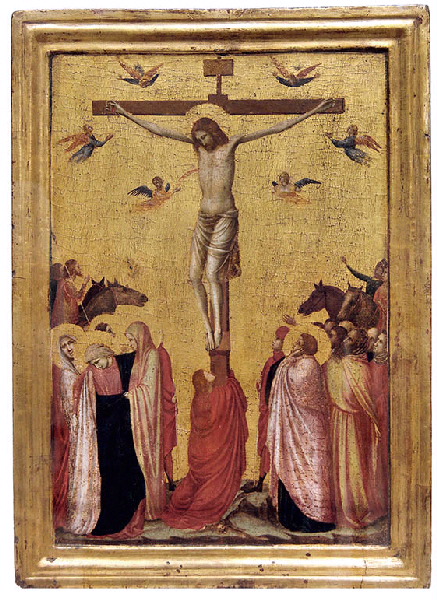
The Crucifixion of Christ, Giotto, c. 1310sGiottoThe Crucifixion of Christc. 1310sGemäldegalerie
Finches and bamboo, Emperor Huizong, early 12th centuryEmperor Huizong of SongFinches and bambooearly 12th centuryThe Metropolitan Museum of Art
De boeddha Amida, anonymous, c. 1125 - c. 1175anonymousDe boeddha Amidac. 1125 - c. 1175Rijksmuseum
Candlestick: knight with dragon, anonymous, c. 1200 - c. 1250anonymousCandlestick: knight with dragonc. 1200 - c. 1250Rijksmuseum
Croix peinte, Giotto di Bondone, 1e quart du XIVe siècle (1300 - 1325)GiottoCroix peintefirst quarter of the 14th century (1300–1325)Salle 708, Aile Denon, Niveau 1Musée du Louvre
La Crucifixion, Giotto di Bondone, XIVe siècle (1300 - 1400)GiottoLa Crucifixion14th century (1300–1400)Salle 708, Aile Denon, Niveau 1Musée du Louvre
Pentecost, Giotto, c. 1310sGiottoPentecostc. 1310sRoom 65The National Gallery
The Presentation of the Christ Child in the Temple, Giotto, c. 1320GiottoThe Presentation of the Christ Child in the Templec. 1320Isabella Stewart Gardner Museum
La Vierge et l'Enfant en majesté entourés de six anges (Maestà), Cimabue, 4e quart du XIIIe siècle (1275 - 1300)CimabueLa Vierge et l'Enfant en majesté entourés de six anges (Maestà)last quarter of the 13th century (1275–1300)Salle 708, Aile Denon, Niveau 1Musée du Louvre
La Dérision du Christ, Cimabue, 4e quart du XIIIe siècle (vers 1280)CimabueThe Mocking of Christlast quarter of the 13th century (c. 1280)Musée du Louvre
The Stefaneschi Triptych: Christ Enthroned, Giotto, c. 1330GiottoThe Stefaneschi Triptych: Christ Enthronedc. 1330Vatican Museums
Madonna and Child Enthroned with Angels and Prophets. ˋSanta Trinità Maestà´, Cimabue, c. 1290sCimabueMadonna and Child Enthroned with Angels and Prophets. ˋSanta Trinità Maestà´c. 1290sUffizi Gallery
The Annunciation, Duccio di Buoninsegna, 1300sDuccio di BuoninsegnaThe Annunciation1300sRoom 58The National Gallery
Madonna and Child, Duccio di Buoninsegna, ca. 1290–1300Duccio di BuoninsegnaMadonna and Childca. 1290–1300Gallery 635The Metropolitan Museum of Art
Bodhisattva Jizo, anonymous, c. 1300 - c. 1350anonymousBodhisattva Jizoc. 1300 - c. 1350Rijksmuseum
Tempelwachter, anonymous, c. 1300 - c. 1400anonymousTempelwachterc. 1300 - c. 1400Rijksmuseum
Guanyin, anonymous, c. 1100 - c. 1200anonymousGuanyinc. 1100 - c. 1200Rijksmuseum
Timpaan van de abdij van Egmond, anonymous, in or after 1121 - in or before 1130anonymousTimpaan van de abdij van Egmondin or after 1121 - in or before 1130Rijksmuseum
Lectern for the Reading of the Gospels with the Eagle of Saint John the Evangelist, Giovanni Pisano, ca. 1301, with later additionsGiovanni PisanoLectern for the Reading of the Gospels with the Eagle of Saint John the Evangelistca. 1301, with later additionsGallery 305The Metropolitan Museum of Art
Five-colored parakeet on a blossoming apricot tree, Emperor Huizong of Song, 1110sEmperor Huizong of SongFive-colored parakeet on a blossoming apricot tree1110sMuseum of Fine Arts, Boston
La Crucifixion, Giotto Di Bondone, 1315GiottoLa Crucifixion1315Musée des Beaux-Arts de Strasbourg
Madonna Enthroned, Giotto, c. 1300sGiottoMadonna Enthronedc. 1300sUffizi Gallery
The Calling of the Apostles Peter and Andrew, Duccio di Buoninsegna, 1308-1311Duccio di BuoninsegnaThe Calling of the Apostles Peter and Andrew1308-1311Gallery 1 · West Building, Main FloorNational Gallery of Art
Badia Polyptych, Giotto, 1300sGiottoBadia Polyptych1300sUffizi Gallery
The Virgin and Child with Saints Dominic and Aurea, Duccio di Buoninsegna, c. 1310sDuccio di BuoninsegnaThe Virgin and Child with Saints Dominic and Aureac. 1310sRoom 58The National Gallery
Annunciation with Saints Maxima and Ansanus, Simone Martini, 1333Simone MartiniAnnunciation with Saints Maxima and Ansanus1333Uffizi Gallery
Madonna and Child, Simone Martini, ca. 1326Simone MartiniMadonna and Childca. 1326Gallery 952The Metropolitan Museum of Art
Saint Andrew, Simone Martini, ca. 1326Simone MartiniSaint Andrewca. 1326The Metropolitan Museum of Art
Durga Killing the Buffalo Demon, anonymous, c. 1000 - c. 1100anonymousDurga Killing the Buffalo Demonc. 1000 - c. 1100Rijksmuseum
Figuur, afkomstig uit de Mariakerk te Utrecht, anonymous, c. 1125 - c. 1175anonymousFiguur, afkomstig uit de Mariakerk te Utrechtc. 1125 - c. 1175Rijksmuseum
Theotokos of Vladimir, 1125Theotokos of Vladimir1125Tretyakov Gallery
Old Trees, Level Distance, Guo Xi, ca. 1080Guo XiOld Trees, Level Distanceca. 1080The Metropolitan Museum of Art
Woods and Valleys of Mount Yu, Ni Zan, dated 1372Ni ZanWoods and Valleys of Mount Yudated 1372The Metropolitan Museum of Art
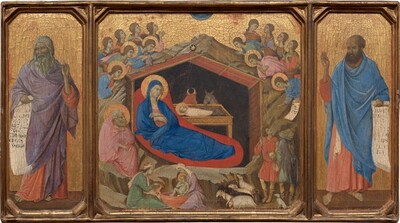
The Nativity with the Prophets Isaiah and Ezekiel, Duccio di Buoninsegna, 1308-1311Duccio di BuoninsegnaThe Nativity with the Prophets Isaiah and Ezekiel1308-1311Gallery 1 · West Building, Main FloorNational Gallery of Art
The Virgin and Child with Two Angels, Cimabue, 1280sCimabueThe Virgin and Child with Two Angels1280sRoom 65The National Gallery
Wang Xizhi watching geese, Qian Xuan, ca. 1295Qian XuanWang Xizhi watching geeseca. 1295The Metropolitan Museum of Art
The Flagellation of Christ, Cimabue, c. 1280CimabueThe Flagellation of Christc. 1280The Frick Collection
1

Medieval art

Two small burns on a picture frame can tell us something that a gold background cannot. They mark the lower edge of Duccio’s Madonna and Child, a panel made around 1290–1300. Candles once stood close enough to scorch it. Before becoming an object studied under museum lighting, the picture participated in someone’s prayers. Its surface records both the painter’s decisions and the use to which another person put them.

What do we mean by medieval art?

The term covers roughly a thousand years of European history, from about 500 to 1500. It brings together objects made for very different purposes: books, church furnishings, painted walls, sculpture, jewellery and small images for private devotion. Byzantine, Romanesque and Gothic are among the more precise names used within that broad span. A date is a starting point, but function often explains more. An image high above an altar had a different task from one held close to a face.

That distinction matters when figures appear larger or flatter than we expect. Before asking whether a painter could reproduce ordinary sight, ask what the image needed to do in its setting. Size can establish authority, and a patterned gold field can separate a holy figure from everyday surroundings. The three objects here suggest three different relationships: a congregation looking up, a king imagining his place in heaven, and a person praying before a mother and child.

A church wall that travelled to Barcelona

The Apse of Sant Climent de Taüll belongs to the Romanesque world of the early twelfth century. Its central Christ occupies an almond-shaped enclosure, with angels and the symbols of the evangelists around him. Mary and apostles stand below. The church was consecrated in 1123. The arrangement gathers biblical visions into an image of divine authority: the building’s curved end becomes a setting in which the worshipper faces something larger than ordinary human presence.

Its journey to the Museu Nacional d’Art de Catalunya began with a modern emergency. After paintings from another Catalan church had been sold and detached, the museum authorities feared further losses. Between 1919 and 1923, they organised a campaign to acquire and transfer murals to Barcelona. The strappo method lifted the painted skin while leaving the underlying plaster behind. These works survived through an intervention that also changed their relationship to the places for which they were made.

Master of Taüll, Apse of Sant Climent de Taüll, about 1123. Museu Nacional d’Art de Catalunya, Barcelona.

Material investigation complicates the image further. Traces of tin sheet survive in Christ’s halo at Taüll. Medieval brilliance could come from metal as well as pigment. In later gilded panels, what looks like a smooth golden expanse may contain punched patterns or incised designs. Contracts could specify the quality of gold to be supplied. Looking closely at the background can lead from theology to the workshop, and from the workshop to the patron’s purse.

Why are the angels wearing royal badges?

Richard II kneels before the Virgin and Child in the Wilton Diptych, made near the end of the fourteenth century and now belonging to London’s National Gallery. Three saints introduce him: John the Baptist and two English royal saints, Edmund and Edward the Confessor. Across the hinge, eleven angels wear Richard’s white hart badge. A sign used by the king’s earthly followers has entered the heavenly company. The political ambition is small enough to carry.

Closed, the diptych shows another white hart, with a crown around its neck, and royal heraldry. Opened, it creates a meeting between the ruler and his sacred protectors. We do not know precisely where Richard used it, and the painter’s identity remains unsettled. English and French authorship have both been proposed. Those uncertainties are worth preserving: the exquisite finish does not give us permission to invent a named genius or an exact ceremony behind the object.

The Wilton Diptych, about 1395–1399. National Gallery, London. The painter’s identity remains uncertain.

A baby reaches for a veil

Return now to Duccio’s small panel at the Metropolitan Museum of Art in New York. The infant reaches towards his mother’s veil. A parapet establishes a boundary between their space and ours, while the gesture makes their relationship immediately legible. Gold remains behind them; bodily contact has not replaced sacred meaning. It gives the person praying another way to approach it. The paint and gold work together with the picture’s modest size, rather than competing to prove which is more modern.

Duccio’s panel was in Gallery 635 on our autumn 2026 check. Including its original frame, it is under thirty centimetres high. That dimension is easy to lose online, where it can fill a screen as completely as the enormous Taüll mural. In the museum, allow the scale to change your behaviour: first register the whole object, then its painted boundary, the child’s hand and the scorched frame. Those burns preserve the proximity of someone whose name we cannot recover.

Duccio di Buoninsegna, Madonna and Child, about 1290–1300. Metropolitan Museum of Art, New York. Candle burns remain on the original frame.