 Jasper JohnsAmerican, 1930
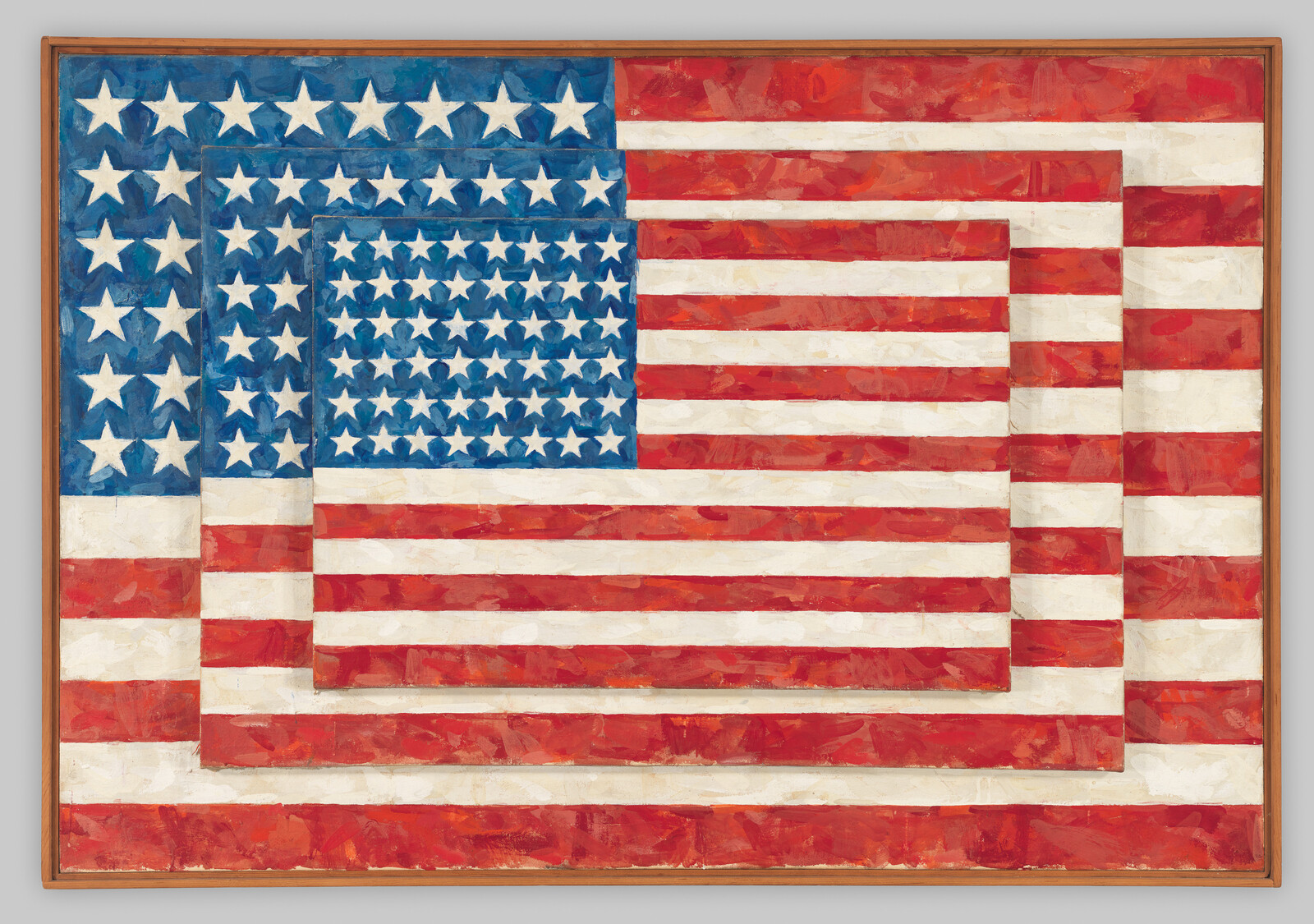
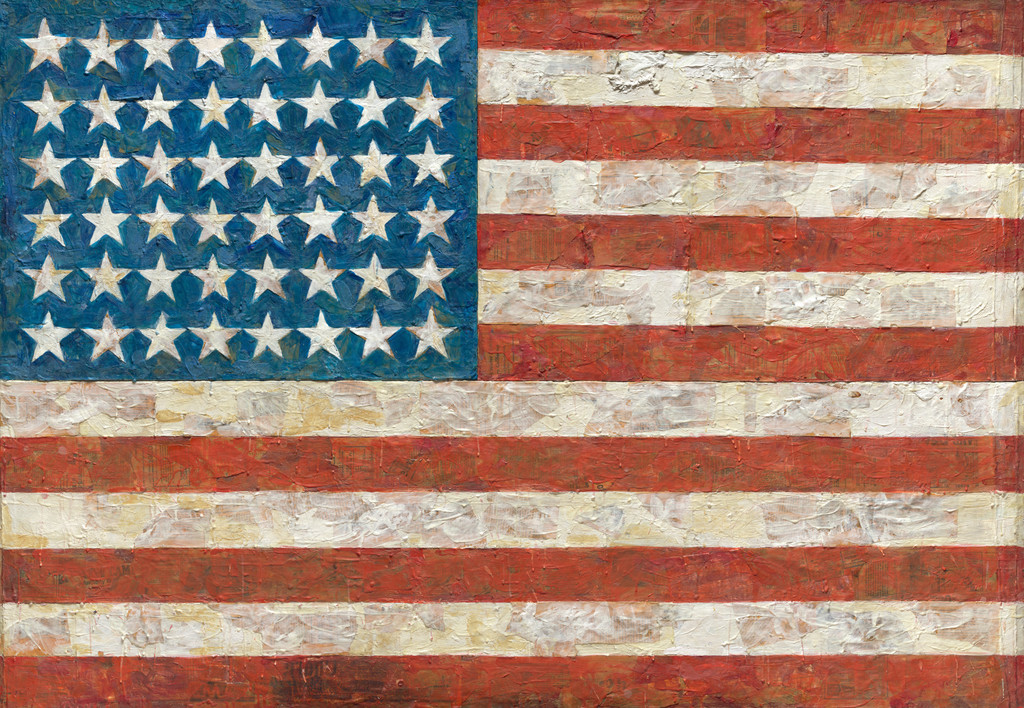
Flag
Can I see it?
Yes, on view now
Where is “Flag” now? The Museum of Modern Art, MoMA, Floor 4, 408, New York. Yes, on view now. Checked November 10, 2026.

Closed· opens tomorrow at 10:30 AM
On public display.
- Checked
- Source
- The museum
About the painting
Flag is an encaustic painting by the American artist Jasper Johns. It was created in 1954–1955, when Johns was 24, two years after he was discharged from the U.S. Army. This painting was the first of many works that Johns made, as he said, that were inspired by a dream of the U.S. flag in 1954. It is one of the paintings for which Johns is best known. It is held in the Museum of Modern Art, in New York.
The painting was featured in the 1980 BBC Two series 100 Great Paintings.
Details
- Accession number
- 106.1973
In the catalog
Sources
- The Museum of Modern Art
- Image: The Museum of Modern Art — © the artist or rights holder
In the life of Jasper Johns
The whole life1951–1953
Drafted into the army during the Korean War
In 1951 his studies were interrupted when he was drafted into the army during the Korean War. He served for two years, first at Fort Jackson, South Carolina, and then in Sendai, Japan.
summer 1953
Meets Robert Rauschenberg
Returning to New York in the summer of 1953, Johns worked at Marboro Books and met Sari Dienes, Rachel Rosenthal and Robert Rauschenberg, five years his senior, with whom he began a romantic and artistic relationship that lasted until 1961. In the same period he was strongly influenced by the choreographer Merce Cunningham and his partner, the composer John Cage.
1954
Destroys his earlier work: flags, targets, numbers
In 1954 Johns destroyed all of his previous artwork still in his possession and began painting flags, maps, targets, letters and numbers, “things the mind already knows”. Unlike the gestural abstraction of the Abstract Expressionists, these paintings could be read as both representational and abstract.
1957
A studio at Coenties Slip among fellow artists
In 1957 Johns lived in former shipping lofts on Lower Manhattan's waterfront around Coenties Slip that had been taken over by artists, alongside Rauschenberg, Robert Indiana and Ellsworth Kelly; the community also housed Agnes Martin for a time.
March 1957
Leo Castelli discovers Johns
In March 1957, while visiting Rauschenberg's studio, the dealer Leo Castelli asked to see Johns's art: on the floor below he found “a fantastic display of flags and targets” and immediately offered Johns an exhibition. According to other accounts, Castelli discovered Johns in 1958.