Jasper JohnsAmerican, 1930
Alphabet
Can I see it?
Yes, on view now
Where is “Alphabet” now? Art Institute of Chicago, Gallery 292, Chicago. Yes, on view now. Checked November 16, 2026.

Chicago, United States
Closing soon· until 5:00 PM
On public display.
- Checked
- In this state since
- Source
- The museum
About the painting
Jasper Johns arranged one complete A-to-Z sequence in Alphabet (1959), in the Art Institute of Chicago, Chicago, the only painting in which he used that single progression. Stencilled letters form a grid, but brushmarks and pasted fragments of painted paper disrupt orderly reading. Primary colours join other hues across the surface, introduced into his practice that year. Following the letters from the upper left becomes difficult as the scattered marks pull attention elsewhere. The measured letterforms and freely applied paint set two methods against each other. On view in Gallery 292.
In the museum's words
Jasper Johns has worked with stencils of alphabet letters since the 1950s, yet this is his only painting that shows a single sequence from A to Z. The artist made Alphabet the same year in which he introduced riots of primary color-augmented by touches of green, pink, orange, pale blue, gray, brown, black, and white into his work. We might try to read this painting in order, letter by letter, from top left to bottom right. But the jumble of strokes, daubs, smudges, and collaged fragments of painted paper scatters our eyes across the animated surface, challenging any sense of sequential progress. In this way, two different stylistic approaches orderly grids of stenciled forms versus brushy gestures are set against one another.
Art Institute of ChicagoCC BY 4.0
Details
- Accession number
- 2015.121
In the catalog
Sources
- Art Institute of Chicago
- Image: Art Institute of Chicago — © the artist or rights holder
In the life of Jasper Johns
The whole life1957
A studio at Coenties Slip among fellow artists
In 1957 Johns lived in former shipping lofts on Lower Manhattan's waterfront around Coenties Slip that had been taken over by artists, alongside Rauschenberg, Robert Indiana and Ellsworth Kelly; the community also housed Agnes Martin for a time.
March 1957
Leo Castelli discovers Johns
In March 1957, while visiting Rauschenberg's studio, the dealer Leo Castelli asked to see Johns's art: on the floor below he found “a fantastic display of flags and targets” and immediately offered Johns an exhibition. According to other accounts, Castelli discovered Johns in 1958.
early 1958
First solo show at the Leo Castelli Gallery
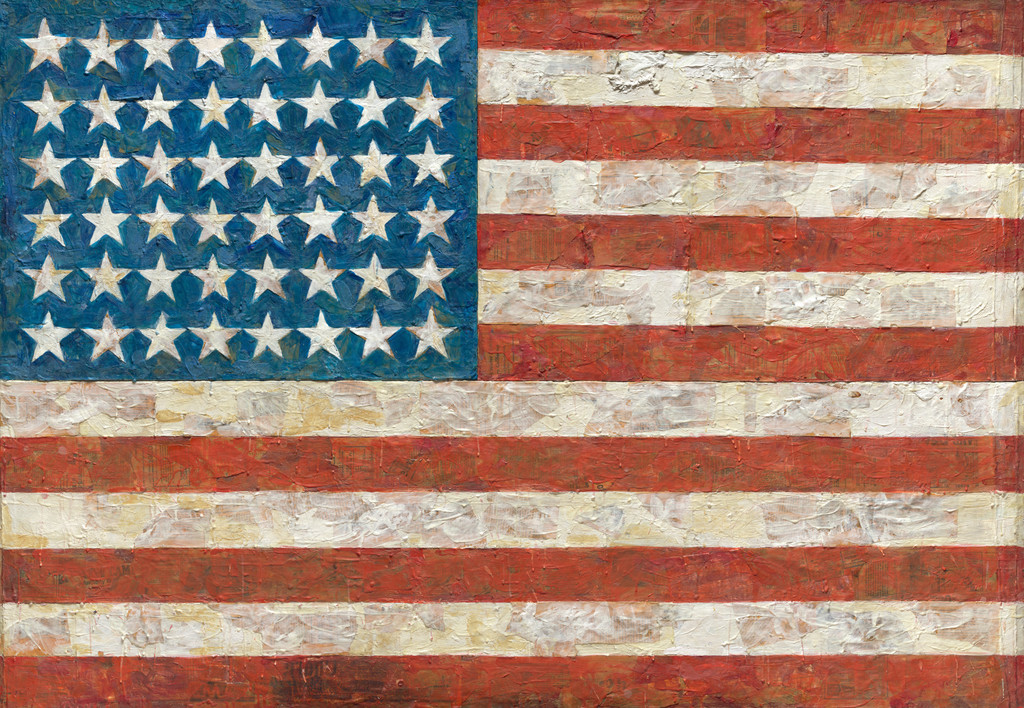
Johns's first solo show at the Leo Castelli Gallery, in early 1958, was well received: all but two of the eighteen works on view sold. Alfred H. Barr Jr., founding director of the Museum of Modern Art, bought three paintings, the first works by Johns to enter a museum collection; the trustees feared attacks by patriotic groups over Flag, so Barr arranged for the architect Philip Johnson to buy it and donate it to the museum in 1973.
1960
Takes up lithography at Tatyana Grosman's ULAE
In 1960 Tatyana Grosman, founder of Universal Limited Art Editions, invited Johns to her printmaking studio on Long Island. Beginning with lithographs of his familiar motifs, such as Target (1960), he went on to publish over 180 editions with ULAE in a variety of techniques.
1961
Parts from Rauschenberg
In 1961 Johns's romantic relationship and close collaboration with Robert Rauschenberg, begun in 1953, came to an end; Rauschenberg had been a profound artistic influence on him.