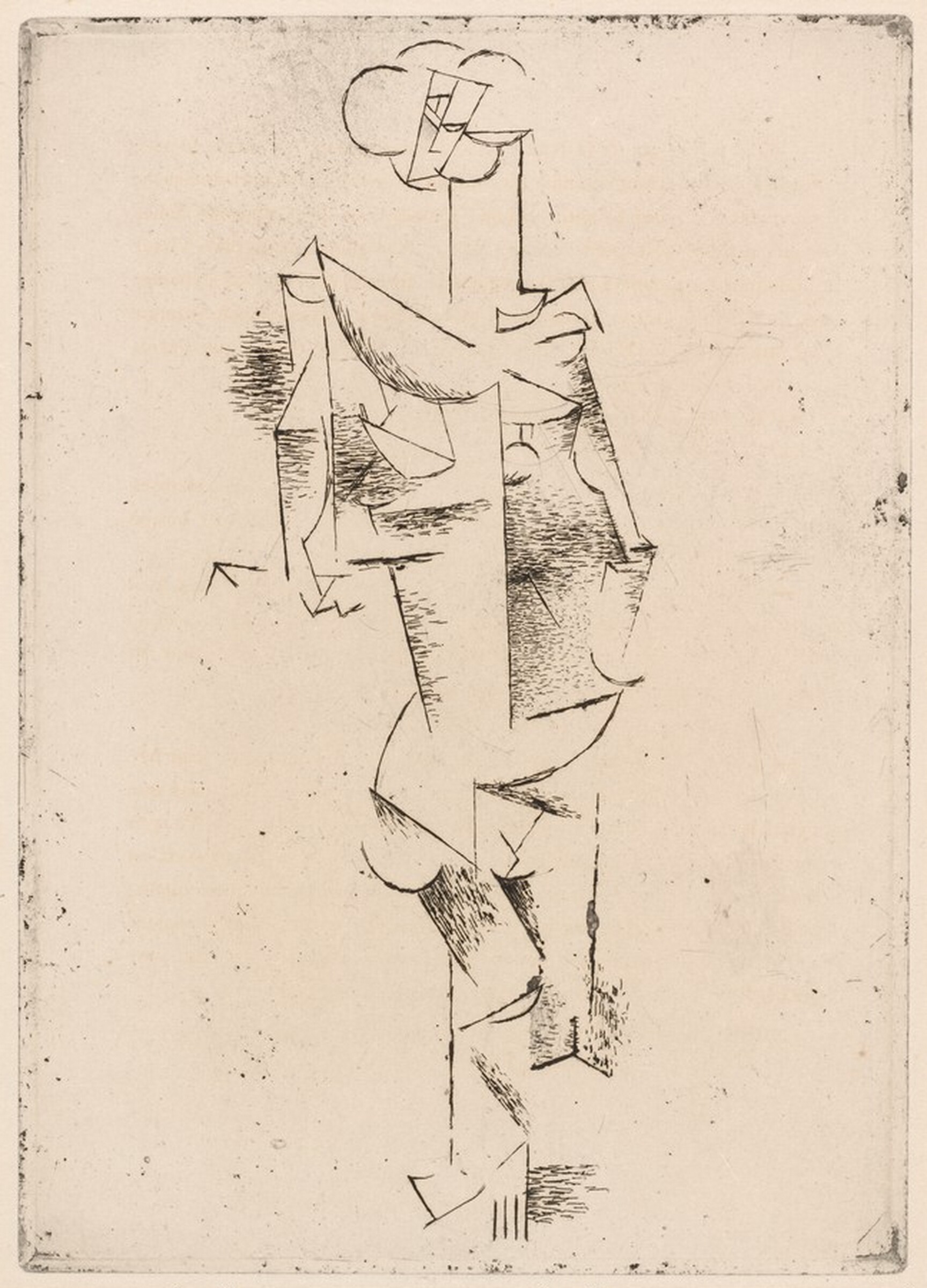
Figure at a Table
May one see it?
Not receiving at present

Washington, D.C., United States
It belongs to the collection, but is not on display at present.
- Checked
- In this state since
- Source
- The museum
Particulars
- Accession number
- 1998.113.10
What it shows
In the catalog
Sources
- National Gallery of Art
- Image: National Gallery of Art — © the artist or rights holder
Meanwhile, in the life of Franz Kline
The whole lifelate 1940s
From figuration to lines and planes
From the late 1940s Kline generalizes his figurative subjects into lines and planes that fit together much like the Cubism of the time. Many of his forms derive from the locomotives, stark landscapes and large mechanical shapes of his native coal-mining region of Pennsylvania — sometimes apparent only from the titles of the works.
1948
Projecting a sketch on the wall: de Kooning's advice
According to Elaine de Kooning, in 1948 Willem de Kooning advises an artistically frustrated Kline to project a sketch onto his studio wall with a Bell-Opticon projector: a four-by-five-inch black drawing of a rocking chair swells into gigantic strokes, and it is widely believed that Kline then turns to large-scale abstract works. Willem himself conceded that working out this vision took considerable time.
1948–1950
The turn to black-and-white abstraction
Over the next two years Kline's brushstrokes become completely non-representative, fluid and dynamic, and he begins painting only in black and white: for him the white is just as important as the black. Viewers also see references to Japanese calligraphy in these paintings, through his exchange with the avant-garde group Bokujinkai and its leader Morita Shiryu, although Kline later denied the connection.


![Ginevra de' Benci [obverse], Leonardo da Vinci, c. 1474/1478](https://api.nga.gov/iiif/8f29e3c9-a289-4d53-abf0-31a66e9e98fa/full/!2400,2400/0/default.jpg)
![Wreath of Laurel, Palm, and Juniper with a Scroll inscribed Virtutem Forma Decorat [reverse], Leonardo da Vinci, c. 1474/1478](https://api.nga.gov/iiif/ff62e8d0-45c4-498f-ad36-6358de827e04/full/!2400,2400/0/default.jpg)