 Edgar DegasFrench, 1834–1917
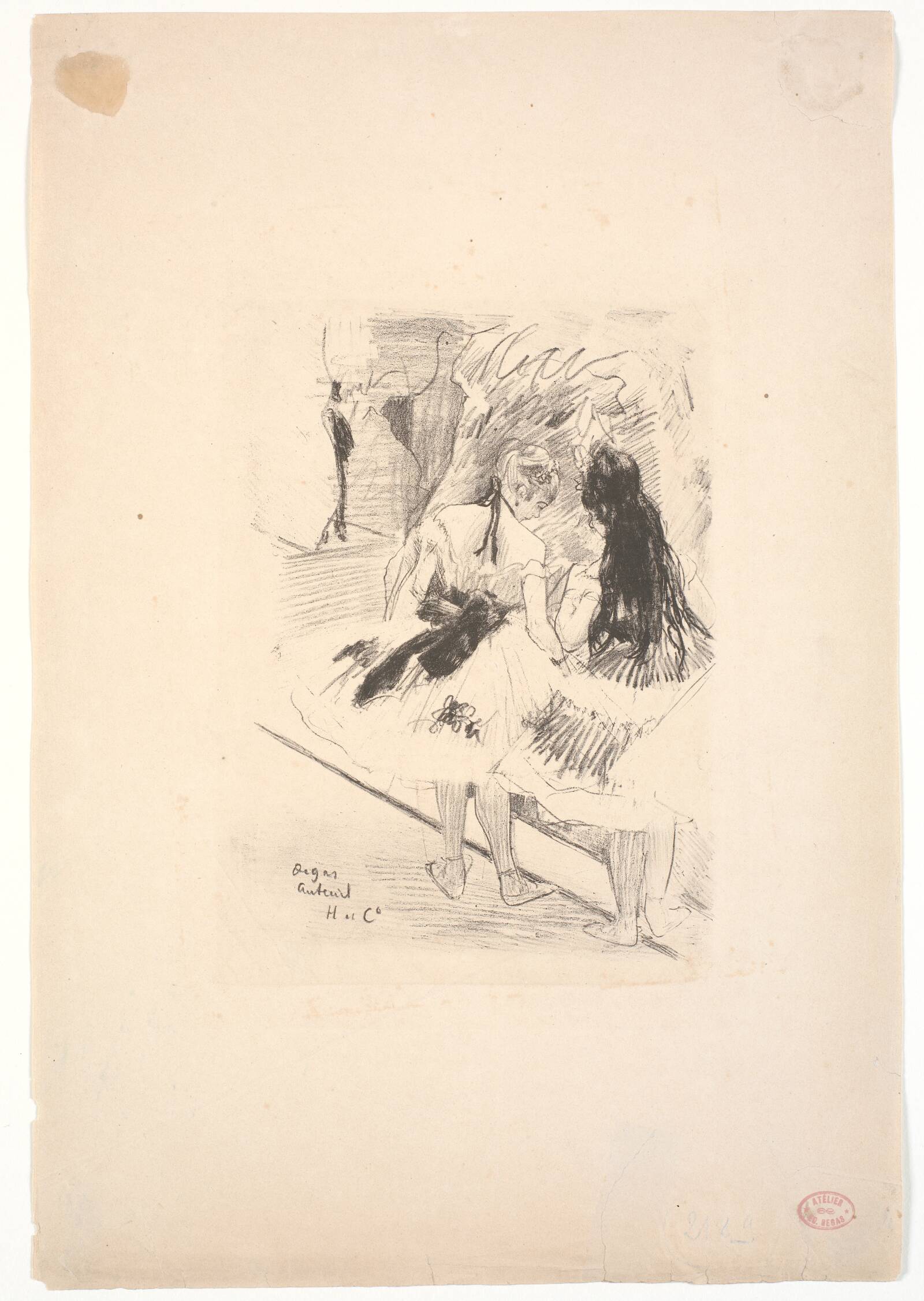
Dans la coulisse
Can I see it?
Not on view at present
Where is “Dans la coulisse” now? Collection: SMK — National Gallery of Denmark, Copenhagen. Not on view at present. Checked September 29, 2026.

Copenhagen, Denmark
It belongs to the collection, but is not on display at present.
- Checked
- In this state since
- Source
- The museum
Details
- Accession number
- KKS9154
In the catalog
Sources
- SMK
- Image: SMK — National Gallery of Denmark — public domain
In the life of Edgar Degas
The whole life1881
“The Little Dancer of Fourteen Years” on show
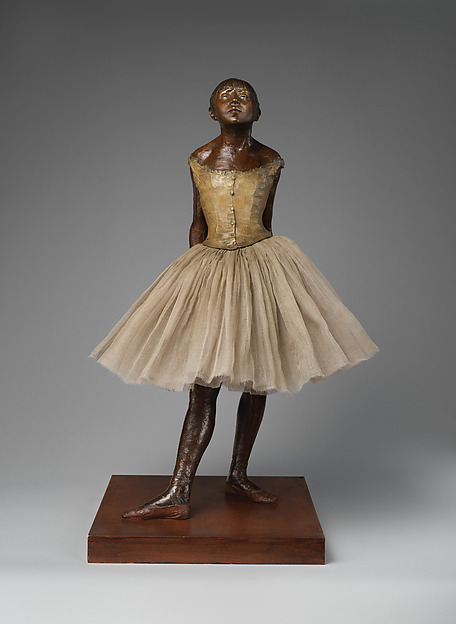
The nearly life-size wax figure with real hair and a cloth tutu, modelled on Marie van Goethem, provoked a strong reaction: critics found its realism extraordinary, but many denounced the dancer as ugly. It was the only sculpture Degas showed in his lifetime.
1881
The pastels “Criminal Physiognomies”
Degas attended the trial of the young gang members convicted of murder in the Abadie affair, sketchbook in hand, and in 1881 exhibited two pastels, “Criminal Physiognomies”. The drawings reveal his interest in features that some nineteenth-century scientists took as evidence of innate criminality.
by 1882
His eyesight sharply worsens
By 1882 Degas's eyesight began to worsen sharply: he turned to pastel and then to sculpture, where he could rely more on touch.
1886
The eighth exhibition: pastel nudes, and the end of the group
At the last Impressionist exhibition Degas showed a suite of pastel nudes, which drew more critical writing than anything else in his lifetime, mostly laudatory. The group broke up, partly through rancour over the inclusion of non-Impressionists such as Forain and Raffaëlli.
after 1886
Into the shadows: he stops exhibiting
After 1886 Degas stopped exhibiting and sold his pictures at high prices through a narrow circle of agents. By the end of the decade he had in effect fulfilled his wish to be “famous and unknown”, withdrawing among close friends.
late 1880s
A passion for photography
Degas photographed his friends, often by lamplight, as in the double portrait of Renoir and Mallarmé. Photographs of dancers and nudes served as references for his drawings and paintings.