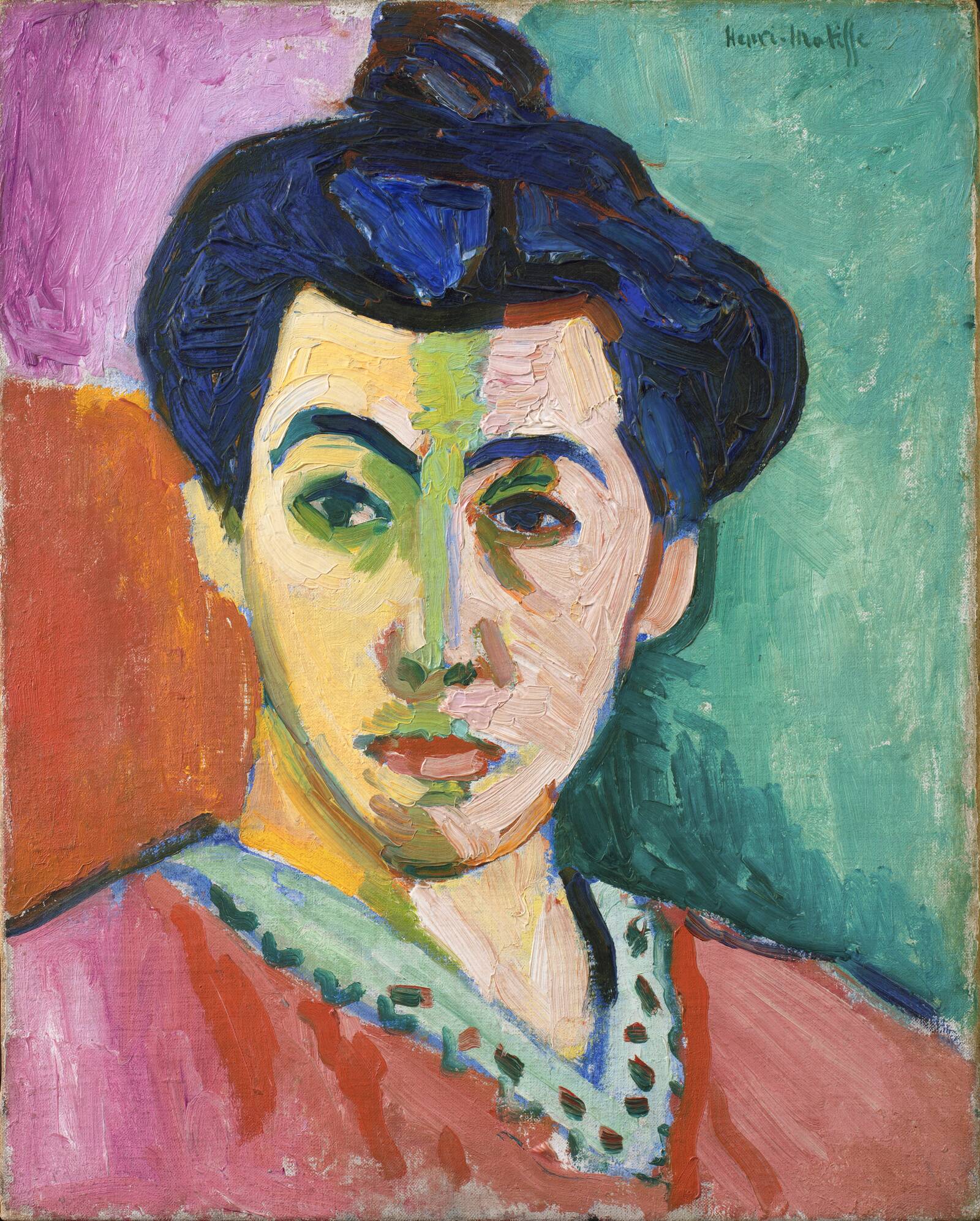
 Henri MatisseFrench, 1869–1954
The Green Stripe
Portræt af Madame Matisse. Den grønne stribe
May one see it?
Yes, receiving visitors

SMK — National Gallery of Denmark
Room213Copenhagen, Denmark
On public display.
- Checked
- 4 hours ago
- In this state since
- Sep 28, 2026
- Source
- The museum's own collection data
About the painting
The Green Stripe (also known as The Green Line or Madame Matisse) is an oil painting from 1905 by French artist Henri Matisse of his wife, Amélie Noellie Matisse-Parayre. The title stems from the vertical green stripe down the middle of Madame Matisse's face, is an artistic decision consistent with the techniques and values of Fauvism. The painting features a bust-length view of Madame Matisse in blocks of bold and vibrant colors. It is associated with the Fauvist Movement due to this unnatural and experimental use of color. The portrait has received both praise and criticism due to this technique as well as the artistic representation of the model. The Green Stripe is currently displayed in the Staten Museum for Kunst in Copenhagen, Denmark.
Particulars
- Accession number
- KMSr171
Comings and goings
On view · Sal 213
SMK · Sep 28, 2026 — now · Verified
Was on view
SMK · Aug 19, 2026 — Sep 28, 2026 · Verified
Sources
- SMK: the museum's own open data · fetched 4 days ago
- Image: SMK — National Gallery of Denmark — public domain
Meanwhile, in the life of Henri Matisse
The whole lifeJune 1904
First Solo Exhibition
Matisse's first solo exhibition was held at the gallery of Ambroise Vollard, though it was not a great success.
summer 1904
Summer in Saint-Tropez with Signac
Together with the Neo-Impressionists Paul Signac and Henri Cross, Matisse went to Saint-Tropez, where he began working in the Divisionist technique. There he painted his first masterpiece, "Luxe, Calme et Volupté" (1904/1905).
summer 1905
Collioure: The Birth of Fauvism
Matisse spent the summer of 1905 with André Derain and Maurice de Vlaminck in the fishing village of Collioure on the Mediterranean. Together with Derain he created a new style that entered art history as Fauvism.
October 1905
Scandal at the Salon d'Automne
Matisse showed "The Open Window" and "Woman with a Hat"; Louis Vauxcelles's review of 17 October 1905 gave the group the nickname "fauves" ("wild beasts"). "Woman with a Hat" was bought by Leo Stein for 500 francs, which raised the market value of the artist's work.
1906
Meeting Pablo Picasso
The first meeting between Matisse and Picasso took place at the Steins' salon on the Rue de Fleurus in Paris. Their creative friendship was full of rivalry and mutual respect.
20 March 1906
"Le Bonheur de Vivre" at the Salon des Indépendants
Matisse presented "Le Bonheur de Vivre" (The Joy of Life), a painting combining pastoral and bacchanal motifs. Critics and academic circles reacted with extreme irritation, but Leo Stein purchased this painting as well.