 Albrecht DürerGerman, 1471–1528
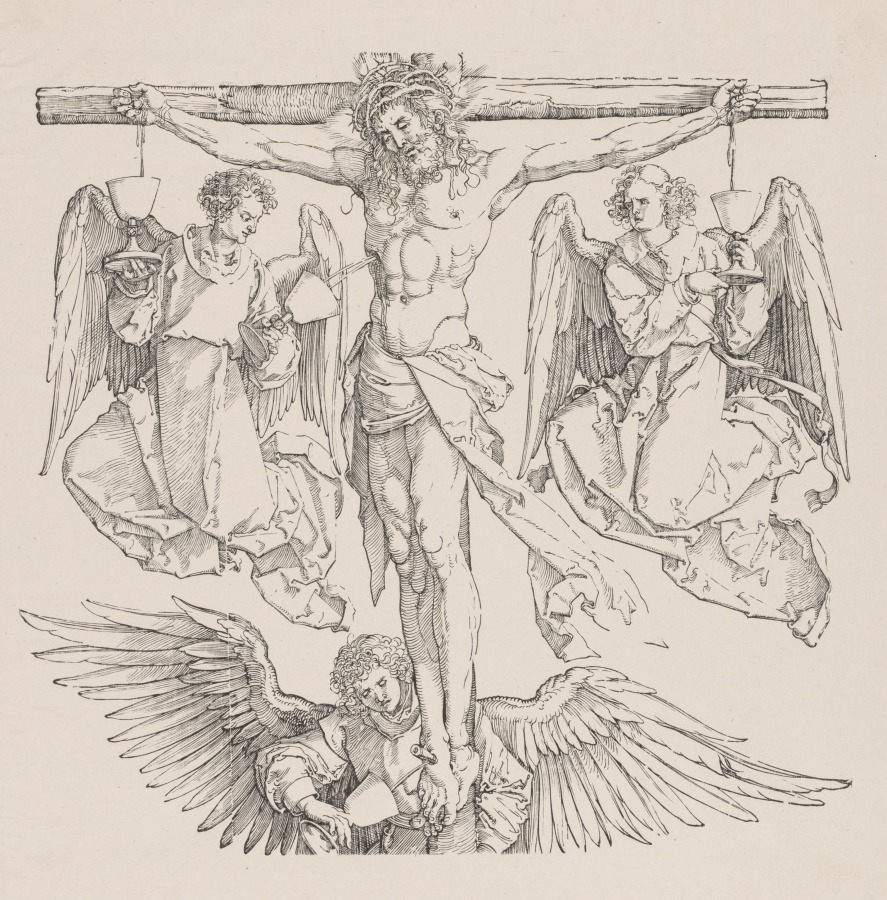
Christ on the Cross
Can I see it?
Not on view at present
Where is “Christ on the Cross” now? Collection: The Cleveland Museum of Art, Cleveland. Not on view at present. Checked October 12, 2026.

Cleveland, United States
It belongs to the collection, but is not on display at present.
- Checked
- In this state since
- Source
- The museum
Details
- Accession number
- 1923.243
In the catalog
Sources
- The Cleveland Museum of Art
- Image: The Cleveland Museum of Art — Museum open access
In the life of Albrecht Dürer
The whole life1507–1528 · Workplace
Nuremberg
1520–1521
An illness caught in the Netherlands
In the Netherlands Dürer caught an unknown illness, possibly malaria, whose attacks plagued him for the rest of his life. He drew himself pointing to his spleen, with the note: “Where the yellow spot is, and where I point with my finger, that is where it hurts.”
1520–1521
Meets Patinir, van Orley and Provoost
In the Netherlands Dürer met Bernard van Orley, Jan Provoost, Gerard Horenbout, Jean Mone, Joachim Patinir and Tommaso Vincidor, though apparently not Quentin Matsys.
1520–1521
Margaret of Austria rejects her father's portrait
Dürer offered his last portrait of Maximilian to the emperor's daughter, Margaret of Austria; she disliked it and refused it, and he ended up trading it for some white cloth. His diary shows that the journey brought him no profit.
1525
Publishes the Four Books on Measurement
His Four Books on Measurement (Instructions for Measuring with Compass and Ruler) appeared in Nuremberg, the first book for adults on mathematics in German, later cited by Galileo and Kepler. Dürer wrote in the craftsmen's vernacular rather than in Latin.
early 1525
The trial of the “three godless painters”
Three of Dürer's pupils — the brothers Hans Sebald and Barthel Beham and Georg Pencz — were charged with godlessness and banished from Nuremberg, and one of his best block-cutters, Hieronymus Andreae, was jailed for links with the rebel peasants. How Dürer himself took it is unknown.

![Madonna and Child [obverse], Albrecht Dürer, c. 1496/1499](https://api.nga.gov/iiif/878db7e6-10ae-4cae-ba5d-6d6f5c413ae8/full/!2400,2400/0/default.jpg)
![Lot and His Daughters [reverse], Albrecht Dürer, c. 1496/1499](https://api.nga.gov/iiif/7565a449-f82a-414b-9bda-c93f55a51b4d/full/!2400,2400/0/default.jpg)