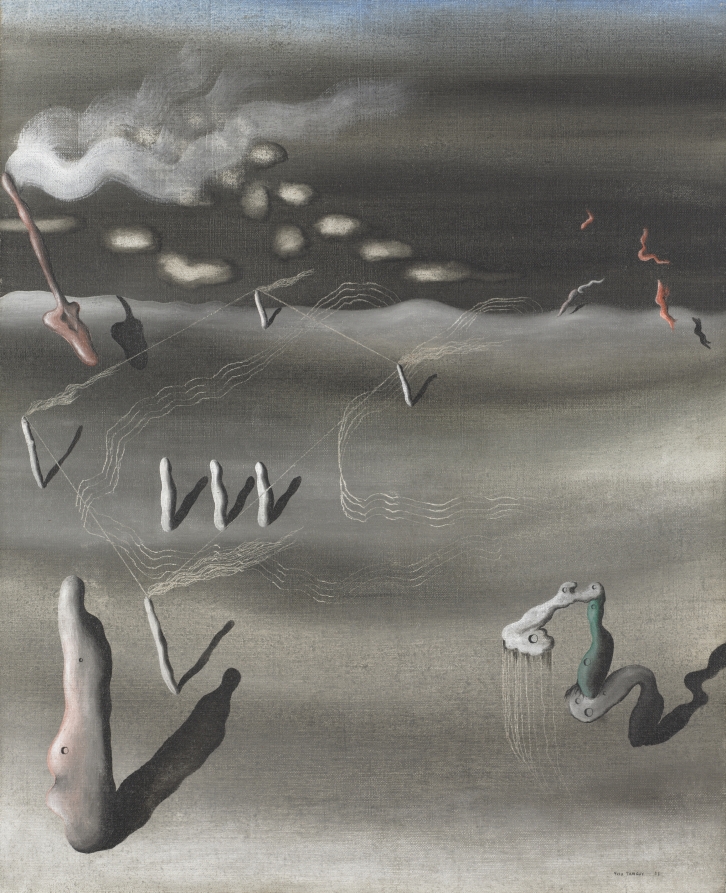
One of the most influential members of the Surrealist movement, Yves Tanguy painted this composition only four years after the movement was founded and two years after he developed his mature style. The composition depicts a series of mysterious forms floating in a dark, dreamlike landscape. Although the objects could indicate rocks, plants, internal organs, or menacing creatures, Tanguy deliberately ensures that the forms remain mysterious. The setting may suggest the ocean floor or a lunar landscape; it, like the objects that seem to animate the scene, is left up to the viewer to interpret according to their own imagination.
Having quickly developed a style of his own, he gives his first solo exhibition in Paris.
1927
Marries Jeannette Ducrocq
Later that same year he marries Jeannette Ducrocq (1896–1977), his first wife.
c. 1927
A contract with Breton for twelve paintings a year
André Breton gives him a contract to paint twelve pieces a year. With a fixed income, Tanguy paints less and ends up creating only eight works for Breton.
3 December 1930
Right-wing activists storm a screening of “L’Âge d’Or”
Activists of the right-wing Ligue des patriotes storm the lobby of the cinema at an early screening of Buñuel and Dalí’s film “L’Âge d’Or” and destroy works by Dalí, Miró, Man Ray and other Surrealists. Tanguy’s painting “Fraud in the Garden” (1930) is among those slashed; it has since been restored.
1930s
His influence on younger Surrealist painters
His style becomes an important influence on several younger painters — Roberto Matta, Wolfgang Paalen, Toyen and Esteban Francés — who adopt a Surrealist style in the 1930s.
1930s
A bohemian life and the failure of his first marriage
Throughout the 1930s Tanguy embraces the bohemian lifestyle of the struggling artist with gusto, which eventually leads to the failure of his first marriage, to Jeannette Ducrocq.