Albrecht DürerDeutschland, 1471–1528
Nemesis (The Great Fortune)
Darf man es sehen?
Ja, es empfängt Besucher

Öffentlich ausgestellt. Wer dafür bürgt, steht unten.

Sammlung: National Gallery of Art, Washington, D.C.
- Geprüft
- Unverändert seit
- Quelle
- Sammlungsdaten des Museums selbst
Über das Werk
In this print Dürer combines Nemesis, the classical goddess of retribution, whose goblet and bridle represent favor and castigation, with the traditional winged figure of Fortune standing on a globe. The landscape beneath the figure has been identified as a view of the South Tyrolean town on Chiusa (or Klausen), which Dürer presumably drew during his first journey to Venice in 1494-95. In his landscape, Dürer combines both a panoramic vastness and an amazing amount of identifiable detail. It looks remarkably like a view a modern traveler has from an airplane.
National Gallery of Art
Angaben
- Inventarnummer
- 1943.3.3485
What it shows
Im Katalog
Kommen und Gehen
Ausgestellt · 101B Prints & Drawings
Cleveland Museum of Art · 2. Okt. 2026 — jetzt · Geprüft
Ausgestellt · 101B Prints & Drawings
National Gallery of Art · 29. Sept. 2026 — 2. Okt. 2026 · Geprüft
Ausgestellt · 101B Prints & Drawings
Cleveland Museum of Art · 29. Sept. 2026 — 29. Sept. 2026 · Geprüft
Ausgestellt · 101B Prints & Drawings
National Gallery of Art · 29. Sept. 2026 — 29. Sept. 2026 · Geprüft
Ausgestellt · 101B Prints & Drawings
Cleveland Museum of Art · 28. Sept. 2026 — 29. Sept. 2026 · Geprüft
Ausgestellt · 101B Prints & Drawings
National Gallery of Art · 28. Sept. 2026 — 28. Sept. 2026 · Geprüft
Ausgestellt · 101B Prints & Drawings
Cleveland Museum of Art · 27. Sept. 2026 — 28. Sept. 2026 · Geprüft
Ausgestellt · 101B Prints & Drawings
National Gallery of Art · 26. Sept. 2026 — 27. Sept. 2026 · Geprüft
Ausgestellt · 101B Prints & Drawings
Cleveland Museum of Art · 19. Aug. 2026 — 26. Sept. 2026 · Geprüft
Quellen
- Cleveland Museum of Art: the museum's own open data · abgerufen vor 7 Tagen
- Bild: National Gallery of Art — Museum open access
Derweil im Leben von Albrecht Dürer
Das ganze Leben1500
Jacopo de' Barbari and the secret of proportion
The Venetian Jacopo de' Barbari, whom Dürer had met in Venice, came to Nuremberg, and Dürer said he learned much from him about perspective, anatomy and proportion. Feeling that de' Barbari would not explain everything he knew, Dürer began studies of his own that became a lifelong preoccupation.
1501–1502
In the circle of Nuremberg's humanists
Through his lifelong friend Willibald Pirckheimer, Dürer entered the circle of Nuremberg's humanists. He engraved illustrations for Conrad Celtis's editions of Hrotsvitha (1501) and of his Four Books of Love (1502), and decorated 14 books in Pirckheimer's library with drawings.
1502
Death of his father
Albrecht Dürer the Elder died, and his son took on the care of his mother and his two younger brothers, Endres and Hans.
1504 · Wirkungsort
Lutherstadt Wittenberg
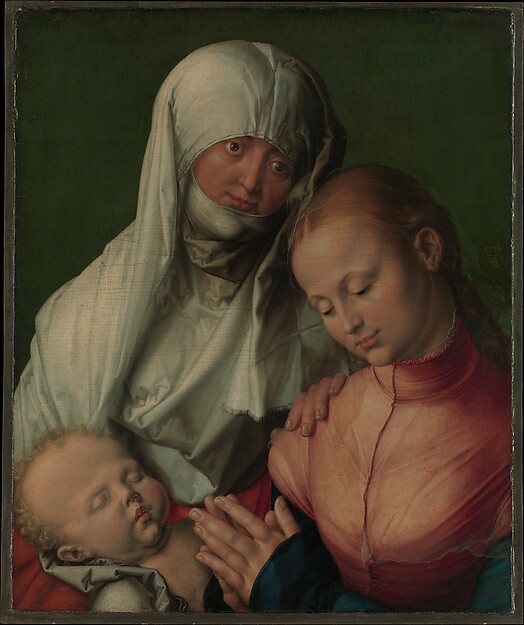
![Madonna and Child [obverse], Albrecht Dürer, c. 1496/1499](https://api.nga.gov/iiif/878db7e6-10ae-4cae-ba5d-6d6f5c413ae8/full/!2400,2400/0/default.jpg)
![Lot and His Daughters [reverse], Albrecht Dürer, c. 1496/1499](https://api.nga.gov/iiif/7565a449-f82a-414b-9bda-c93f55a51b4d/full/!2400,2400/0/default.jpg)