 Paul GauguinFrankreich, 1848–1903
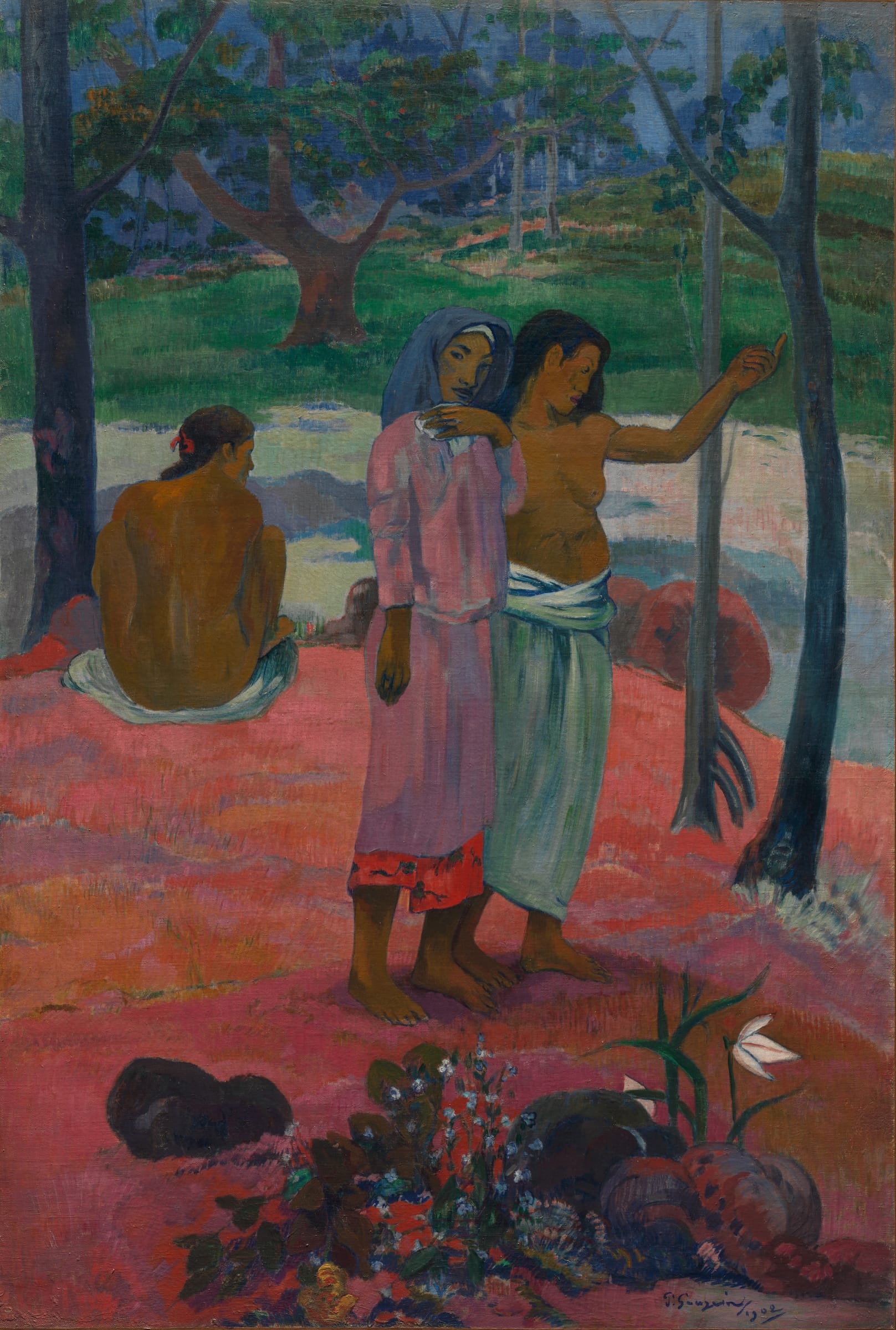
The Call
Darf man es sehen?
Ja, es empfängt Besucher

Öffentlich ausgestellt. Wer dafür bürgt, steht unten.
- Geprüft
- Unverändert seit
- Quelle
- Sammlungsdaten des Museums selbst
About the painting
The Call is a 1902 painting by Paul Gauguin, produced in Marquesas, Polynesia a year before the artist's death. It is now in the Cleveland Museum of Art.
The pose of woman on the right extending her hand is a reference to a frieze from the Parthenon.
In the museum's words
Painted on a remote island in Polynesia a year before the artist's death, The Call belongs to a series of late works that explore the mysteries of life and death. Two women stand with bare feet, as if on sacred ground. One woman gestures to someone outside the picture, perhaps responding to a "call" from fate or destiny. Gauguin realized his ambition of painting from memory and the imagination through such mysterious, dreamlike images.
Cleveland Museum of Art
Angaben
- Inventarnummer
- 1943.392
Im Katalog
Quellen
- Cleveland Museum of Art: the museum's own open data · abgerufen vor 6 Tagen
- Bild: Cleveland Museum of Art — CC0 (Cleveland Museum of Art Open Access)
Derweil im Leben von Paul Gauguin
Das ganze Leben1891–1901 · Wirkungsort
Tahiti
February 1900
Editor of the Newspaper Les Guêpes
In February 1900 Gauguin became editor of the local newspaper Les Guêpes, receiving a salary for it, and remained in the post until his departure from Tahiti in September 1901; the paper was known for its vicious attacks on the governor and officialdom.
last years of life
Illnesses of the Final Years
In his last years the artist suffered severely from heart disease, eczema, and the after-effects of arsenic poisoning; the intense pain had to be dulled with morphine. His situation was aggravated by constant conflicts with the administration over his attempts to defend the rights of the native population.
16 September 1901
Move to Hiva Oa, the House of Pleasure
On 16 September 1901 Gauguin arrived at Atuona on the island of Hiva Oa (Marquesas Islands), where he bought a plot from the Catholic mission and built a two-story house he named the Maison du Jouir ("House of Pleasure"). Here, despite illness and poverty, he worked at full strength — painting landscapes, writing stories, and engaging in journalism.
27 March 1903
Sentence: Fine and Three Months in Prison
After Gauguin's campaign against the gendarmes and his accusations of corruption, the gendarme Claverie sued him for libel: on 27 March 1903 the local magistrate sentenced the artist to a fine of 500 francs and three months in prison. Gauguin appealed to Papeete, but the imprisonment was never carried out — he died shortly afterwards.
8. Mai 1903
Died



![Pair of Wooden Shoes (Sabots) [left], Paul Gauguin, 1889/1890](https://api.nga.gov/iiif/44a731a9-e900-4898-a282-01034fcaa6ca/full/!2400,2400/0/default.jpg)