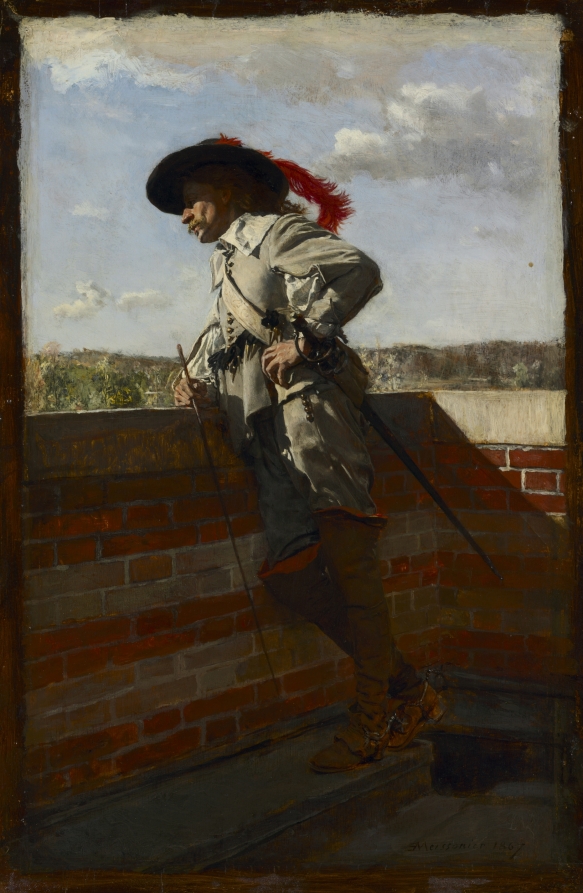
 Jean-Louis-Ernest MeissonierFrankreich, 1815–1891
On a Terrace
Darf man es sehen?
Ja, es empfängt Besucher

Öffentlich ausgestellt. Wer dafür bürgt, steht unten.
- Geprüft
- Unverändert seit
- Quelle
- Sammlungsdaten des Museums selbst
About the painting
Trained as a printmaker and book illustrator, Meissonier specialized in small paintings depicting scenes from French history and literature. This painting on wood panel depicts a man dressed like a character from The Three Musketeers (published in 1844) by Alexandre Dumas père. Such paintings, admired for their technical virtuosity and romantic subjects, were immensely popular. Meissonier also painted contemporary military subjects and themes and became an arch-foe of the Realist painter Gustave Courbet.
Cleveland Museum of Art
Angaben
- Inventarnummer
- 1986.68
Im Katalog
Quellen
- Cleveland Museum of Art: the museum's own open data · abgerufen vor 7 Tagen
- Bild: Cleveland Museum of Art — Museum open access
Derweil im Leben von Jean-Louis-Ernest Meissonier
Das ganze Leben1860s
A turn to battle subjects and high prices
In the 1860s he begins to paint historical and battle scenes from the time of the French Revolution, the Napoleonic Wars and the conflicts of Emperor Napoleon III; his contemporaries valued them even more than his earlier genre works. In time he received 300,000 francs each for The Charge of the Cuirassiers and Napoleon I in 1814, and 200,000 for Napoleon III at Solferino, which its first owner later resold for 850,000.
1867 · Auszeichnung
Commander of the Legion of Honour
June 1868
Travels to Antibes with easel, family and horses
In June 1868 Meissonier travels to Antibes with canvas and easel, his wife, son and daughter, and two of his horses, Bachelier and Lady Coningham. The light of the south attracted him: in the Antibes landscapes he, possibly under the influence of plein-air landscapists, abandoned for a while his obsession with historical authenticity in favour of something more spontaneous.