Can I see it?
Where to See Salvador Dalí: Melting Watches, a Lobster Telephone and the Last Supper
Dalí said his soft watches arrived in a flash after a meal of Camembert. The paint tells a less convenient story, and it is a good place to start looking past the moustache.
2. november 2026 · 7 min. læsning · ART WIKI’s redaktion
Dinner was over, the Camembert was soft, and Salvador Dalí had an idea. That, at least, was his account of The Persistence of Memory, written a decade later. He claimed to have finished it in two hours. Examination of the paint complicates the anecdote. The branch underneath a hanging watch was never painted continuously; space for the watch had been reserved. Dalí had planned the encounter before telling us it happened by surprise. The improbably quick masterpiece belongs to his autobiography. The carefully constructed painting belongs to New York's Museum of Modern Art.
New York: a small painting with a long shadow
At just over 24 by 33 centimetres, The Persistence of Memory can feel almost private after its enormous life in reproductions. On our autumn 2026 check, it was on MoMA's fifth floor, in gallery 517. The gold cliffs recall the Catalan coast; below them, a fleshy profile sags under another watch. Ants gather on the one timepiece that still looks solid. The landscape is sufficiently precise to make the impossible objects look like evidence. It is worth letting the empty sea occupy as much of your attention as the watches.
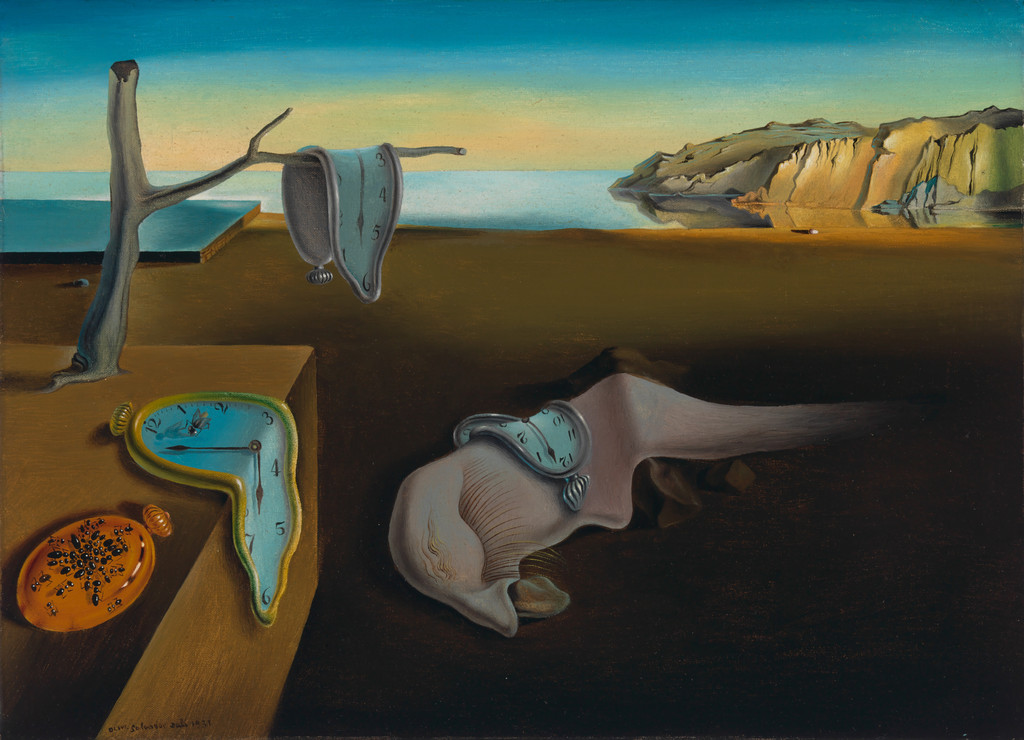
Paris did not immediately buy the promise. The painting remained unsold at its first exhibition there in 1931; its appearance at Julien Levy's New York gallery in January 1932 helped turn it into a sensation. An anonymous gift brought it to MoMA in 1934. That journey matters when looking at this apparently solitary dream. A dealer, a transatlantic audience and a museum helped make the private landscape into a public image. Its small size made no obstacle to that enlargement of reputation.
Madrid: before the friendship became a film
Luis Buñuel looks down from his portrait as though he has already judged the spectator. Dalí painted Portrait of Luis Buñuel in 1924; it belongs to the Museo Reina Sofía. They had met at Madrid's Residencia de Estudiantes, whose circle included Federico García Lorca. Their collaboration on the film Un Chien Andalou came in 1929. Here the head remains firmly constructed, with a tiny landscape behind it. You can see a young painter testing how much volume and authority a face can carry, before either friend had made that assault on cinema.
Five years later, a head becomes an entire terrain in The Great Masturbator, also in the Reina Sofía. Dalí painted it at the end of summer 1929, after Gala stayed in Cadaqués while her husband, Paul Éluard, returned to Paris. Desire has company here. The grasshopper draws on a childhood fear, and the huge lowered face makes intimacy look exposed and precarious. Dalí kept the painting in his own collection. Unlike a portrait that fixes another person's appearance, it lets the painter's fears take possession of the body.

Chicago and Minneapolis: answering the lobster
A magazine photograph gave Dalí a different kind of face to rearrange. In Mae West's Face which May Be Used as a Surrealist Apartment, the film star's hair becomes curtains, her eyes become framed pictures and her nose becomes a fireplace. Her lips supply the sofa. The Art Institute of Chicago owns this 1934–35 image, which was not on view at our autumn 2026 check. Its joke is also a practical design proposal. You could furnish a room by following the face from forehead to chin, although you might never again look at your furniture innocently.
Edward James took that possibility seriously. He and Dalí developed furniture ideas during Dalí's stay at his London house in 1936; the lips eventually became real sofas. Minneapolis Institute of Art's Aphrodisiac Telephone belongs to the same domestic adventure. Eleven working telephones were made for James's homes, with plaster lobsters fitted over their receivers. The Minneapolis example was not on view on our autumn 2026 check. Knowing it was designed to function changes the joke. Someone was meant to lift the crustacean to an ear and conduct an otherwise ordinary conversation.
Washington: seven thousand people come to supper
Easter was approaching when Washington unveiled The Sacrament of the Last Supper on 31 March 1956. More than seven thousand visitors came on the first day. Dalí had spent nine months on the painting, acquired by Chester Dale. Christ is transparent; the twelve participants occupy a symmetrical arrangement beneath a dodecahedron, a solid with twelve pentagonal faces. The National Gallery of Art recorded it in M-100 on our autumn 2026 check. The sea behind the table returns the sacred gathering to a landscape associated with Dalí's Catalan home.
Allow a separate visit in your imagination for this later Dalí. After the compressed anxieties of Madrid and the soft watches in New York, Washington's table can look disconcertingly orderly. Choose your actual museum around the picture you want to meet, and recheck that particular work before travelling. For the Chicago image and Minneapolis telephone, our last checks mean you should wait for a confirmed display rather than build a journey around the collection address alone.
På forsiden: Erindringens bestandighed — Salvador Dalí. © the artist or rights holder
Mere at læse
Where to see an artist →Can I see it?
Where to See William Bouguereau: The Birth of Venus and a Fight in Hell
The painter of polished goddesses also painted a man biting another man's neck. Following Bouguereau from Paris to American collections means looking at the ambition beneath the immaculate skin.
Can I see it?
Where to See Edward Hopper: Nighthawks, Empty Streets and a Warning at Sea
The diner has no visible entrance, the familiar street has impossible shadows, and the cinema was assembled from several buildings. Hopper's America looks observed because he edited it so carefully.
Can I see it?
Where to See Élisabeth Vigée Le Brun: Marie Antoinette, Self-Portraits and a Life in Exile
A change of dress could rescue a royal portrait from scandal. Vigée Le Brun understood what an image could do for a sitter, and used the same intelligence to build her own career across Europe.