Can I see it?
Where to See Edward Hopper: Nighthawks, Empty Streets and a Warning at Sea
The diner has no visible entrance, the familiar street has impossible shadows, and the cinema was assembled from several buildings. Hopper's America looks observed because he edited it so carefully.
2. november 2026 · 7 min. læsning · ART WIKI’s redaktion
Jo Hopper wrote to her sister-in-law in January 1942 with news of a finished picture. Edward had posed for the two men using a mirror; she had posed for the woman. For about six weeks, the lunch counter at night had absorbed him. The result was Nighthawks, now at the Art Institute of Chicago. That ordinary domestic arrangement sits behind one of painting's least approachable public places. Two people working at home invented four people whom generations of viewers have tried, unsuccessfully, to get to know.
Chicago: the coffee is inside, but you are outside
The glass in Nighthawks gives a clear view and refuses entry. Hopper omitted any visible door. Three customers and a counterman occupy a pool of artificial light while the street stays empty. He recalled a restaurant on Greenwich Avenue where two streets met, but enlarged and simplified it for the painting. The Art Institute acquired the canvas in 1942; our autumn 2026 check found it in gallery 262. Resist supplying the people with a complete story. You cannot tell how long they have been there, what brought them together or who will leave first.

A letter to the museum's director in May 1942 records Hopper's pleasure at the purchase. He thought the previous winter had brought him closer to saying what he wanted in paint. His interests extended beyond the street outside his studio: he admired Hemingway's diner story The Killers and went to the movies. That does not turn the painted counter into an illustration of a particular plot. It helps explain why a scene in which almost nothing happens can feel like a story interrupted at the instant before we arrived.
New York: a museum buys an empty morning
Juliana Force and Gertrude Vanderbilt Whitney bought Early Sunday Morning in 1930, and it became a centrepiece of the new Whitney Museum's opening exhibition. The painting was on view there at our autumn 2026 check. Long before this institutional welcome, the Whitney Studio Club had given Hopper his first solo exhibition in 1920. The row of shopfronts therefore belongs to a story of patient support as well as a history of New York streets. A museum placed an image of almost nothing happening near the centre of its own beginning.
Seventh Avenue supplied the starting point for Early Sunday Morning, but geography cannot quite account for it. The avenue runs north to south, so those long shadows do not behave as morning shadows would at the site. Shop signs refuse to become readable advertisements. Upstairs curtains differ from window to window, suggesting inhabitants without showing them. Hopper gives enough information to make the place familiar, then withdraws the information that would make it useful as a record. The barber pole and hydrant have taken over the pavement usually occupied by people.
MoMA: a house behind a barrier
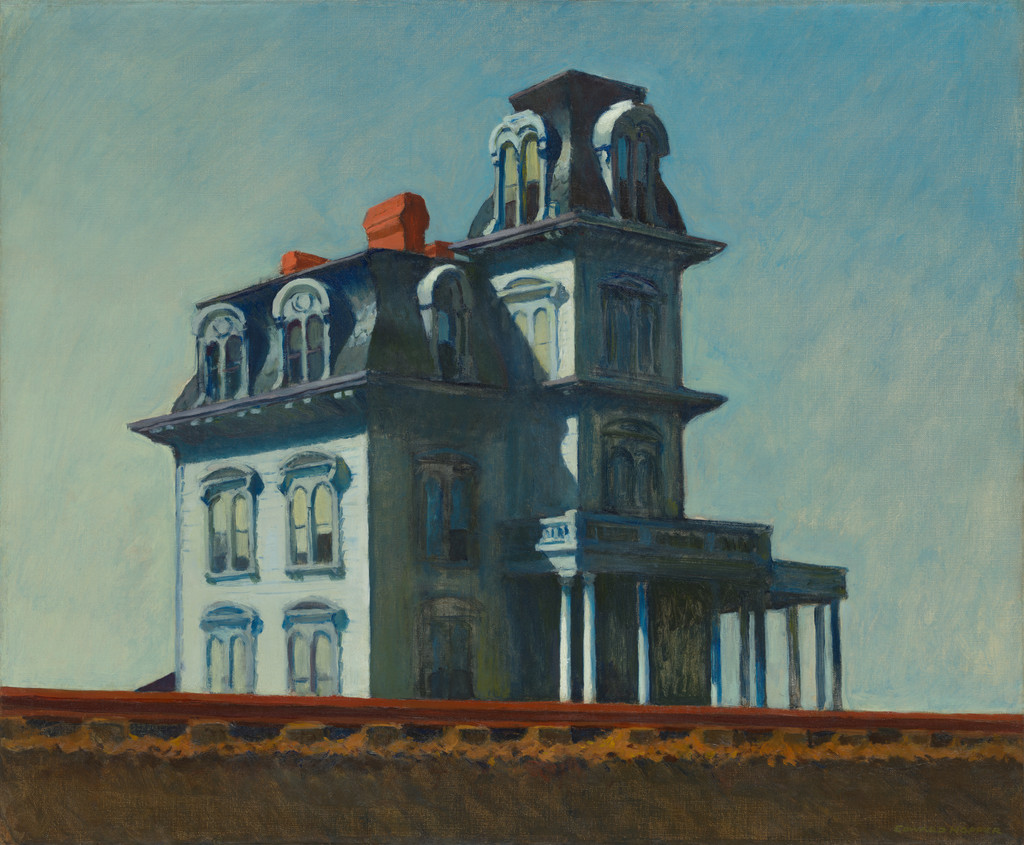
An anonymous gift made House by the Railroad the first painting acquired by MoMA, in January 1930. It was in fifth-floor gallery 521 on our autumn 2026 check. The Victorian house rises behind railway tracks that cut across its base, leaving the viewer without a comfortable route to the front door. It is tempting to call the building abandoned, but the canvas does not establish that. What it establishes is distance. Windows, projecting bays and the elaborate roof offer plenty to examine while the strip of railway keeps the ground out of reach.
Memories of several service stations went into Gas, painted in 1940. MoMA held it in gallery 519 on the fifth floor at our autumn 2026 check. A lone attendant works among red pumps as daylight drains from the roadside and the station's own light begins to count. Searching for the exact station would miss the construction. Hopper has brought separate observations into a place that seems ready for a customer who never arrives. The road continues beyond the lit patch; the picture stops before telling us what waits along it.
Fifty-three surviving sketches expose the labour behind New York Movie. Hopper borrowed details from several cinemas and used Jo as the usherette's model at home. A decorated column divides the spectators watching the screen from the employee standing beside the stairs. For one group, this is entertainment; for the other person, it is a workplace and an interval in a shift. MoMA owns the 1939 painting, but it was not on view at our autumn 2026 check. Do not assume that seeing the house and the filling station means this canvas will be available too.
Madrid and Washington: sunlight does not settle everything
Before those cinemas and diners came Girl at Sewing Machine, painted about 1921 and owned by Madrid's Thyssen-Bornemisza Museum. Hopper had spent years illustrating magazines and had travelled to Paris several times. Here a woman's hair almost hides her face as she bends over her work beside a window. Light falls into the dark interior, making the white clothing and the geometry of the wall compete for attention. Nothing tells us that she is unhappy. Concentration can look like solitude when the observer is excluded from the task.
Everyone aboard the boat in Ground Swell looks towards a bell buoy. Hopper finished the painting in September 1939; historian Alexander Nemerov connects its suggestion of distant disturbance with radio news of the outbreak of war. That is an interpretation, not a declared programme. The sunny scene belongs to Washington's National Gallery of Art, where our autumn 2026 check recorded gallery G-006. The buoy supplies a warning in an otherwise inviting sea. You can enjoy the blue water and still wonder what has drawn every person's attention away from the horizon.
Build a New York visit around the Whitney and MoMA if you want several sides of Hopper within one city; choose Chicago if the diner is the picture you have been waiting to see. Check individual displays before travelling. Afterwards, leave your camera in your pocket for the first block outside: look at the gaps between people and the places where a window lets you see without letting you in.
På forsiden: Nighthawks — Edward Hopper. © the artist or rights holder
Mere at læse
Where to see an artist →Can I see it?
Where to See Élisabeth Vigée Le Brun: Marie Antoinette, Self-Portraits and a Life in Exile
A change of dress could rescue a royal portrait from scandal. Vigée Le Brun understood what an image could do for a sitter, and used the same intelligence to build her own career across Europe.
Can I see it?
Where to See Guercino: A Rediscovered Samson, Death in Arcadia and a Pope at His Desk
A lost painting turned up in a Beirut palace. Guercino's pictures have travelled far from Cento, but their stories still turn on intimate things: a back, an empty bowl, a hand that will not let go.
Can I see it?
Where to See Jacob van Ruisdael: Windmills, Waterfalls and Invented Hills
A Dutch windmill can look as imposing as a cathedral. Ruisdael knew how to make that happen, and sometimes moved the landscape around to help.