 Salvador DalíSpanien, 1904–1989
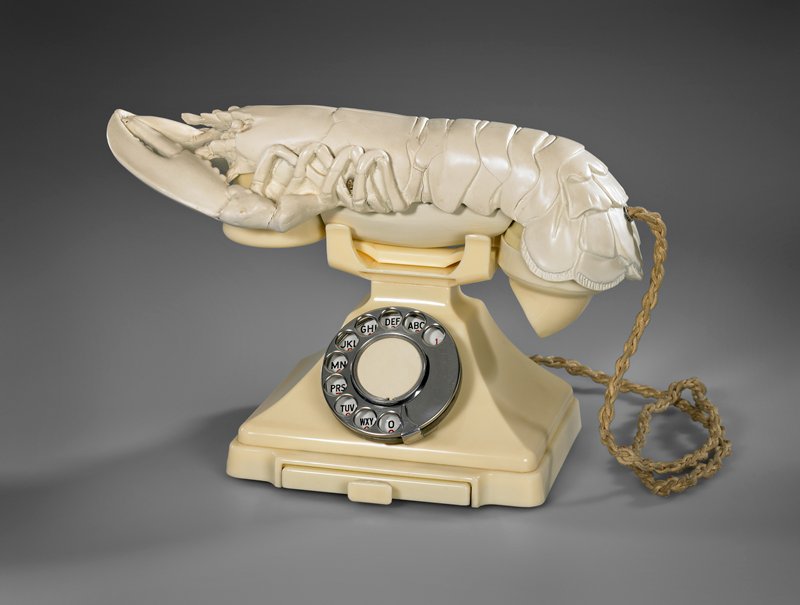
Aphrodisiac Telephone
Kan det ses?
Ikke udstillet lige nu
Hvor er »Aphrodisiac Telephone« i dag? Samling: Minneapolis Institute of Art, Minneapolis. Ikke udstillet lige nu. Kontrolleret 29. september 2026.

Minneapolis, USA
Det hører til samlingen, men er ikke udstillet for tiden.
- Kontrolleret
- Uændret siden
- Kilde
- Museet
Om skulpturen
Lobster Telephone (also known as Aphrodisiac Telephone) is a Surrealist object, created by Salvador Dalí in 1936 for the English poet Edward James (1907–1984), a leading collector of surrealist art. In his 1942 book The Secret Life of Salvador Dalí, Dalí wrote teasingly of his demand to know why, when he asked for a grilled lobster in a restaurant, he was never presented with a boiled telephone.
Med museets ord
In the 1930s, virtually every major surrealist artist championed the modified found object as the ultimate modern art form. This lobster telephone is one of six all white versions that Dali made in association with the pioneering British interior designer Syrie Maugham (1879-1955) for the home of the surrealist collector Edward James.
This classic Surrealist piece was among the most desirable 1930s original objects still obtainable when it was acquired with museum funds in 1996. Very few of these imaginatively transformed household items remain, although several have been issued as editions. Potentially functional, four versions with red lobsters have survived as well.
Minneapolis Institute of Art
Oplysninger
- Inventarnummer
- 96.2
I kataloget
Kilder
- Minneapolis Institute of Art
- Billede: Minneapolis Institute of Art — © Salvador Dali, Gala-Salvador Dali Foundation / Artists Rights Society (ARS), New York
Imens i livet hos Salvador Dalí
Hele livet1936
A lecture in a diving suit in London
At the International Surrealist Exhibition in London Dalí lectured in a deep-sea diving suit and helmet, which had to be unscrewed when he gasped for breath. “I just wanted to show that I was plunging deeply into the human mind,” he said.
1936
The Spanish Civil War and Lorca's death
The Civil War found Dalí in London. On learning that his friend Lorca had been executed by Nationalist forces, he claimed to have shouted “Olé!”, yet he referred to the poet in his art and writings for the rest of his life; he never took a public stand for or against the Republic.
1936
MoMA show and the cover of Time
Dalí took part in MoMA's “Fantastic Art, Dada, Surrealism” and held a solo show at Julien Levy's; “Soft Construction with Boiled Beans (Premonition of Civil War)” drew particular attention. On 14 December the 32-year-old Dalí was on the cover of Time magazine.
March 1938
Meets Sigmund Freud
Thanks to Stefan Zweig, Dalí met Freud and sketched his portrait; Freud whispered, “That boy looks like a fanatic.” The next day Freud wrote to Zweig that he had regarded the Surrealists as complete fools, but “that young Spaniard, with his candid fanatical eyes” had changed his estimate.
April 1939
The break with Buñuel
Soon after Franco's victory in the Civil War, Dalí wrote to Luis Buñuel denouncing socialism and Marxism and praising Catholicism and the Falange, and Buñuel broke off relations with him.
June – August 1940
Fleeing the war to the United States
The Second World War found the Dalís in France; they took refuge in Arcachon, where he painted “Slave Market with the Disappearing Bust of Voltaire”. On 20 June 1940 the Portuguese consul in Bordeaux, Aristides de Sousa Mendes, issued them visas, and in August they sailed from Lisbon to New York, to live in the United States for eight years.