City guide
Art in Autun: Eve, Jean Hey and the Musée Rolin in One Day
A medieval Eve survived inside a house wall; a cardinal brought his dog into the Nativity. Follow their stories between Autun’s temporary museum exhibition, cathedral and Roman ruins.
2. november 2026 · 7 min. læsning · ART WIKI’s redaktion
Eve reaches backwards without looking at the fruit. Her body follows the narrow strip of stone as though a doorway had taught it to move. Her face turns one way while her hand has already committed itself to another. The twelfth-century Temptation of Eve, traditionally attributed to Gislebertus, belongs to the Musée Rolin. Its original setting, the cathedral of Saint-Lazare, still gives the sculpture a city around it.
Plan the visit around a temporary arrangement. The Musée Rolin is closed for a major rebuilding project; a selection from its collections is presented as Merveilles choisies at the natural history museum in impasse Rollet. Begin there, then climb towards the cathedral and the old Rolin mansion. Allow the afternoon for the Roman remains beyond the centre. The changes of address are part of the story here: sacred images became building material, a family house became a museum, and a prison is being drawn into its future.
Eve: the stone that came back from a wall
In 1766, the cathedral’s side portal was dismantled and its sculpture dispersed. The surviving Eve was reused in a house. A century later, work to install a shop exposed the relief inside the masonry; the architect Jean Roidot-Houdaille acquired it. There is something almost unbearable about the conjunction. A figure made to warn people about a fatal choice survived because someone wanted useful stone, and reappeared because someone wanted retail space. Neither operation required anyone to care about medieval sculpture.
Look closely at the mismatch between her limbs and the surrounding branches. Knees, elbows and foliage make a broken rhythm across the rectangle; the head interrupts it with a face that seems occupied elsewhere. The fruit is being taken behind her back. A clawed hand bends the branch towards her. What remains is enough to make the temptation legible, although the figure of Adam that once faced her has disappeared. The absent companion matters: an apparently self-contained image began as one part of a conversation across a church entrance.
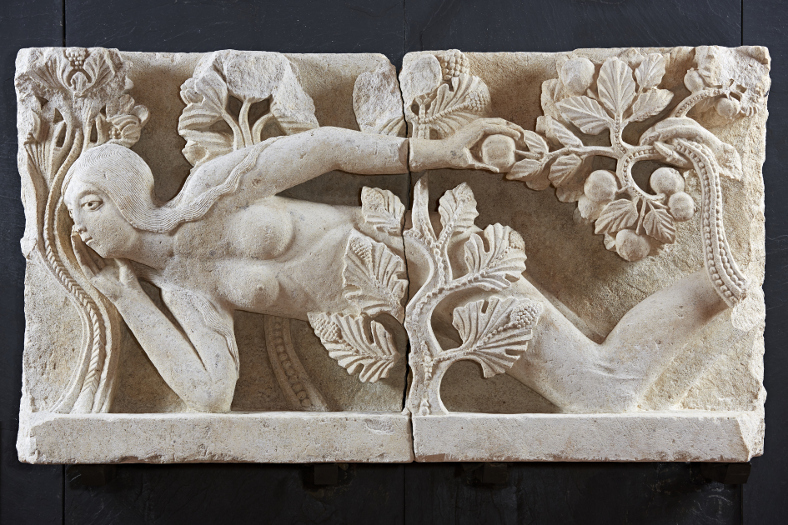
At Saint-Lazare, consider the practical difference between a museum encounter and a doorway. A relief above an entrance meets people passing underneath; a detached fragment permits a longer, closer inspection. Neither position is neutral. It is tempting to imagine that the present object has always looked complete because its contours now seem so persuasive. Remember the missing stone. Autun rewards the visitor who asks what a beautiful fragment used to be attached to.
A cardinal brings his dog to Bethlehem
The little dog has made itself comfortable beside an exceptionally well-dressed worshipper. In Jean Hey’s Nativity with Cardinal Jean Rolin, painted in 1480, the donor kneels at the right while the child lies at the left. The cardinal’s hat and arms hang from a beam of the stable. These are rather elaborate arrangements for a humble birthplace. His presence asks for prayer and remembrance, but he has also made certain that posterity will have no difficulty identifying him.
Jean was the son of Nicolas Rolin, the Burgundian chancellor whose fifteenth-century mansion became the museum’s home. His patronage changed the skyline too: he had Saint-Lazare’s spire built in 1469. This makes the walk between the cathedral and the house unusually satisfying. A family name that might pass unnoticed on a museum sign becomes a person in a painting, then a piece of architecture overhead. Power could pay for masonry and for the image of its own devotion.

The panel originally belonged to the vestment room that the cardinal built at the cathedral, now the chapel of Saint Joseph. Its small scale suits a meeting at close quarters. Follow the fence towards the shepherds and the landscape beyond, then return to the donor’s kneeling figure. The solemnity keeps being interrupted by ordinary occupation: people lean on a barrier, an animal settles down, a hat has been put away. Bethlehem feels inhabited, even while the cardinal arranges his place within it.
Anne Boleyn and the nineteenth century’s appetite for grief
A queen’s arrest offered Édouard Cibot a very different kind of religious and political theatre. His Anne Boleyn in the Tower of London in the First Moments of Her Arrest dates from 1835, almost three centuries after the event. Two women occupy a dark interior; distress supplies the action. The distance in time is essential to looking at this picture. Cibot could invent the private interval that official history leaves out, when news has arrived but its consequences have not yet been fully understood.
Anne was arrested on 2 May 1536 and taken to the Tower by barge. Her prison accommodation was the royal apartment where she had awaited her coronation three years earlier. On 19 May she was executed. Those rooms make the reversal more chilling than any imagined dungeon: the same place could receive a prospective queen and contain a condemned one. Carry that knowledge back to the canvas, without treating its gestures or furnishings as eyewitness evidence.

Autun bought the painting in 1982 from the Heim Gallery. It therefore entered the collection through a modern decision, unlike the religious objects inherited from local buildings. That distinction gives the museum some useful unpredictability. A city collection need not restrict itself to people born nearby. Here, a French painter’s imagined Tudor tragedy sits within an institution otherwise so closely entangled with the surrounding streets.
Across the Arroux, a temple with the wrong name
The name Temple of Janus supplies an easy explanation for the tall Roman ruin northwest of town, across the Arroux. It is also misleading. The association arose from an interpretation of the place-name Genetoye, which refers to broom bushes. Archaeologists have found an offering naming Ieniecus, possibly one of the sanctuary’s deities. A familiar Roman god has obscured a much less familiar local one. Reading the name on a map is only the beginning of understanding the place.
Two walls of the central chamber still rise more than twenty metres. Their survival owes something to reuse: the temple became part of a medieval fortified structure. After Eve’s journey through a domestic wall, this is a different outcome of the same human habit of finding new uses for old stone. Leave enough space around this stop to walk and look up; its scale is difficult to absorb from a photograph.
Back near Saint-Lazare, the future Panoptique will unite the Rolin mansion, a former courthouse and the circular prison. For a visit now, check the temporary exhibition’s dates and selection before booking around a particular picture. Put the indoor stop first in uncertain weather, keep daylight for the temple, and choose shoes for the uphill return. Autun is small enough to tempt a hurried visit; the climb is a good reason to refuse one.
På forsiden: La tentation d'Eve — Gislebertus. © S. Prost; Ministère de la Culture (France), base Joconde
Mere at læse
Art city by city →City guide
Art in Rennes: Rubens, Veronese and the Parlement de Bretagne in Two Days
A Bavarian prince’s hunting picture reached Rennes after a military seizure. Start with its smallest animal, then follow the city’s art from a private cabinet to a palace rescued from fire.
City guide
Art in Lyon: Renoir, Suzanne Valadon and the Musée des Beaux-Arts in Two Days
A convent lived partly on shop rents, a museum helped the silk trade, and an actress left the city her paintings. Lyon’s art is tangled up with the ways people earn, believe and choose to live.
City guide
Art in Troyes: Seurat, Courbet and Stained Glass in One Day
A textile fortune brought modern painting to an old bishop’s palace. Follow it from Seurat’s factory smoke to a sea assembled in the darkroom, then let the cathedral change the light.