City guide
Art in Lyon: Renoir, Suzanne Valadon and the Musée des Beaux-Arts in Two Days
A convent lived partly on shop rents, a museum helped the silk trade, and an actress left the city her paintings. Lyon’s art is tangled up with the ways people earn, believe and choose to live.
2. november 2026 · 7 min. læsning · ART WIKI’s redaktion
Shop rents helped support the nuns who lived in Lyon’s Palais Saint-Pierre. Behind the solemn façade on place des Terreaux, spiritual life and commercial income were close neighbours. The building now contains the Musée des Beaux-Arts, and that old arrangement is a useful introduction to the city. Art here repeatedly passes between belief, money and work. A museum founded partly to help silk manufacturers eventually received an actress’s collection; a painter spent much of his life describing the journey of a soul.
Make the museum the centre of a day, with the Croix-Rousse silk district as its afternoon continuation. For two days, split painting and the former abbey’s architecture, then give the weaving visit its own morning. Begin with Renoir’s Young Woman with a Blue Choker. Continue to Suzanne Valadon’s Marie Coca and Her Daughter Gilberte and Louis Janmot’s Spring, from The Poem of the Soul. Their subjects are people growing up, looking away or becoming aware of one another. Their routes into Lyon tell three very different stories.
Saint-Pierre: a convent that paid its way
In 1659, Abbess Anne de Chaulnes secured the money to rebuild Saint-Pierre. The project took until 1685, when her sister Antoinette was abbess. Four wings surrounded a cloister, giving the religious community a setting on a palatial scale. Ground-floor shops later supplied part of the institution’s income. Walking through the former abbey, it is worth holding those two uses together. Seclusion did not require the complete exclusion of the city’s business.
The Revolution emptied the convent, and the municipal council designated it as a place for preserving art in 1792. The museum’s formal foundation followed in 1801. One aim was practical: provide models for Lyon’s silk industry, then in difficulty. A painter’s arrangement of colour or a carefully observed flower could have consequences beyond a frame. The building’s new public purpose joined artistic education to the city’s need to make and sell things.
Give the architecture a little of the attention normally reserved for the paintings. The former refectory and ceremonial staircase preserve the ambitious decoration undertaken by Thomas Blanchet between 1675 and 1684, with stucco reliefs by Nicolas Bidaut and Simon Guillaume. These were spaces for movement and communal use. Their scale helps explain why a museum could grow here without ever quite erasing the building it inherited.
Renoir and the actress who left Lyon her pictures
The blue ribbon in Renoir’s portrait gives a quiet image a firm point of definition. Painted in 1888, Young Woman with a Blue Choker belongs to the end of a period when he had been questioning Impressionism’s loose handling. He wanted more solidity without losing the lightness of paint. Look at the relationship between the figure’s outline and the less definite background. The problem is almost tactile: how can a face seem substantial while its surface remains visibly made of brushstrokes?
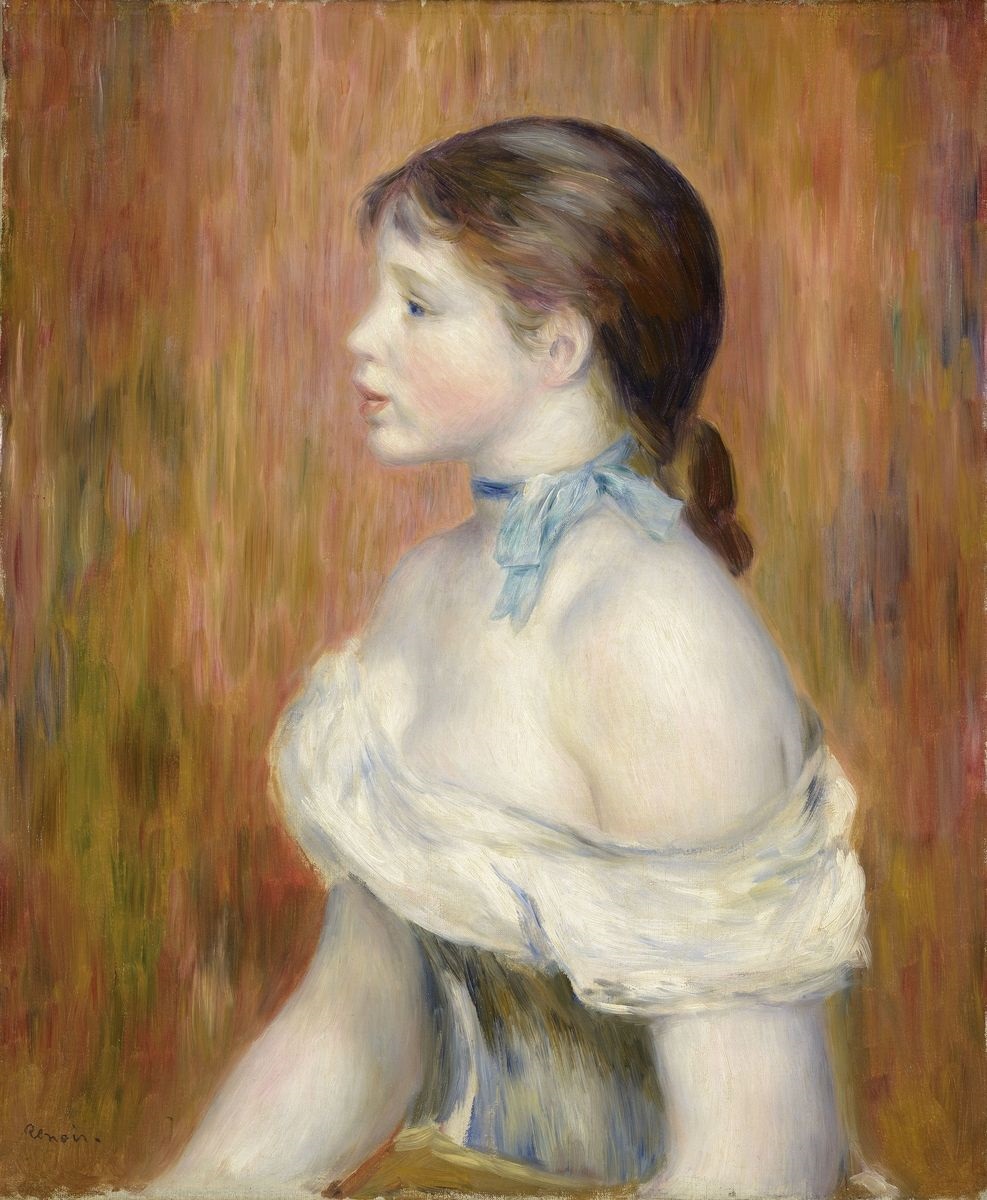
The painting reached Lyon through Jacqueline Delubac’s 1997 bequest. Born in Lyon, Delubac had acted on stage and in films and been married to Sacha Guitry. After leaving acting in the early 1950s, she built a collection of her own. Her later husband, Myran Eknayan, collected nineteenth-century art; this Renoir had belonged to him. The bequest brought together his pictures and her more modern choices, preserving the differences between two people’s tastes.
Delubac began considering the future of the collection in 1988. Its presentation to the public in 1998 coincided with the completion of the museum’s renovation. That timing gave Lyon an unusually personal way of entering the new building: through works someone had chosen to live with. A visitor sees a sequence of names and dates, but the collection was also furniture for the mind, accumulated through preferences, purchases and the ordinary fact of sharing a home.
Valadon: the child looks back
Gilberte sits below her mother with a doll, looking towards the viewer. Marie seems less available. In Marie Coca and Her Daughter Gilberte, painted in 1913, Suzanne Valadon makes the familiar arrangement of mother and child difficult to settle into. The floor’s perspective pushes the room towards us. Chairs, clothes and bodies occupy the space with an almost physical insistence. Begin with the child’s gaze, then see how little the mother’s position does to reassure it.
Marie was Valadon’s niece. The picture therefore belongs to the circle of relatives and friends from whom she made many of her portraits. A reproduction of a work by Degas hangs on the wall, acknowledging the man who encouraged her artistic ambitions. Earlier, Valadon had modelled for painters including Renoir and Puvis de Chavannes. Here she controls the encounter herself: who looks out, how the bodies are placed, and how much comfort a family scene is allowed to offer.

Lyon purchased the canvas directly from Valadon in 1935, using income from the Chazière foundation. Set that decision beside Delubac’s later gift. A public collection can grow through someone’s private affection for a picture, or through an institution choosing to support a living painter. The resulting portraits need not agree about beauty or intimacy. Their disagreement is one reason to spend time with both.
Janmot: spring before the losses begin
Children gathering flowers might seem an undemanding subject. Janmot’s Spring places that meeting near the beginning of a much longer account of existence. It is the fourth painting in the first cycle of The Poem of the Soul, where a boy encounters the girl who will accompany his youth. The flowers make the moment feel sufficient in itself. Knowing that the story continues changes the experience: this happiness is something the later narrative will put at risk.
Janmot began the project in Rome in 1835 and continued it until 1881. Eighteen paintings and sixteen large drawings, accompanied by a long poem, follow an earthly and spiritual journey. The enterprise grew out of his Catholic convictions and the religious revival in nineteenth-century Lyon. It also consumed an extraordinary amount of time. The fresh beginning in this one scene belongs to a project that aged with its maker.
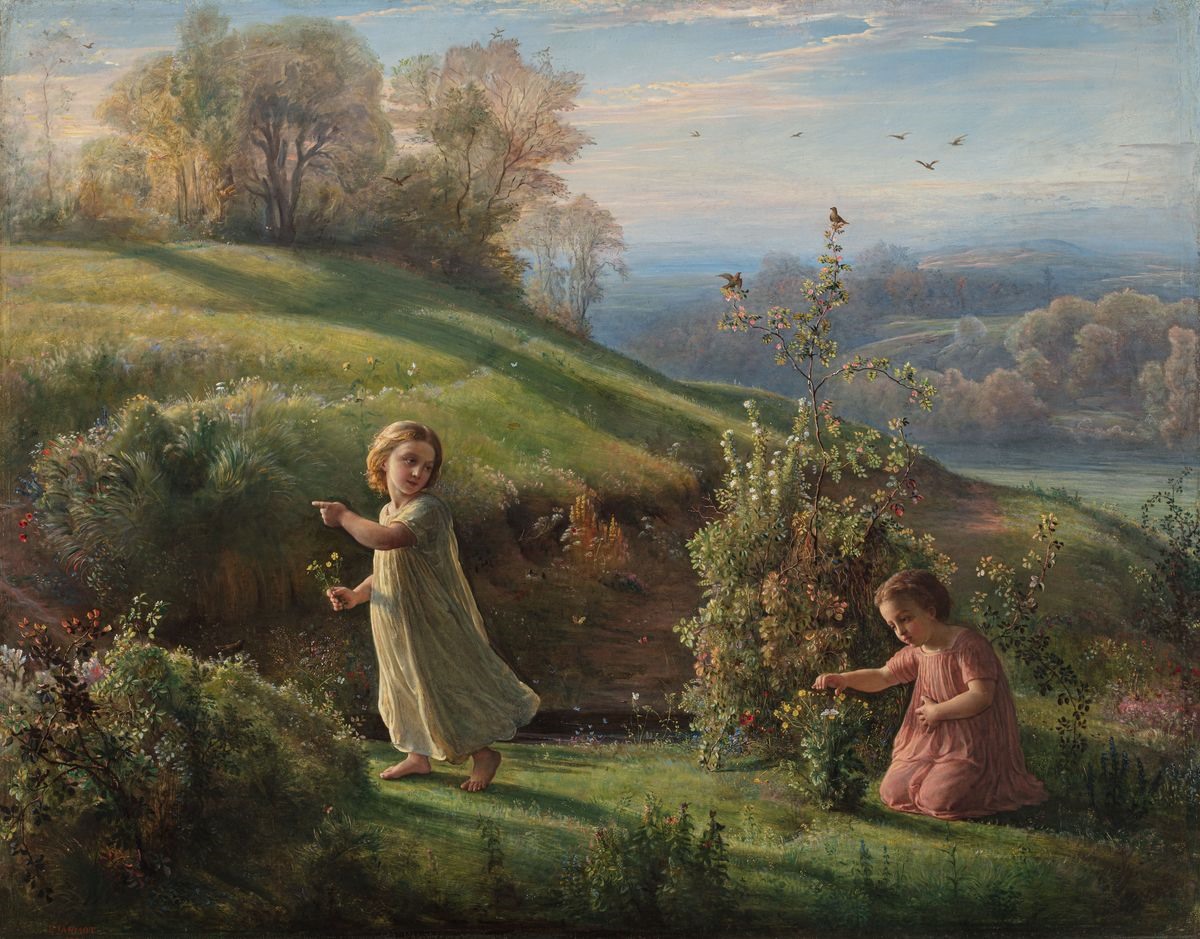
Delacroix helped the first cycle reach the Paris Universal Exhibition in 1855, where it attracted Gautier and Baudelaire. Janmot nevertheless failed to achieve the success he wanted. Decades of further work followed. Approach the painting without trying to master the whole programme at once: watch the children’s gestures on the flowering ground before reading the theological explanation. A long argument about the soul still needs a convincing small encounter between two people.
Croix-Rousse: take the flowers back to the loom
Silk manufacturers had pressed for a free drawing school in Lyon in 1756. Flower study was part of its teaching, and students later used the botanical garden to work from nature. This supplies a useful second reading of the museum’s attention to plants, surfaces and colour. Such looking could prepare someone for paid work. A flower was capable of becoming a pattern, and a pattern of helping sell a length of silk.
Continue uphill to the Maison des Canuts at 10 rue d’Ivry, where guided visits include a demonstration on a hand-operated Jacquard loom. Book the demonstration rather than assuming that a general visit includes it. In autumn 2026 the fine arts museum reports partial closures, so check access before travelling for a particular painting; Tuesday is its regular closing day. Leave the weaving stop enough time to hear the explanation. After hours of looking at finished surfaces, watching one being made is a satisfying way to end.
På forsiden: Jeune fille au ruban bleu — Pierre-Auguste Renoir. © Image © Lyon MBA – Photo Alain Basset; Ministère de la Culture (France), base Joconde
Mere at læse
Art city by city →City guide
Art in Troyes: Seurat, Courbet and Stained Glass in One Day
A textile fortune brought modern painting to an old bishop’s palace. Follow it from Seurat’s factory smoke to a sea assembled in the darkroom, then let the cathedral change the light.
City guide
Art in Kazan: Nikolai Fechin, the Fine Arts Museum and a Kremlin Walk
A girl seated on a table, a soaking village crowd and a slaughterhouse reveal three very different sides of Fechin. His home city gives these paintings a history beyond the frame.
City guide
Art in Compiègne: Winterhalter, Tissot and Lavinia Fontana in One Day
One empress appears twice: first surrounded by silk and attendants, then in black beside her son in exile. Between the portraits, Compiègne reveals how a court made itself look at ease.