City guide
Art in Troyes: Seurat, Courbet and Stained Glass in One Day
A textile fortune brought modern painting to an old bishop’s palace. Follow it from Seurat’s factory smoke to a sea assembled in the darkroom, then let the cathedral change the light.
2. november 2026 · 7 min. læsning · ART WIKI’s redaktion
Smoke drifts above a patch of houses. The paint is thick, the roofs warm pink and orange, the factory chimney blunt against the sky. Georges Seurat’s Banlieue is a small, unsettled beginning to an art day in Troyes. The industrial landscape has a particular resonance here: the collection that brought it to the city was paid for by a textile business. Before looking for picturesque streets, spend a moment with this less accommodating view of modern life.
Give Troyes a full day, with the Musée d’Art moderne as the main appointment. The former bishop’s palace, the cathedral beside it and the nearby Saint-Loup museum make a compact first circuit. Continue towards the Hôtel-Dieu-le-Comte for the Cité du Vitrail. Paint, photographic paper and coloured glass ask for different kinds of attention; leaving time between them is more useful than adding another stop.
The Lévy collection: what the factory helped to buy
In 1976, Pierre and Denise Lévy gave almost two thousand works to the French state, with a condition: the collection must stay together in Troyes. The museum opened in the former episcopal palace in 1982. Pierre had arrived in the city in 1927 and married Denise Lièvre the following year. Her father entrusted him with Le Jersey troyen, the hosiery business that developed into Devanlay et Recoing. The route from knitted fabric to paintings was a family history before it became a civic one.
The city’s account of the donation preserves Pierre’s own reasoning. The collection, he felt, owed its existence to the work of Troyes textile employees; it ought therefore to come back to the people of Troyes. That thought complicates the usual story of a generous collector. Behind the purchase at a gallery were hours worked elsewhere, by people whose names would not appear beside the picture. Keep that distinction in mind without treating every acquisition as a political manifesto.
A friendship supplied another education. Maurice Marinot, the Troyes painter and glassmaker, became close to the couple in 1937. His drawings recorded their domestic surroundings and the factory, including employees arriving on bicycles. Those observations connect two worlds often kept apart in museums: the office where a painting could hang and the workplace that financed it. This is a collection to read through relationships as well as movements.
Seurat before the dots, Courbet before the interruption
The chimney in Banlieue, painted around 1882, belongs to an early Seurat. Anyone expecting a surface of carefully separated dots will find a rougher handling of paint. Warm colour does not make the scene comfortable. Houses sit exposed beside open ground; smoke loosens the edges that architecture tries to keep firm. Look first at the chimney’s vertical line, then at the less obedient air around it. The picture rewards a small change in viewing distance.
Barely forty centimetres wide, this canvas had a life among collectors before the Lévys owned it. The national museum catalogue records its earlier ownership by Félix Fénéon and its appearance in his 1947 sale. Such a small object can carry a surprisingly long social itinerary. Its scale also makes a useful demand: approach it without expecting the physical authority of a monumental canvas. A few houses and a column of smoke have to do all the work.

Courbet makes looking itself the action in Marc Trapadoux Examining a Book of Prints, painted around 1849. The sitter holds the book on his knees and a pipe in his other hand. No imagined conversation is needed: the interruption belongs to us. We have arrived while someone is busy with images, and he has not arranged his attention for our benefit. The small wooden panel makes that absorbed activity feel close.
Trapadoux was a writer and philosopher from the Parisian bohemian circle around the Andler-Keller brasserie, near Courbet’s studio. He had a talent for self-invention: according to the biographical tradition, he claimed to have been born aboard a ship returning from the Americas, although records place his birth in Lyon. The reader therefore has a less sober life outside the frame. Courbet’s restraint becomes more interesting when the model is allowed his eccentricity.

Saint-Loup: a wave assembled in the darkroom
A short walk takes you from a collection given away to one founded partly through seizure. Revolutionary confiscations formed the nucleus of the Musée des Beaux-Arts et d’Archéologie, housed at the former Saint-Loup abbey. That different origin matters: public museums could be made by dismantling older concentrations of property. The building is a useful second stop even when your first interest is the nineteenth century rather than the abbey’s past.
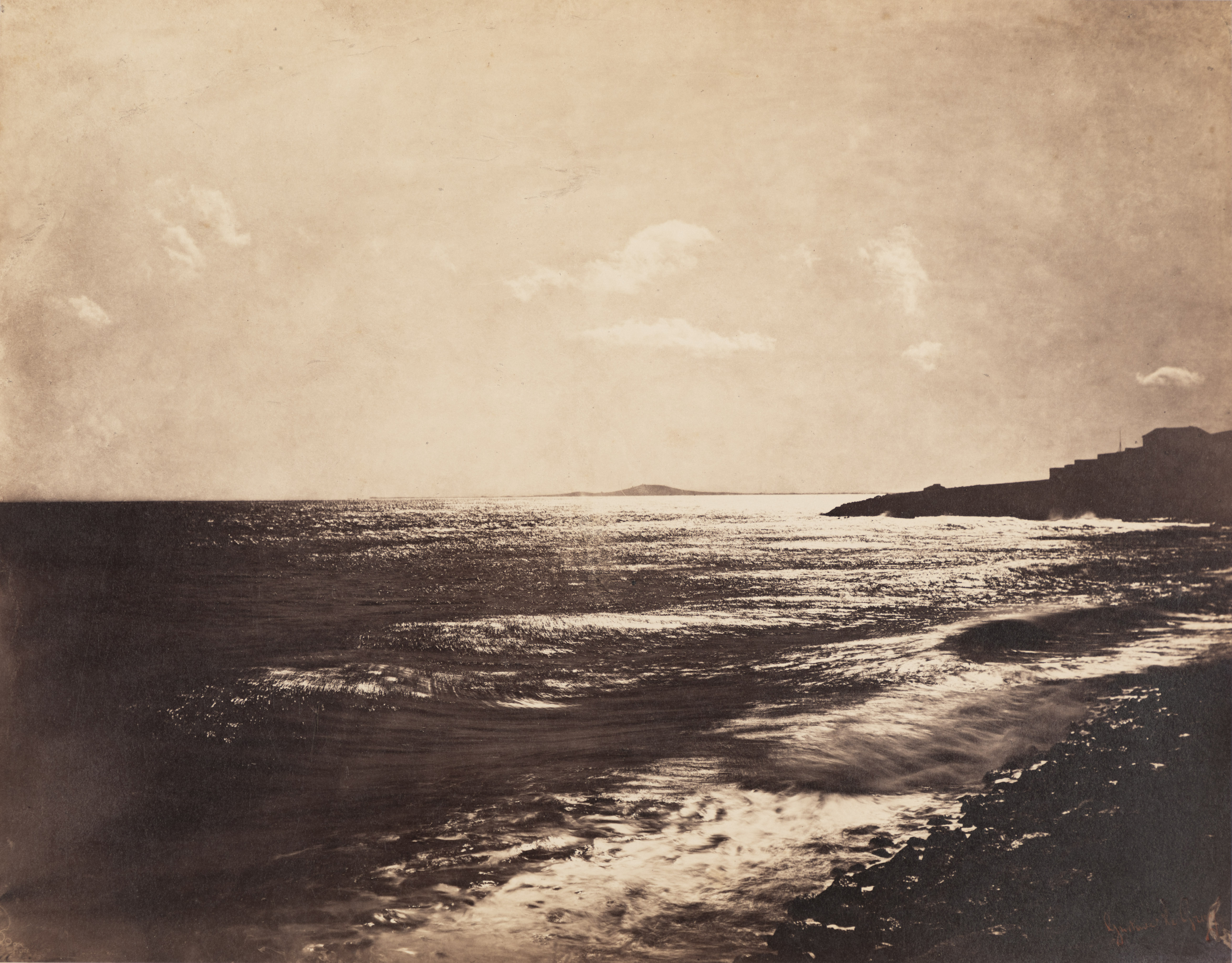
Its photographic collection includes Gustave Le Gray’s Large Wave, Mediterranean Sea. Le Gray trained as a painter before taking up photography. His sea pictures faced a material problem: the photographic emulsions of the period responded differently to different colours, making it difficult to record water and sky satisfactorily in a single exposure. The apparent instant required patient construction. He combined a negative for the sea with another for the clouds.
The Getty’s comparison of his seascapes shows that a sky could even recur above different foregrounds. Knowing this changes the pleasure of the photograph without cancelling it. Follow the horizon as a join, then let the image become weather again. What seems most immediate may depend on the longest preparation. Troyes preserves seventy-three Le Gray prints; contact Saint-Loup before travelling if photography is the reason for your visit, since the museum explains that fragile paper collections require rotations and controlled lighting.
Finish with light that comes through the image
The cathedral offers a different way to think about a surface. Its construction stretched across centuries, and the planned Saint-Paul tower was never completed for lack of funds. The stained glass likewise belongs to different periods, including thirteenth-century glazing in the choir and later work in the nave. Leave the decoding of individual scenes aside and compare the sizes of figures and the balance between coloured pieces and painted detail. The building gives you time to adjust your eyes.
At the Hôtel-Dieu-le-Comte, the Cité du Vitrail occupies part of a former hospital whose history began with a count’s donation in 1157. Its eighteenth-century rebuilding brought larger windows and more generous circulation, practical decisions intended to improve conditions for patients. Light had a medical purpose here before the building became a place to study stained glass. That change of use is worth noticing as you move between the courtyard and the interiors.
Make the modern museum your longest visit, keep Saint-Loup as a deliberate second appointment, and use the cathedral to slow the afternoon down. If time is short, choose between a longer museum visit and the Cité du Vitrail; do not hurry through both to complete a list. Check opening hours separately for each building, and ask about any particular photograph before buying your train ticket. A day with three pictures remembered clearly is ample justification for coming to Troyes.
På forsiden: LA BANLIEUE — Georges Seurat. RMN-GP; Ministère de la Culture (France), base Joconde
Mere at læse
Art city by city →City guide
Art in Kazan: Nikolai Fechin, the Fine Arts Museum and a Kremlin Walk
A girl seated on a table, a soaking village crowd and a slaughterhouse reveal three very different sides of Fechin. His home city gives these paintings a history beyond the frame.
City guide
Art in Compiègne: Winterhalter, Tissot and Lavinia Fontana in One Day
One empress appears twice: first surrounded by silk and attendants, then in black beside her son in exile. Between the portraits, Compiègne reveals how a court made itself look at ease.
City guide
Art in Avignon: Botticelli, Carpaccio and the Palace of the Popes in One Day
A banking scandal brought Italian paintings to the papal city. Follow their journey from a mother’s touch to a pope’s imaginary woodland, then to a museum gate made by a former prizewinner.